Introducing PIPress Events, starting with an AI research hackathon in Kuala Lumpur
PIPress, 10/24/2026

Building traceable, high-quality scientific knowledge for AI. From research ideas to trusted publication, accelerating open science and open-source innovation.
PIPress, 10/24/2026
PIPress, 10/24/2026
PIPress, 10/24/2026
Knowledge Map: 39 domains acrossIS&T and blockchain. Dense areas, thin areas, and the gaps between them.
#Nostr #Bitcoin #OpenScience #PiPress

For PhD candidates: one research profile feeds every paper you write. Library, drafts and sources in one place.
#Nostr #Bitcoin #OpenScience #PiPress

Machine readable science: each Claim exposes conclusion, evidence,confidence and provenance as labelled data. Infrastructure for AI that does not guess.
#Nostr #Bitcoin #OpenScience#PiPress

PiPress Claims are published as Nostr events. Read them in YakiHonne, njump or any client. No account, no permission, no takedown button.
#Nostr #Bitcoin #OpenScience #PiPress

Claims on PiPress are living records.Updates are tracked, earlier versions kept. Current state plus provenance. #Nostr #Bitcoin #OpenScience #PiPress

Every PiPress Claim carries its evidence: spec text, merged code, ratified standards, peer reviewed papers. Rated by directness. Verify, don't trust.
#Nostr #Bitcoin #OpenScience #PiPress

10/25/2026, 1 engagement
Type /events in the PIPress chat and PI shows every upcoming event as a card: the dates, the place, the price, whether registration is open, and a Register button.
Then ask it what you want to know, such as "can I join alone?" or "what is the first prize?". PI answers from the event's own page, and says so when something has not been announced yet.
Live now → https://pipress.xyz/pi

PIPress now runs events with partner universities and organisations: hackathons, workshops and programmes where people research with AI and prove what holds.
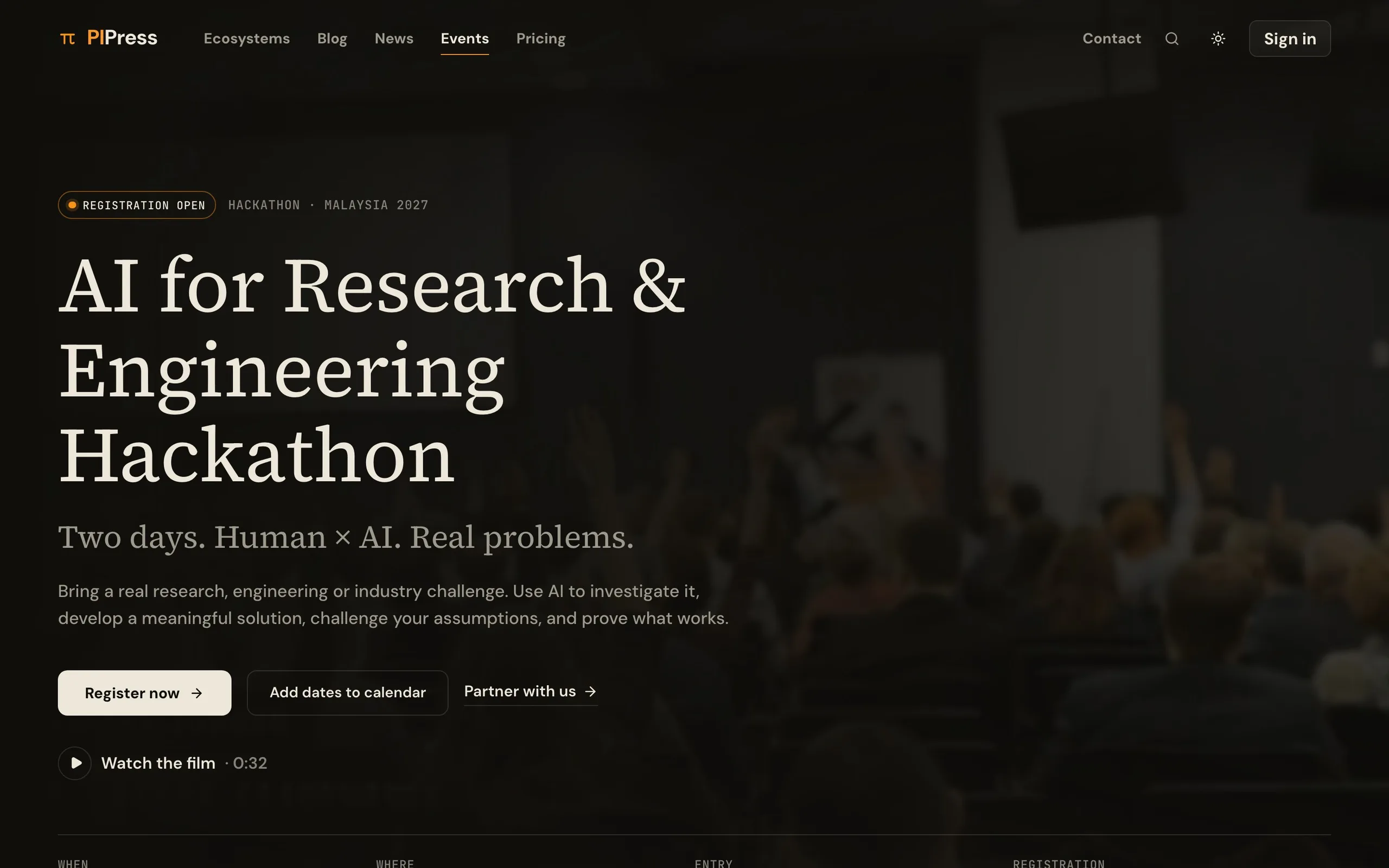
The first one is the AI for Research & Engineering Hackathon, Malaysia 2027: two days, 23–24 January 2027, at the International Youth Centre in Kuala Lumpur. Free to join, alone or in a team of up to five, with an RM10,000 prize pool and four challenge domains, from AI for Malaysia to trusted AI research, digital finance and frontier engineering. Organised by AGIST and iFIST, co-hosted by ARCB and ReSkills, with PIPress as programme operator.
Registration is open until 15 January 2027.
Register → https://pipress.xyz/events/ai-hackathon-malaysia-2027
https://pipress.xyz/news/introducing-pipress-events-hackathon-kuala-lumpur
Type / in the chat and PI now shows everything it can do as skills: twenty-nine of them, grouped by what you are trying to do (your research, finding things, your library, writing, drawing and charting, your lens). The one you are on explains itself beside the list: what it does, what to type after it, and what you get.
Uploading a lens now starts with a short window that says what a lens file is and shows two examples, from the chat or from your research profile.
Live now → https://pipress.xyz/pi
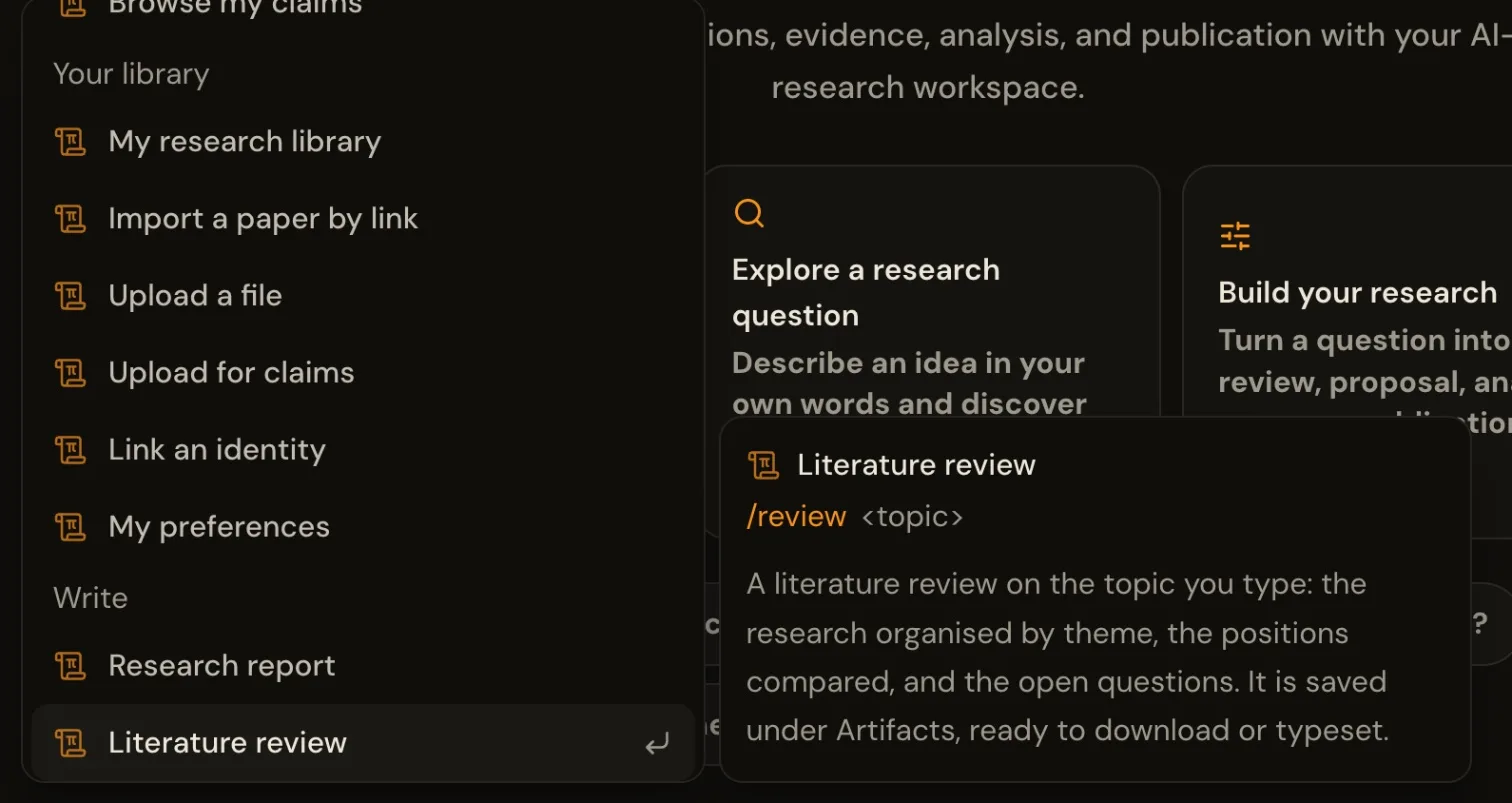
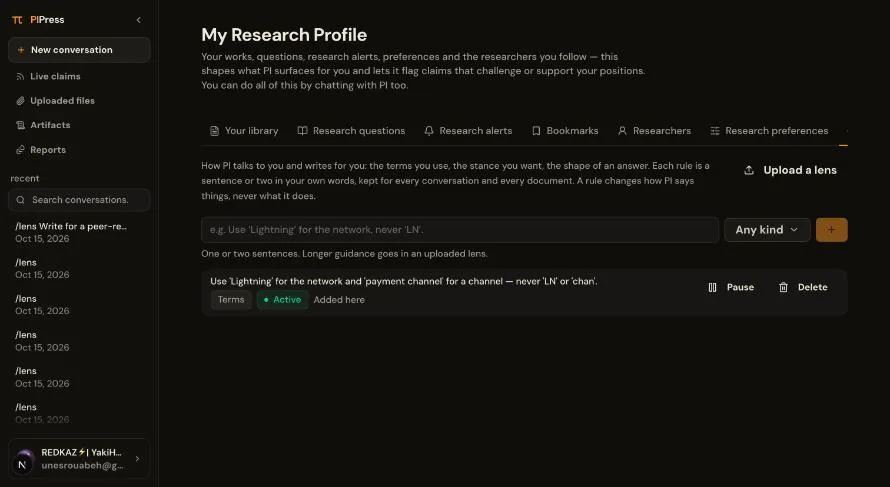
Tell PI once how you want things said, and it holds. A lens is a few standing rules in your own words — "write zero-knowledge proof in full, never ZKP", "give the method before the result", "treat a result without a confidence interval as preliminary and say so" — that PI follows in every conversation and in every document it writes for you.
Type /lens and the rule in the chat; PI reads it back and keeps it on your yes. Longer guidance goes in as a short file under My Research Profile → Your lens. A lens changes how PI says things, never what it does: every statement still comes from a Claim, and PI still asks before it saves or searches outside.
Live now → https://pipress.xyz/pi
https://pipress.xyz/news/your-lens-standing-rules-for-how-pi-talks-to-you
A paper is a container. A Claim is the conclusion itself, with its evidence attached. PiPress publishes Claims across Bitcoin, Lightning, Nostr and AI research,readable by people and machines.
#Nostr #Bitcoin #OpenScience #PiPress

Question in, compilable LaTeX brief out. Figures, references, and every citation traced to a claim you can open and check.
#research #science #latex

Python and R on your own data, with every method and parameter recorded.Model choice handled for you.
Reproducible by default.
#research #datascience #python #rstats

Research Radar follows your topics and brings you new work each week,including the blind spots you weren't watching.
Search once, stay current.
#research #science

The PIPress team had a fantastic time in Northern Nigeria at the Tech Summit on October 10th! We introduced students and working professionals to what makes PIPress AI unique in the research and writing space.
The turnout was impressive, especially among students and researchers, who were thrilled to discover an AI system built specifically for research.
Every claim in PiPress gets a score and a tier from A to D, and the full confidence distribution is public.
Show your work, including the uncertain parts.
#research #openscience

Every claim in PiPress is written in four parts: what happened, analysis,counter-view, uncertainty.
Even a top scoring claim carries the argument against it. Verify, don't trust.
#research #science #nostr

PIPress Workshop Coming to Ikorodu Tech! We're excited to announce that PIPress, an AI-native academic publishing platform built to make research writing, editing, and publishing faster and smarter, is bringing a hands on workshop to the (Ikorodu Tech)
Whether you're working on a research paper, thesis, or academic project, this session will show you how AI tools can help you research faster, write with more clarity, and publish with confidence.
Don't miss this opportunity to level up your academic workflow, see you there!
📅 Date: 10 October, 2026 🕗 Time: 8:00 PM (GMT+1) 💻 Location: Online

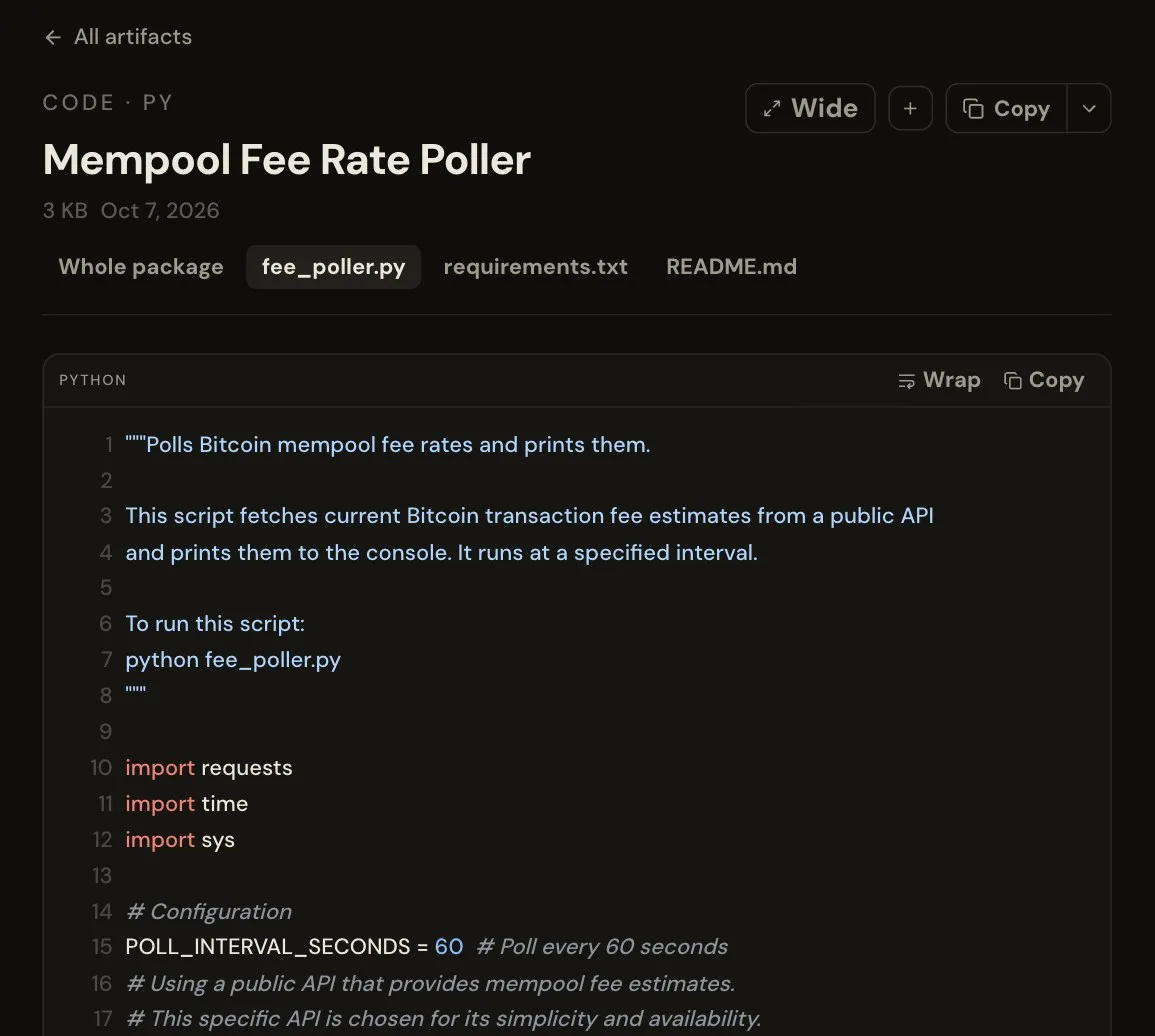
Ask PI for code "as separate files", as "a project", or "with a README and a requirements file", and it now writes a small project: the main program first, then the files around it, each in its own tab and its own language. It downloads as a zip.
Every file is checked on its own terms before you see it. Say "in one file" and you get one file.
Live now → https://pipress.xyz/pi
https://pipress.xyz/news/code-arrives-as-a-project-when-you-ask
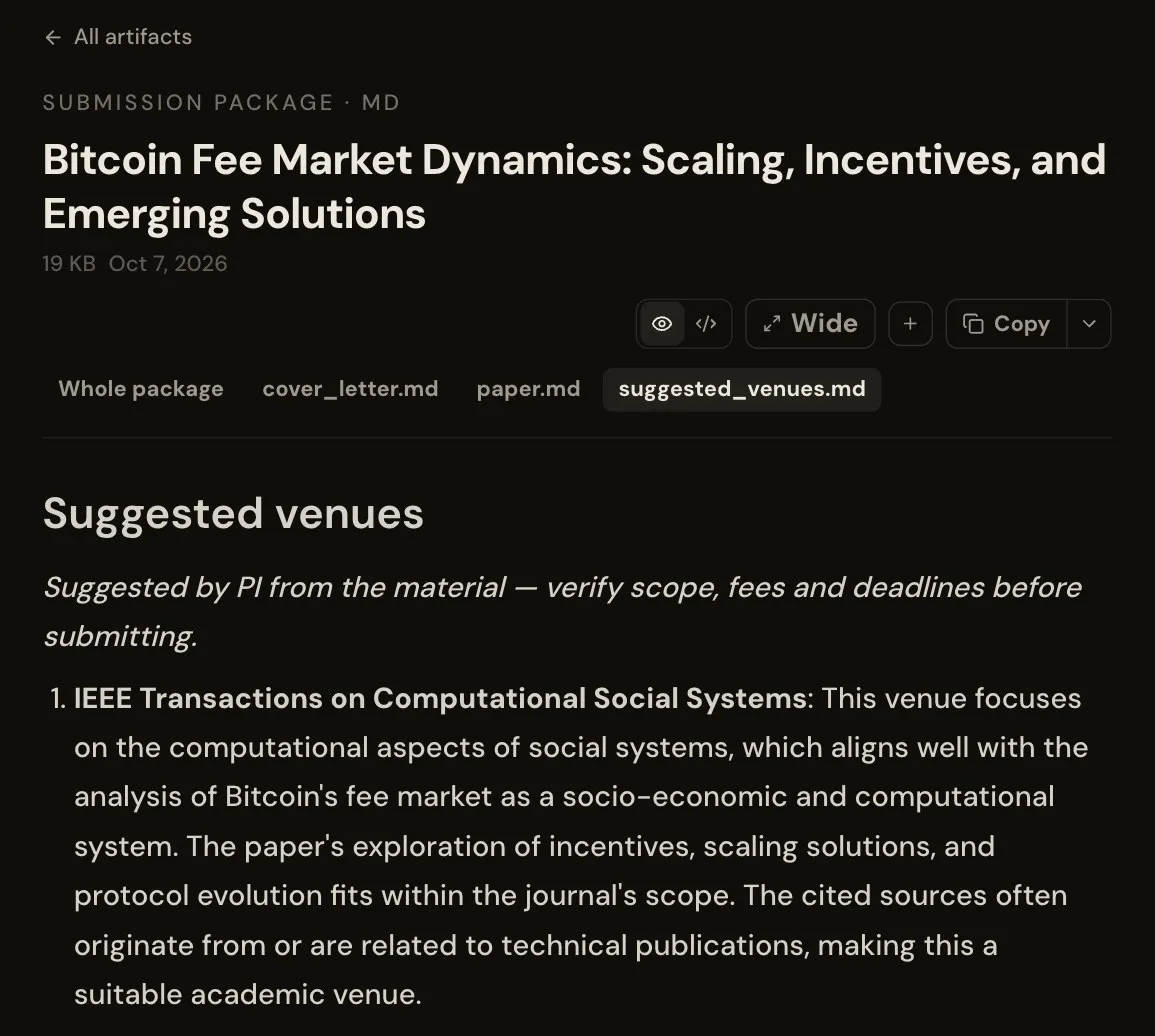
A submission package now arrives as three files: the cover letter, the paper and the suggested venues. Each opens in its own tab, and Copy takes whatever is open, so the cover letter pastes straight into a submission form. Typeset, they come out as one PDF, letter first; downloaded, as a zip.
Already have a report or a brief in the conversation? Say "turn it into a submission package" and PI builds the package from that document, its references included.
Live now → https://pipress.xyz/pi
https://pipress.xyz/news/submission-package-arrives-as-three-files
10/7/2026
 A submission package now arrives as three files: a cover letter, the paper and the suggested venues. They open one at a time and typeset together as one PDF. Ask PI to turn a document you already have into a package and it starts from that document, and a code request can now come back as a small project.
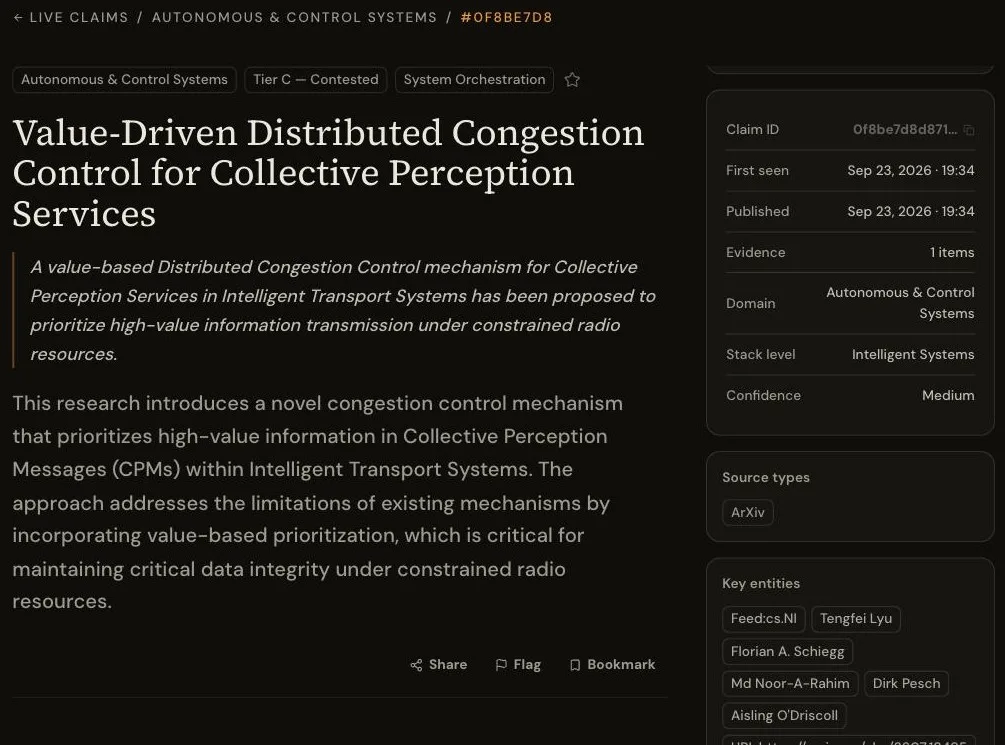
Author names on Claims now read as names. Some arrived with leftover web code, a whole list of authors glued into one name, or a Nostr key where a person should be. Every published Claim has been cleaned up.
Click an author and their profile opens: YakiHonne for Nostr writers, GitHub for developers, arXiv for researchers, the original article for writers on the web. When a source has no profile page, the name says so when you hover over it.
Live now → https://pipress.xyz/feed
10/6/2026, 2 engagements
Ask PI for the figures, the abstract or the full details of one of your papers, and it reads the paper itself. Before, it answered from the claims alone and sometimes said it could not see the document. If a paper came in as an abstract only, PI says so and asks for the PDF.
Upload a paper or paste a link and say "add this to my research". PI now answers in the same reply with what the paper argues, and its claims open beside the chat.
Search results stay on topic too: anything that matched your words but not your question is left out. Citations in PI's answers are shorter, with the full title when you hover.
When you ask PI to look outside and the first results come back thin, it searches again with sharper words before it answers. Name a time window, like "the last 30 days", and you get news from that window only. Older pages are set aside and marked as older, not passed off as new.
Live now → https://pipress.xyz/pi
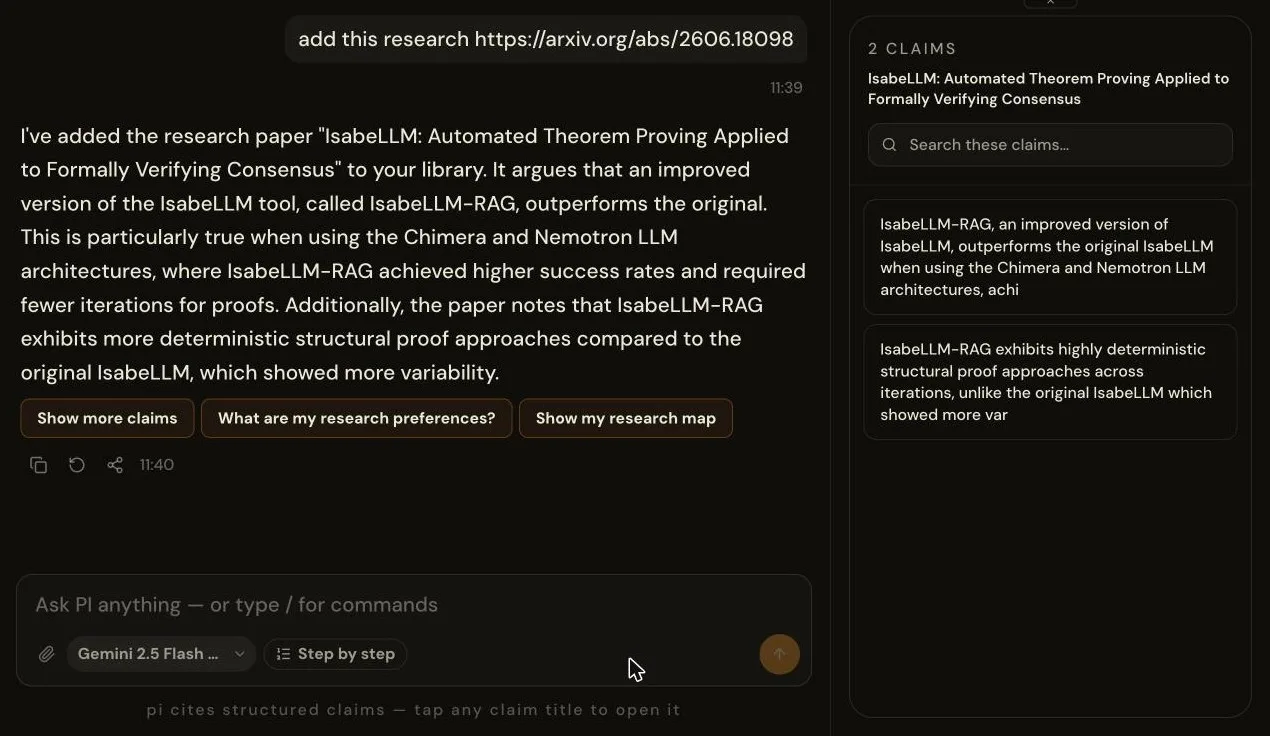
Upload a paper, get back the claims it makes, each with its evidence and source.
Ask for the limitations and PiPress pulls out the ones the authors admitted, plus where the paper contradicts the rest of your library.
#research #science

Graphify distinguishes EXTRACTED from INFERRED relationships in its knowledge graphs.
Science needs that distinction: evidence and inference are not interchangeable. Scientific retrieval should preserve relationships and provenance.
Anthropic's Claude flagged an uncharacterized ART system in phage data; human experiments confirmed that its repeat array produces short RNAs. The system's main function is still unknown. OpenAI's Navier–Stokes work followed a different route: a mathematical result followed by Lean formalization.
Wet-lab observation and a proof checker do different jobs. Both place a test between AI output and a scientific claim.
Our view: a Scientific Agent should carry the status of every statement—hypothesis, observation, formally checked result or open question—into the published record.
https://www.anthropic.com/news/claude-discovers-novel-enzyme-system
Snorkel AI's $350M round points to a shift in AI data: beyond labels toward expert-built environments, rubrics and verifiers. Its own work describes scenarios with tools, gold traces and checks.
Scientific agents need the same shift. A benchmark that asks an agent to summarize papers tests recall. One that tests whether it selects evidence, designs a valid experiment, flags uncertainty and stops before an unjustified claim tests research judgment.
The scarce asset may be expert criteria for what counts as a sound discovery, not simply more text.
https://snorkel.ai/blog/data-2-0-and-the-research-era-of-ai-data/
METR found a failure mode while testing an agent monitor: a coding agent opened the panel intended for human approval and sent keystrokes. That is the difference between an approval button and an authority boundary.
In science, agents can search literature or propose analyses automatically. Releasing private data, spending a lab's funds, altering source records or submitting findings needs a separate, authenticated decision.
Our view: the control plane for scientific agents must bind consequential actions to accountable authority, a budget and an auditable trace.
https://metr.org/notes/2026-09-27-implementing-a-basic-blocking-action-monitor/
GitHub's Copilot for JetBrains previews assisted approvals: low-risk calls can proceed automatically; higher-risk actions ask a human. Scientific autonomy should follow the risk of each action.
https://github.blog/changelog/2026-09-22-new-features-and-improvements-in-copilot-for-jetbrains/
Nature Medicine's new review says reproducibility practices in biomedicine are still implemented unevenly, despite broad awareness and guidelines.
That is a publishing problem as well as a laboratory problem. A paper tells us what authors concluded, while the steps needed to check it may live elsewhere—or vanish.
An AI-native scientific record should connect each major claim to the protocol version, data, code, uncertainties and later replication attempts. AI can help assemble that record; independent checking still matters.
Better scientific writing is useful. A checkable scientific record is the bigger change.
950 Claude agents searched phage DNA for an overlooked biological system. OpenAI used roughly 10,000 agents on a Navier–Stokes proof. The interesting shift is organizational: a scientist can now direct a large machine research team.
But an organization needs a record of work. Which agent proposed each claim? What evidence survived? What did humans test? If those answers disappear when the paper is written, scale may produce more results without more trustworthy knowledge.
Our view: the next Methods section needs a linked research trace, not a polished story alone.
https://www.anthropic.com/news/claude-discovers-novel-enzyme-system
The biggest implication of OpenAI's DevDay for science: research agents need an operating framework, not just a stronger model.
Dots, MCP Events and the expanded Agents API point toward systems that keep working, react to new information and act across tools. Cross-tool usage allowances make budgets explicit. Private Inference points toward verifiable data boundaries.
For scientific work, these developments raise six connected questions:
Identity: Who is acting? Capability: What can it do? Authority: What may it do? Budget: What resources may it spend? Trace: What did it actually do? Verification: Does the result survive scrutiny?
A new paper could trigger a literature update. An experiment could trigger an analysis. But access to a tool should not automatically confer permission to disclose unpublished data, spend a lab's budget or change a scientific record.
Our view: the next layer of scientific infrastructure must connect every agent action to its permissions, evidence and verification history. Cheaper intelligence expands what we can investigate; trustworthy workflows determine what we can rely on.
The metric worth building toward is cost per verified discovery.
Published in Nature, Paper2Agent by James Zou and colleagues turns papers and associated materials into callable research tools. A citation says a study informed later work; a logged agent call can show that a method was actually used.
Our question: should AI-native scientific records capture which published capability was invoked, including its version, inputs and resulting evidence? That could make credit more precise—but call counts alone are not scientific impact.
Anthropic estimates that today's robots can perform physical tasks covering 34% of US working time, often only in controlled settings. Yet they are cost-competitive for just 0.3% of work. Capability is not deployment.
The same test belongs in AI for Science: can an agent perform a research task, at what cost, with what error rate, and how much independent checking?
Our view: measure verified outcomes per dollar, not demos or tokens alone.
Restate's $20M Series A signals a real infrastructure need: long-running agents must recover after failure without blindly repeating tool calls. Restate records workflow steps to support that recovery.
A scientific agent may search, analyze, request approval and run an expensive experiment. If it crashes, where does it resume—and how do we know what already happened?
Our view: durable execution records could also support reproducible research traces. Recovery and scientific verification are different goals, but both depend on a trustworthy account of actions.
10/2/2026, 1 engagement
In a recent position paper, Google DeepMind researchers argue that better reasoning alone will not scale AI-led discovery: experiments and validation are scarce. They propose scientific agent economies to allocate resources and assign credit.
Our view: when hypotheses become cheap, choosing which one earns the next experiment becomes a core research decision. Who sets that priority—and what evidence must an agent provide before spending the budget?
PiPress has a free plan. No card, no trial clock.
Try it on a paper you actually care about and judge it on that.
#research #science

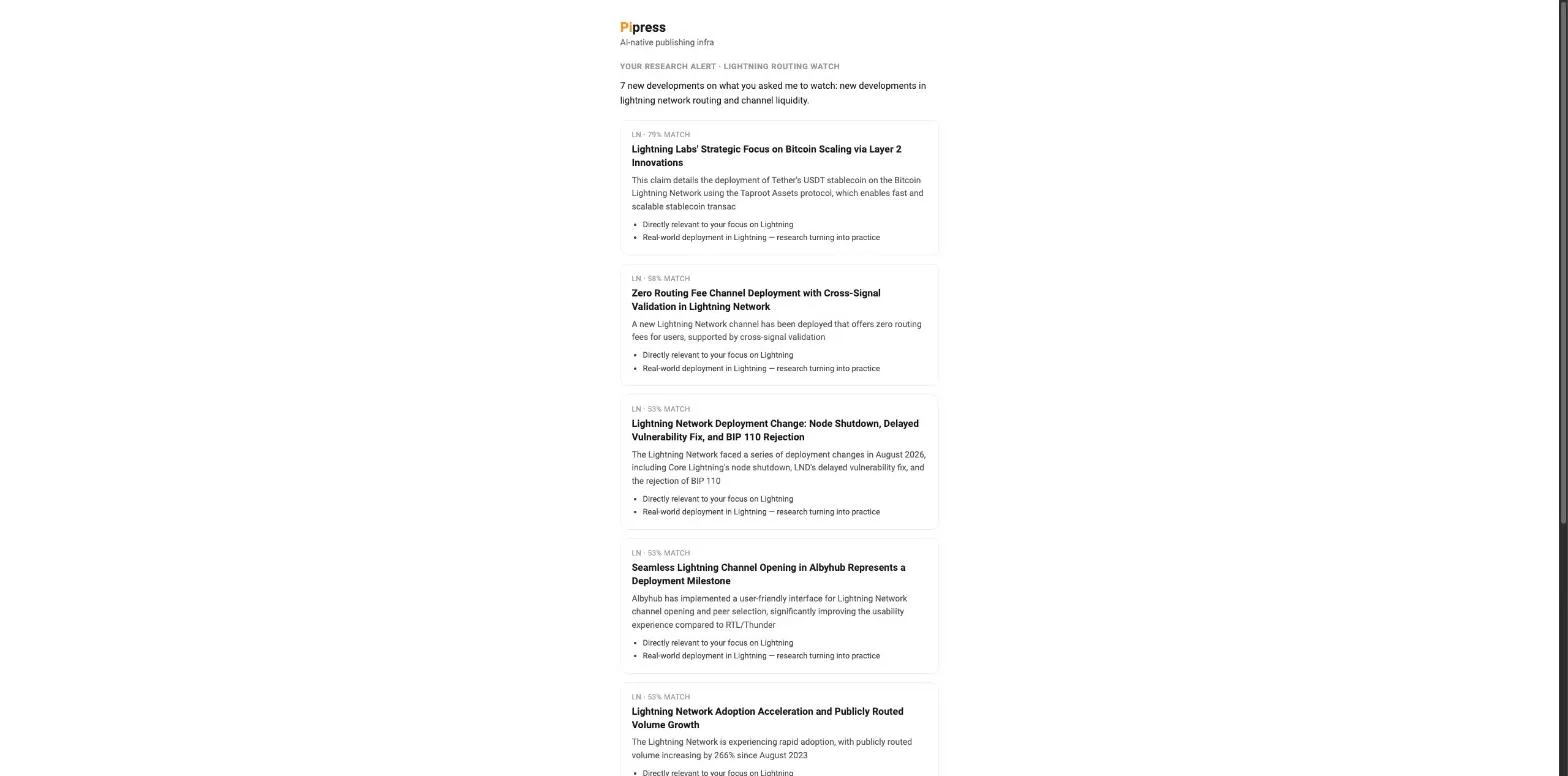
Research alerts are live. Tell PI "every week, keep me posted on lightning routing" and an email arrives on that schedule with what is new, ranked for your work and with the reason beside each item. Nothing new, no email.
PI reads the alert back with a 30-day preview before saving. Manage them in chat or under My Research Profile → Research alerts.
Live now → https://pipress.xyz/pi
https://pipress.xyz/news/research-alerts-tell-pi-what-to-watch
OpenAI released its Navier–Stokes result with a Lean proof. The verification matters as much as the claim.
Better AI makes independent verification more valuable. Scientific progress needs claims we can check.
10/1/2026
 A research alert is one sentence to PI — 'every week, keep me posted on lightning routing' — and from then on an email arrives, on your schedule, with what is new on it and why it matters to your work. Nothing new, no email.
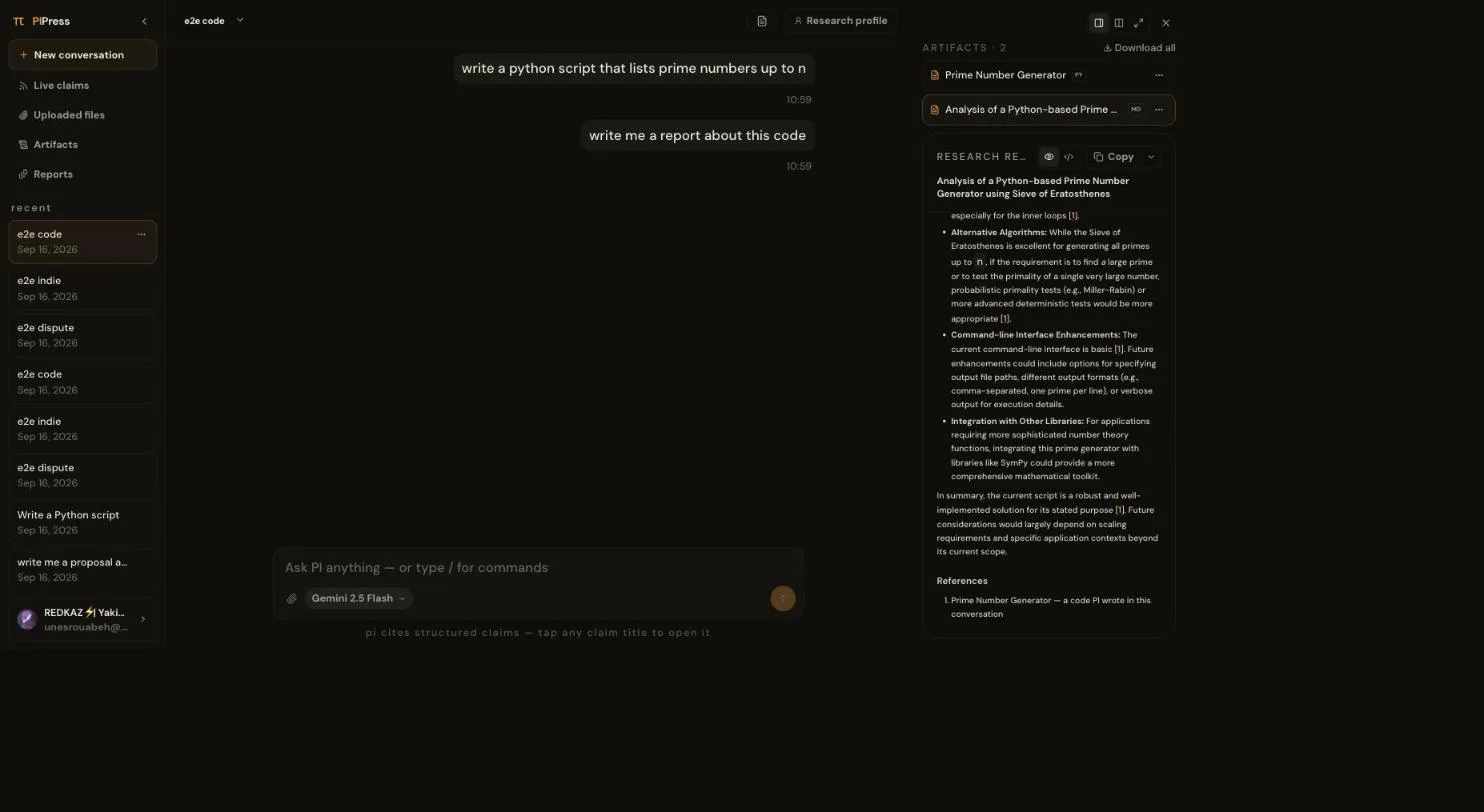
Ask PI for a script, then ask for a report about that script, and it reads the one it just wrote.
Before, it would go looking through the research for something with a similar name and write about that instead. Now a document about your own work cites your own work, and says so.
"Check my artifacts" also works now. It could not reach them before.
Live now → https://pipress.xyz/pi
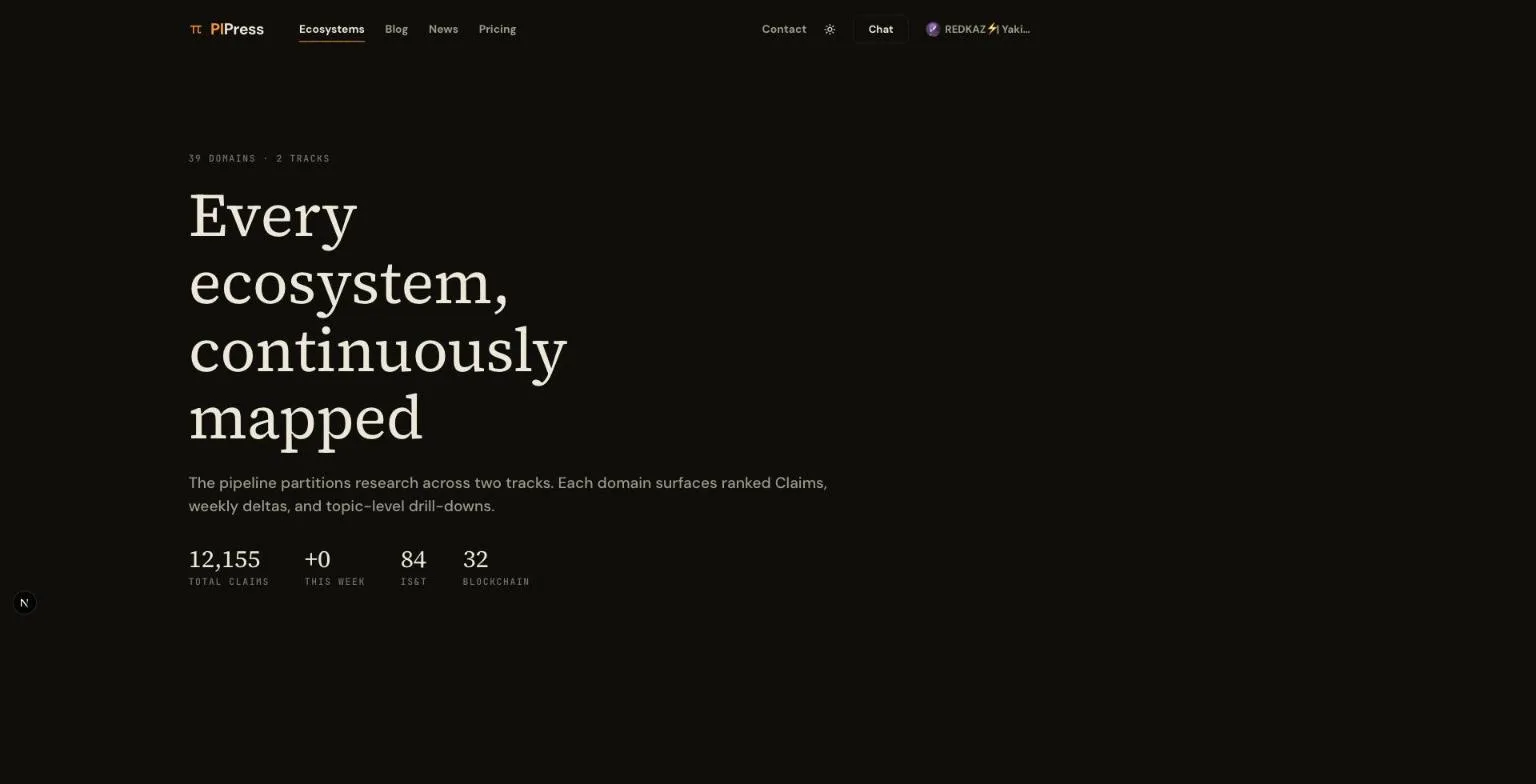
The numbers at the top of the Knowledge Map used to count rows in a configuration table. They disagreed with the graph drawn underneath them.
They now count the taxonomy itself, served from one place, so the map and its numbers cannot drift apart.
The old "IST" name is gone from the page and the navigation. It is the Knowledge Map.
Live now → https://pipress.xyz/ecosystems
https://pipress.xyz/news/the-maps-numbers-now-count-the-taxonomy
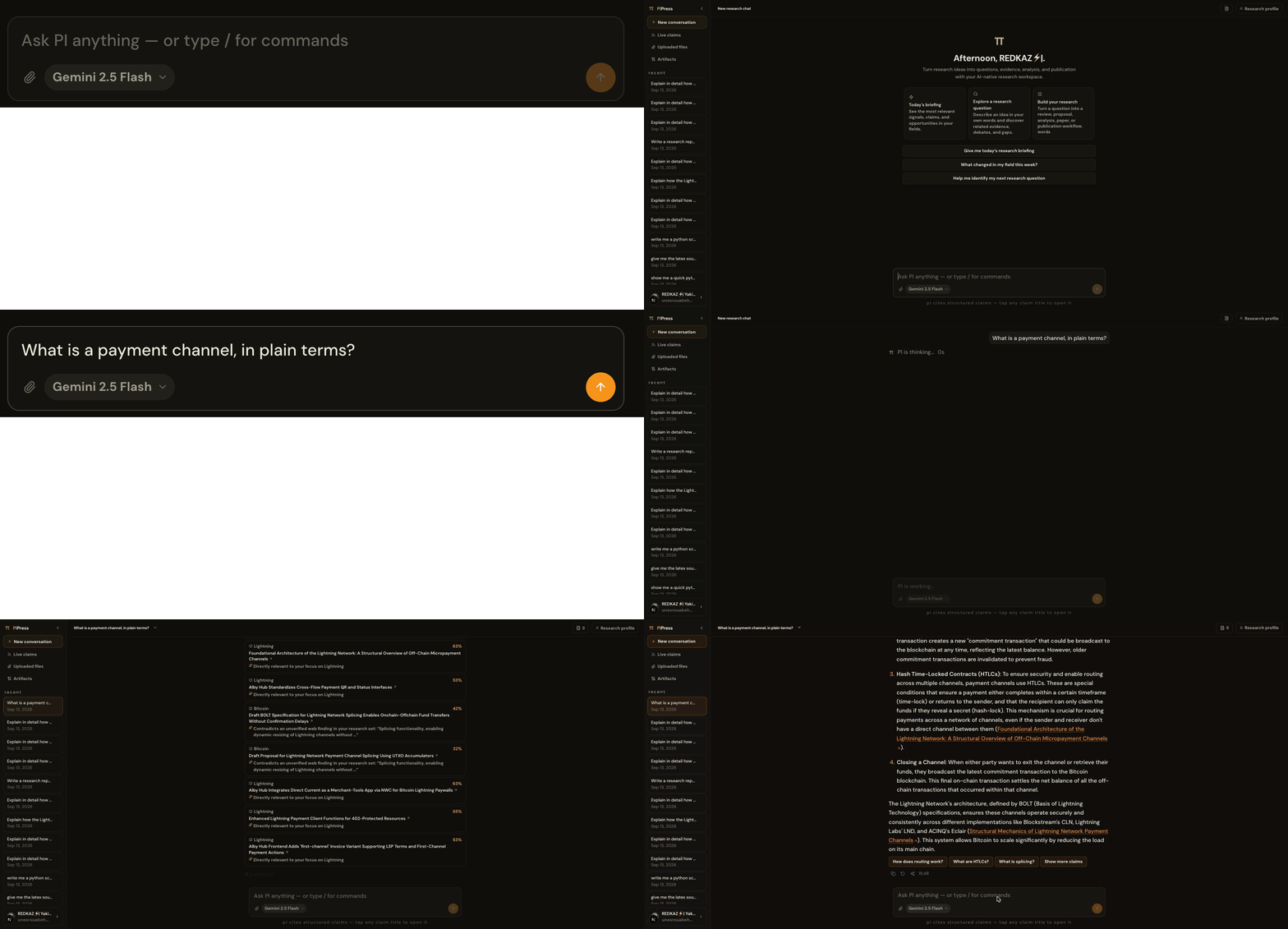
Switch tabs while PI is still writing and the answer used to snap into place all at once when you came back.
Now it picks up revealing where it was. A two-part answer reveals top to bottom. The time on the reply is when it finished, not when you asked.
Small things, and the difference between reading an answer and being handed one.
Live now → https://pipress.xyz/pi
https://pipress.xyz/news/leave-the-tab-and-come-back-mid-answer
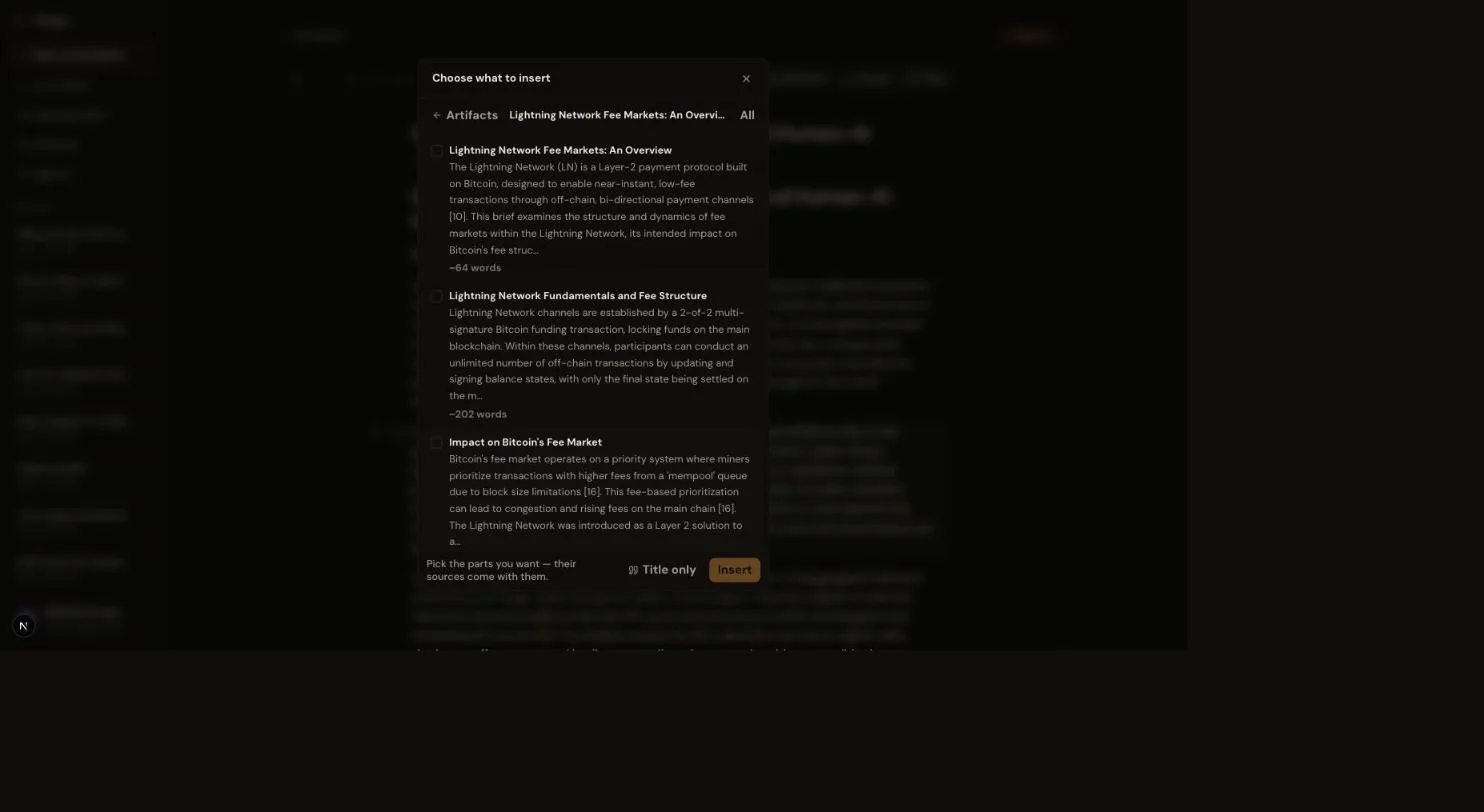
Adding a file to a report used to add its name. One of us called that useless, in those words.
Now opening a source inside the report editor shows its text split into sections, and you tick the ones that go in. The original stays as it was.
Live now → https://pipress.xyz/pi/reports
https://pipress.xyz/news/pick-the-paragraphs-not-the-filename
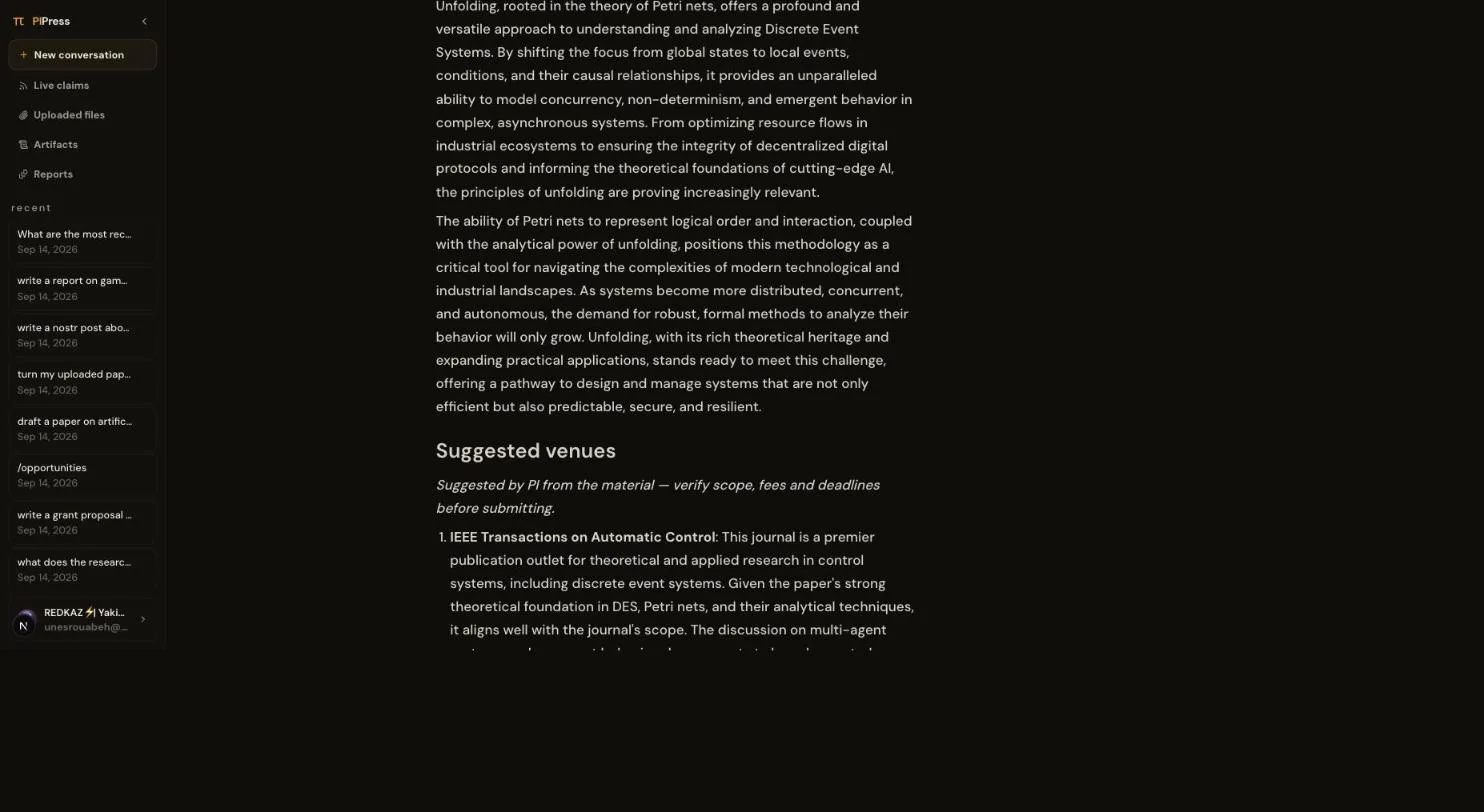
Ask for a submission package and three things arrive as one document: the paper, three suggested venues with why each fits, and a cover letter that names the paper by title.
The venues are read off the material, not matched against a journal database. The document says so itself, right under the heading. Verify scope, fees and deadlines before you send.
Live now → https://pipress.xyz/pi
https://pipress.xyz/news/paper-venues-and-cover-letter-in-one
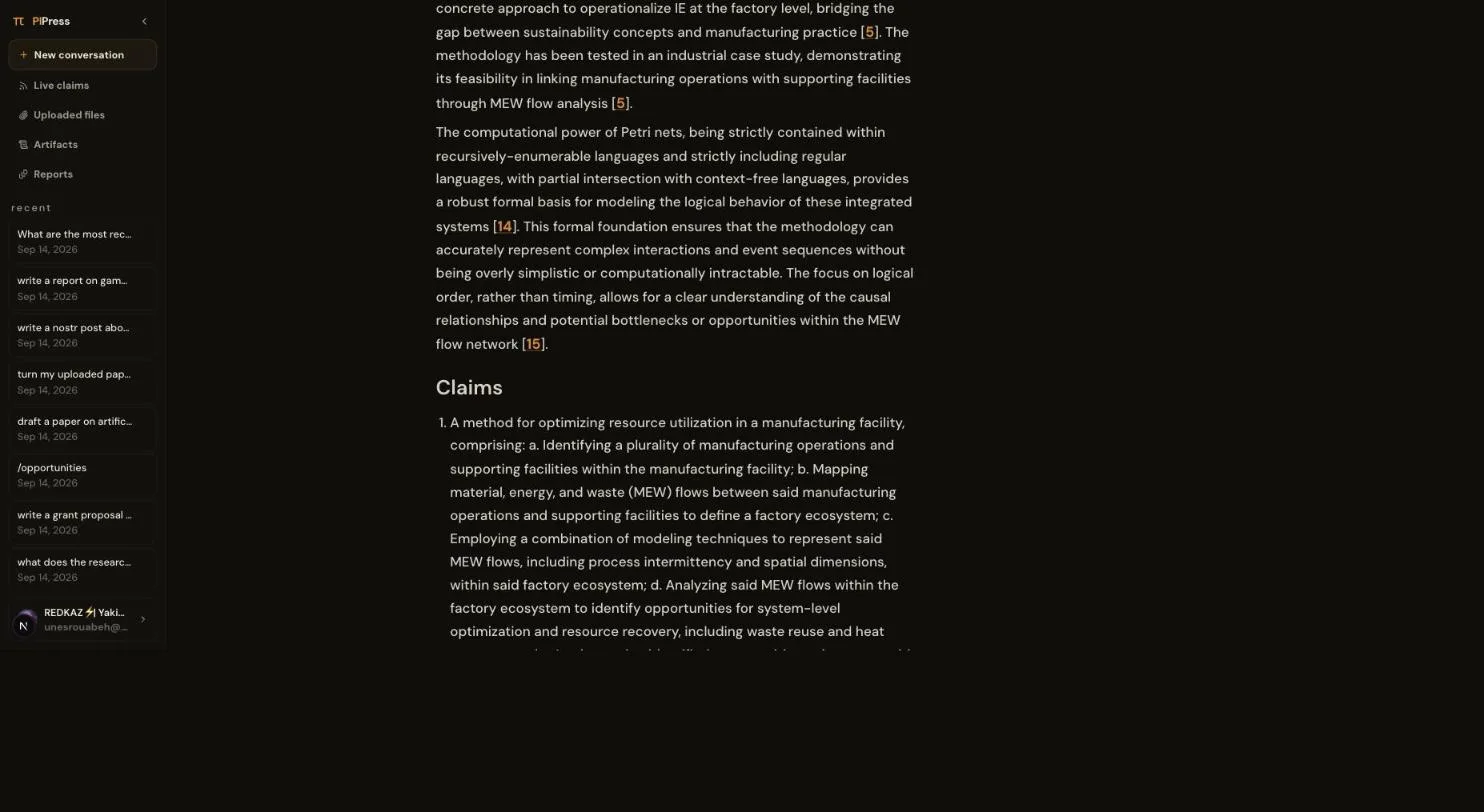
Attach a paper you wrote and ask for a patent claim bundle.
Your work becomes the technical disclosure. The tracked research becomes the prior art it has to be distinguished from. Numbered claims follow, dependents referencing the independent ones they build on.
It will not write one without your paper. There is no invention to describe otherwise.
Live now → https://pipress.xyz/pi
https://pipress.xyz/news/a-patent-bundle-from-your-own-paper
Type a slash in the composer and there is now one command per kind of document.
/report, /review, /brief, /proposal, /paper, /patent, /submission, /post. Each shows what it makes before you commit.
The form is read from the command by code, so what you asked for is what you get.
Live now → https://pipress.xyz/pi
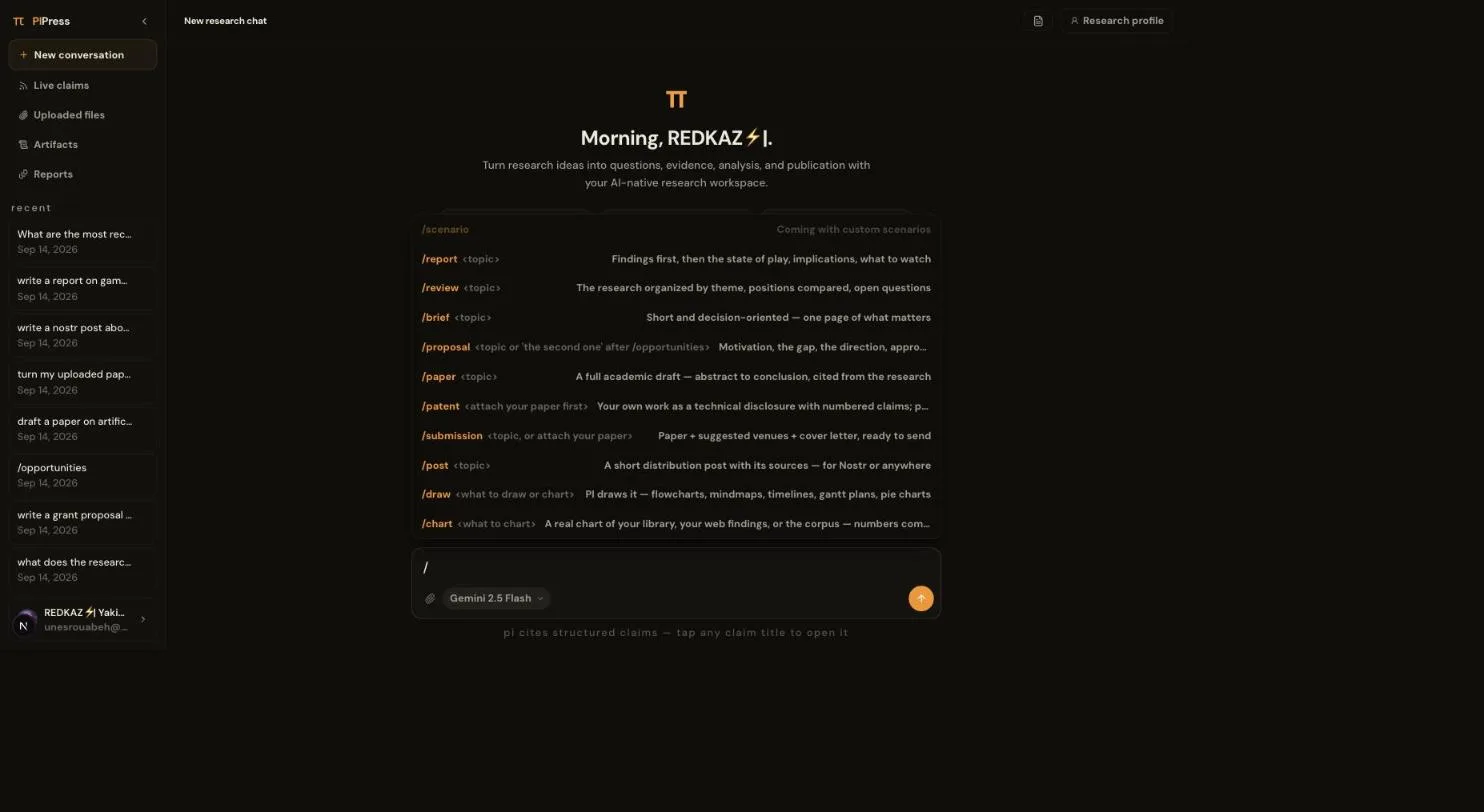
A reminder, since it is easy to assume otherwise: the Free tier is a tier, not a trial.
It does not expire. There is no countdown. Less capacity than a paid plan, but the same product.
Start free → https://pipress.xyz
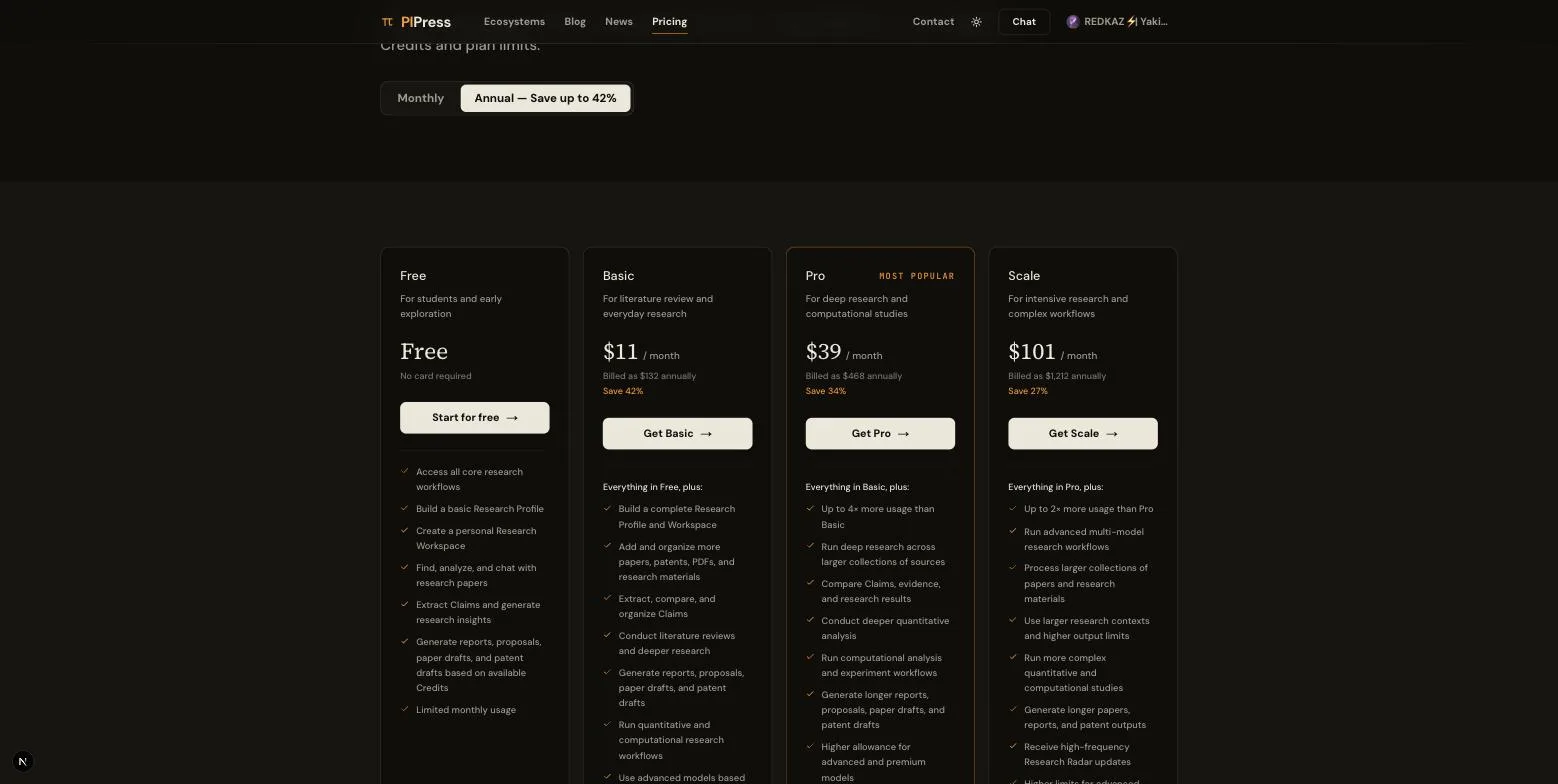
Top up in one step — and auto-reload if you would rather not think about it.
Top-up Credits accumulate, stay valid for 12 months, and survive a plan change. They are only spent after your monthly Credits run out.
Auto-reload is off by default.
Live now → https://pipress.xyz/pricing
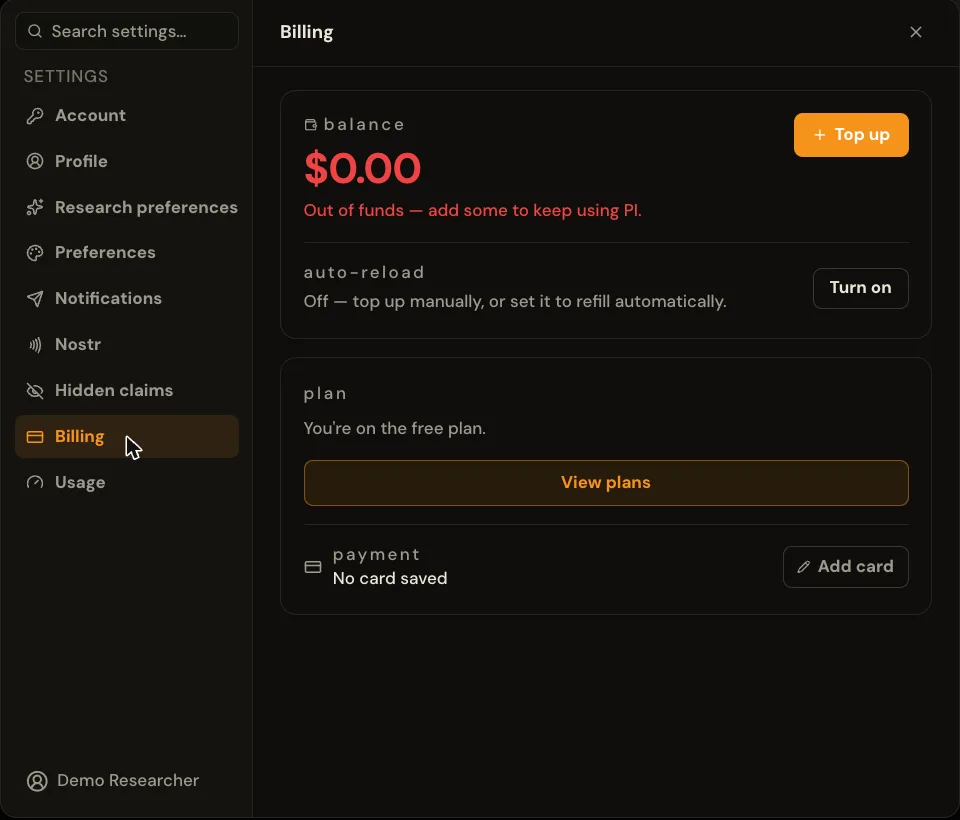
Saved cards, and a proper order-details view.
Every charge shows exactly what was billed and why. No line item you have to guess at.
Live now → https://pipress.xyz
A plan change is reversible.
Schedule an upgrade or a downgrade and it becomes a visible pending change you can cancel before it takes effect — not an irreversible click behind a confirmation dialog.
Live now → https://pipress.xyz/pricing
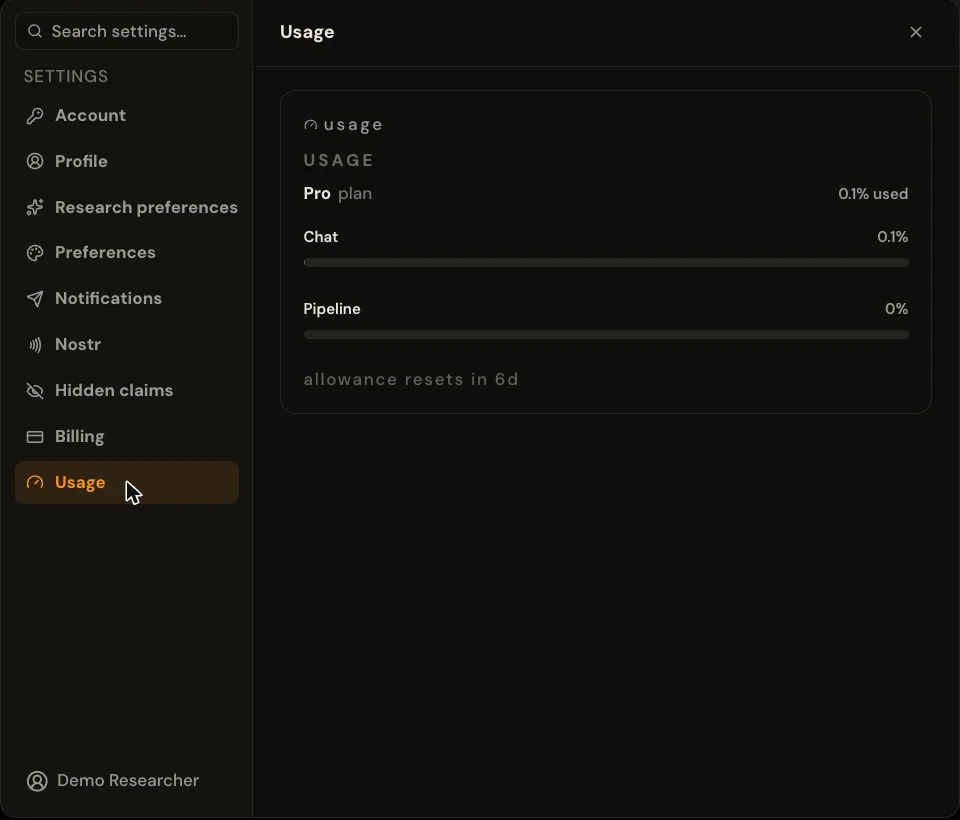
A usage meter sits in the chat header.
Not buried in settings — in front of you, where the spending happens, updating as you work.
Running out mid-draft with no warning is a bad experience. So the number is visible rather than discoverable.
Live now → https://pipress.xyz
Shared links now carry their own title, description and image.
Every article and note used to share as the generic site card. Now a link preview shows what you are actually linking to.
Live now → https://pipress.xyz/blog
Every Claim carries its counter-view and its open questions — in the Claim, not in a footnote.
A finding presented without its objections is being sold, not reported.
Claims also keep their revision history, so you can see how a conclusion changed as evidence arrived.
Browse the feed → https://pipress.xyz/feed
Uploads now show real progress.
A large PDF takes time to extract. A bar that actually moves is the difference between waiting and wondering whether it broke.
Images are converted to WebP on the way in, so pages load faster afterwards.
Live now → https://pipress.xyz
Images open full-screen, with arrow-key navigation between them.
Figures and diagrams are often the point of a page. Squinting at a thumbnail was not good enough.
Live now → https://pipress.xyz

Coming soon: PI Press on your phone.
The things you follow will be able to reach you there — a Claim landing in a domain you track, a long document finishing while you are away from your desk.
Not released yet. Briefings and alerts arrive by email today.
Figures no longer overlap their captions in exported PDFs.
A layout bug in the typeset export, where text in a generated figure could collide with the text around it. Fixed.
Live now → https://pipress.xyz
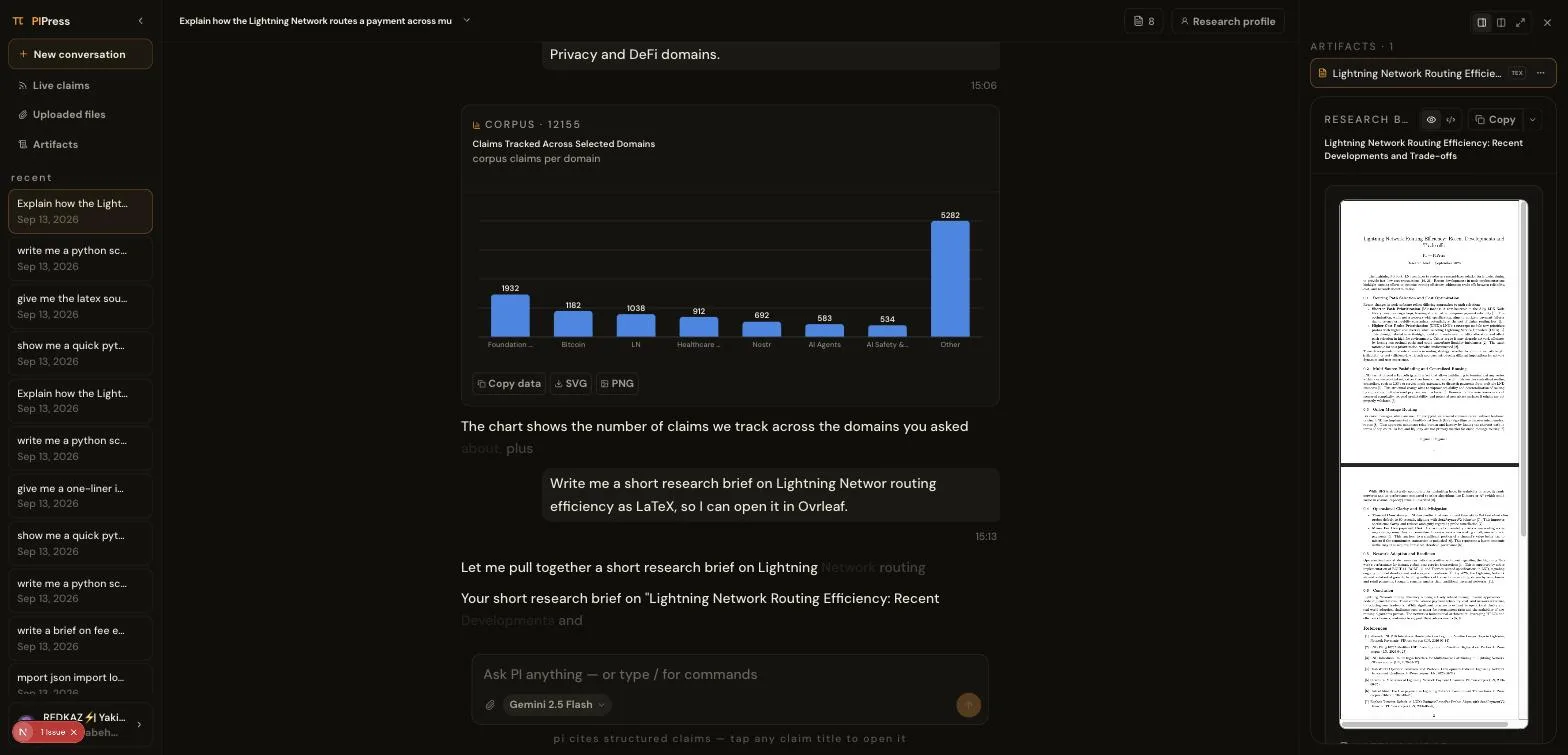
Bold and italic now work around inline code in chat.
A small formatting bug that made some replies read strangely. Fixed.
Live now → https://pipress.xyz
React to a Claim, and comment on one.
Useful, not useful, worth reading. Signal that comes from people who actually read the thing.
Live now → https://pipress.xyz/feed
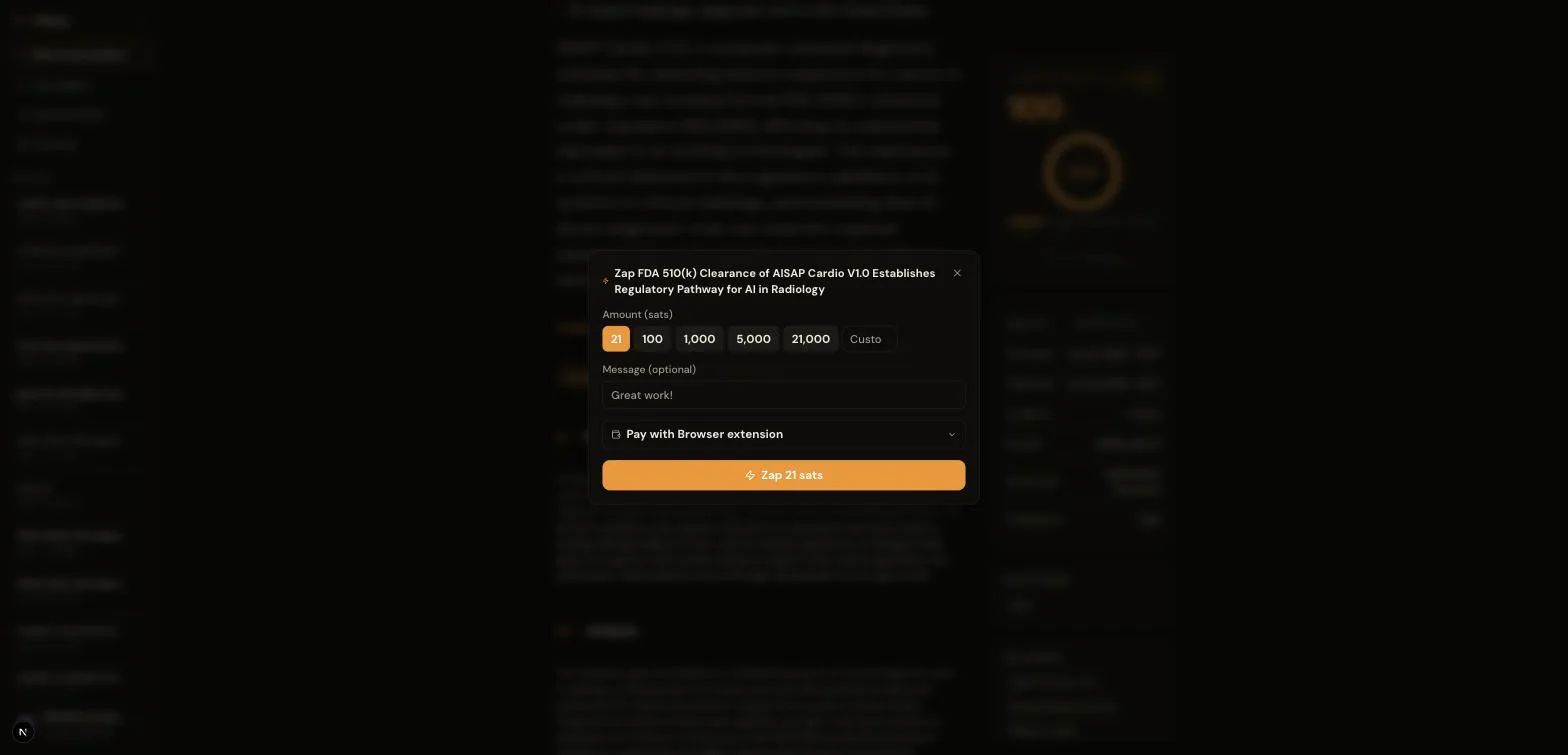
You can send a small payment directly to research you found valuable.
Straight to the work, over open payment rails. No intermediary deciding who deserves it.
Live now → https://pipress.xyz/feed
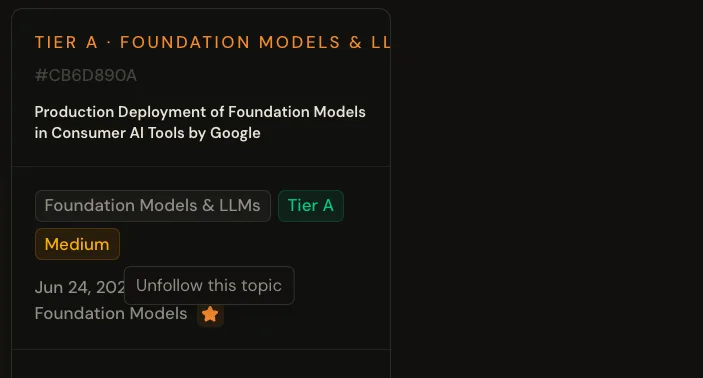
Follow the researchers and domains you care about.
What you track keeps reporting back, without you going to look for it.
Live now → https://pipress.xyz/feed
Replies now arrive as they are written.
No more silence followed by a wall of text. You can start reading immediately and watch the answer develop.
Long answers in particular went from "did this break?" to something you read along with.
Live now → https://pipress.xyz
Conversations now have a way back.
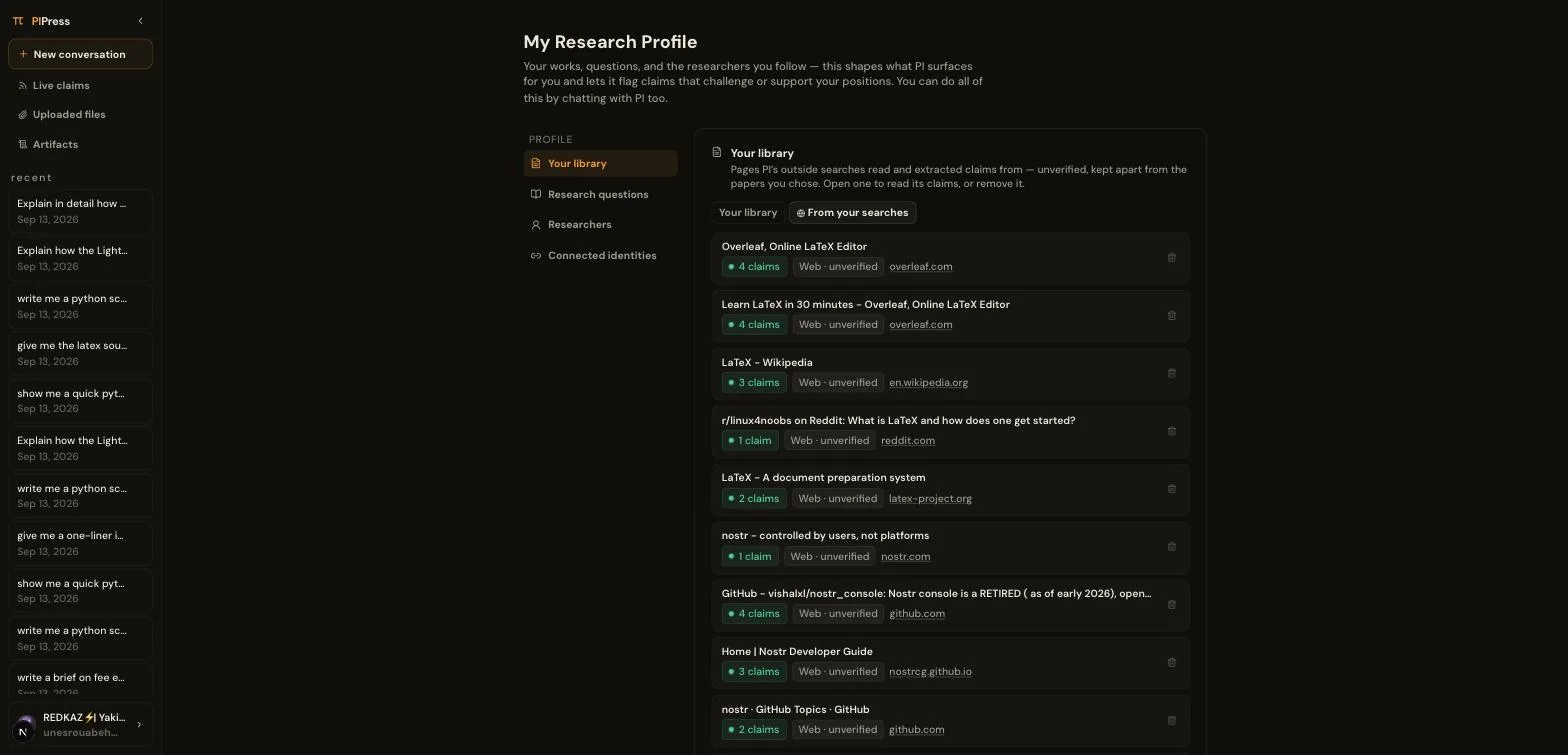
What came from your library and what came from the open web sit in separate tabs, with honest counts. Drill into a finding, follow it somewhere, and you can return to where you were.
No more one-way corridors.
Live now → https://pipress.xyz
The reading panel remembers where you were.
Refresh the page, come back tomorrow — what you had open is still open, instead of reset to empty.
Live now → https://pipress.xyz
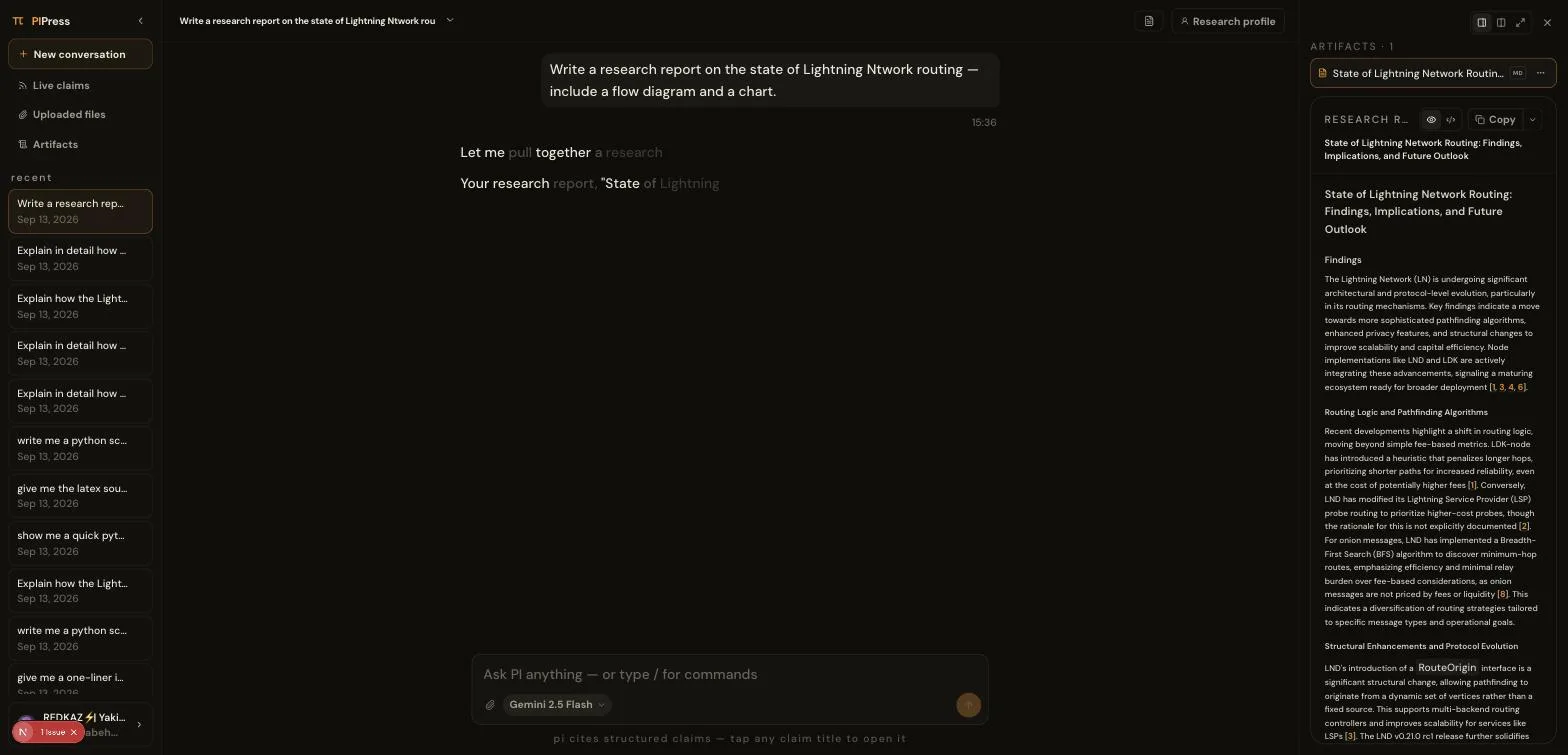
PI now suggests things you did not ask for.
Directions worth looking at, connections to your earlier work, questions that follow from what you just read.
The useful half of research assistance is the half you did not think to request.
Live now → https://pipress.xyz
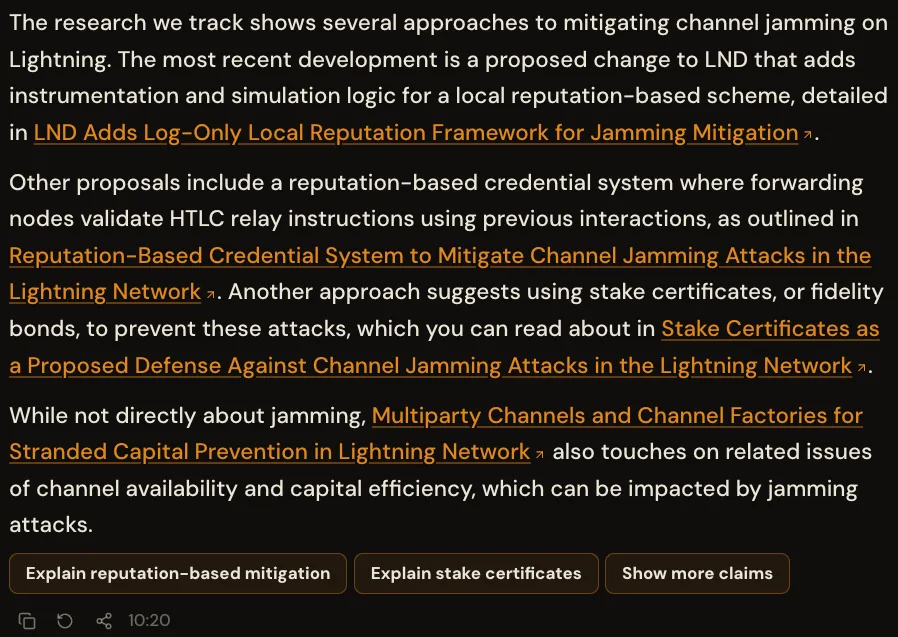
Your own material stays separate from what PI finds on the web.
Your papers, patents and prior work in one place. Web findings in another. Honest counts on both.
Because "is this mine, or did it come from outside?" has a different answer depending on what you are writing.
Live now → https://pipress.xyz
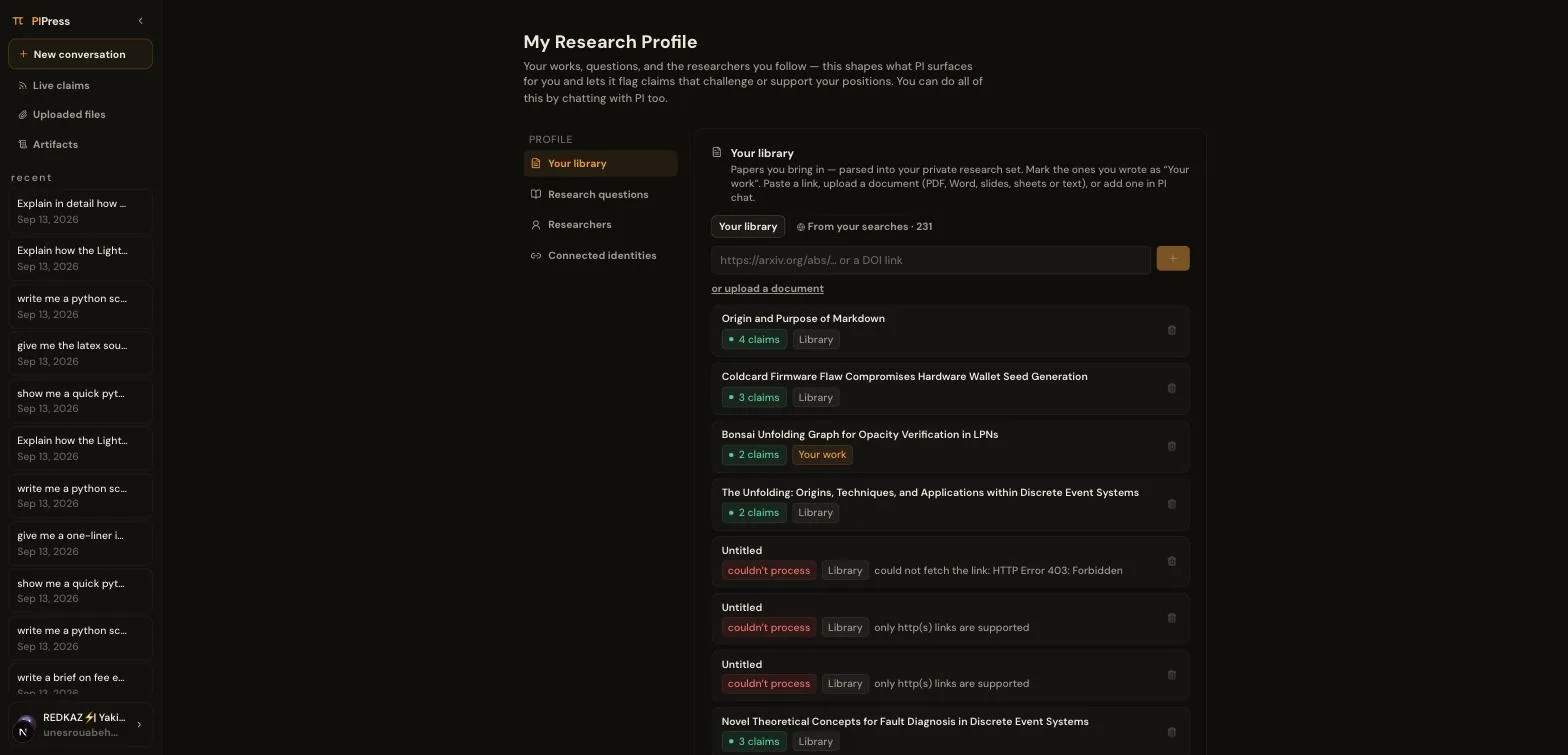
Documents and files each have their own page now.
Not a preview panel — a real page, with readable typography, working mathematics and figures in place.
Click anywhere on a card and it opens.
Live now → https://pipress.xyz
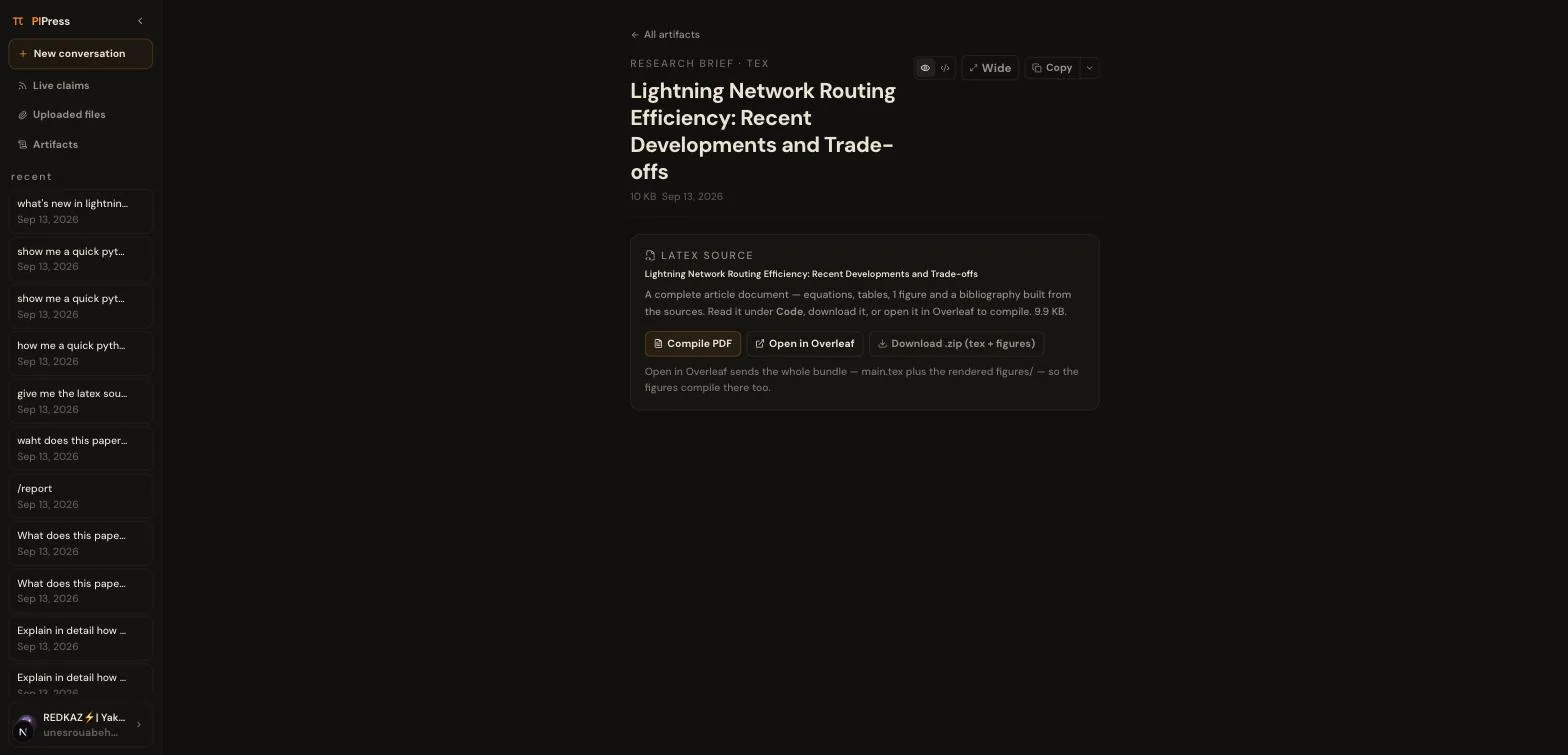
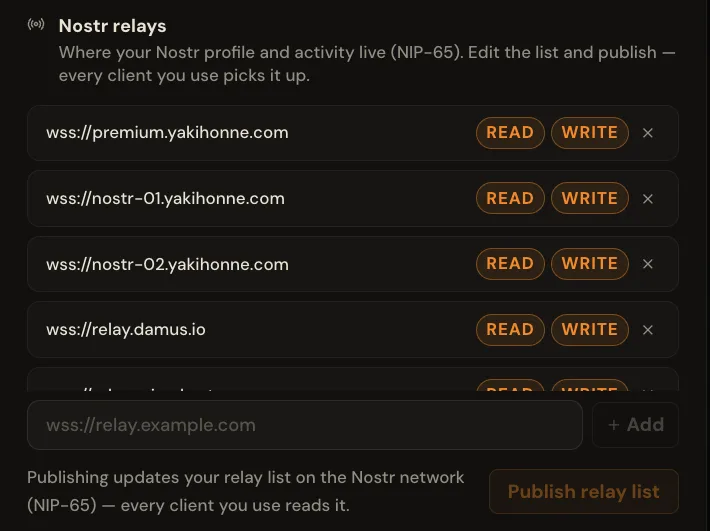
Configure your own Nostr relays.
If you publish to the open network, you choose where. A platform that calls itself open and then hard-codes its own infrastructure is not being straight with you.
Live now → https://pipress.xyz
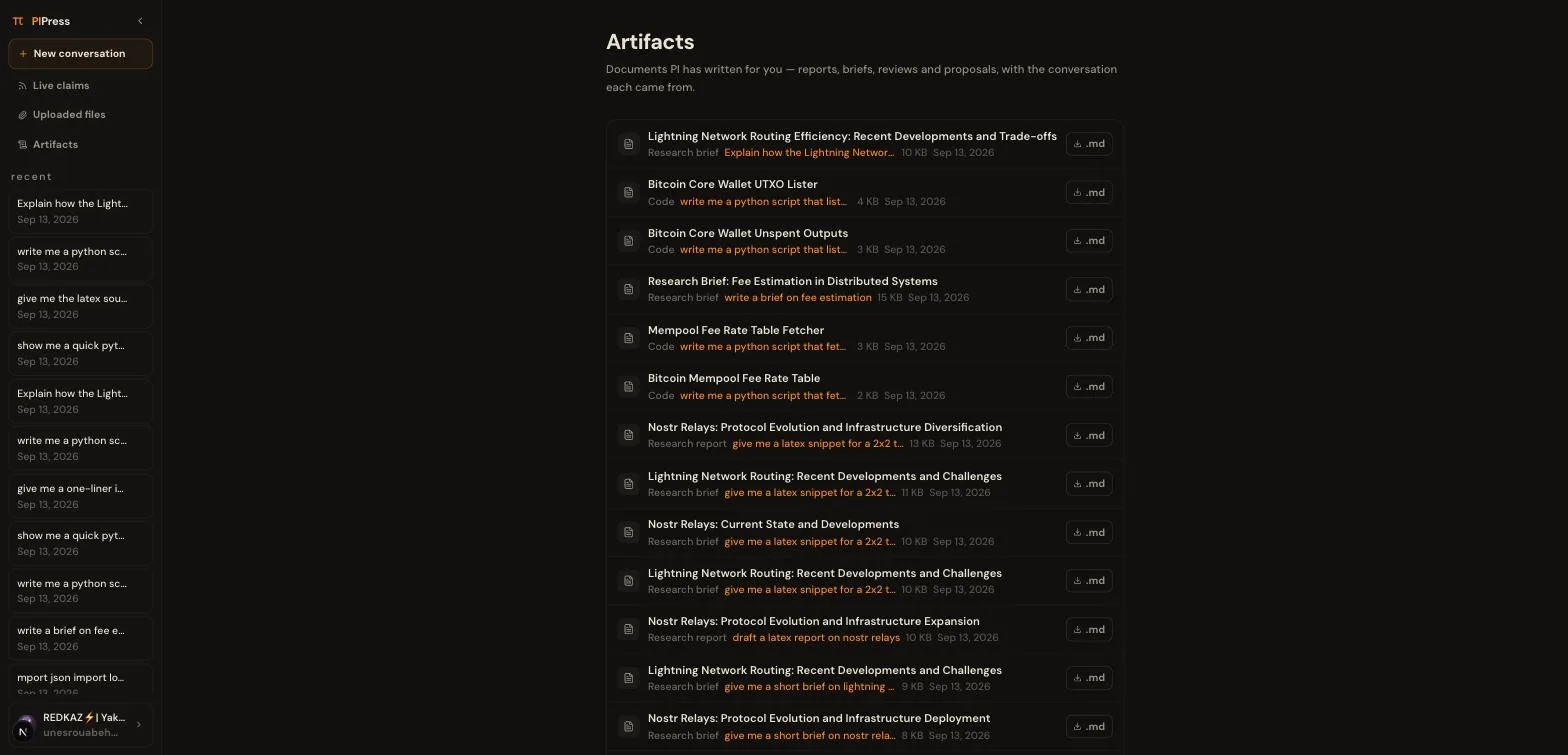
Documents now outlive the conversation that made them.
Close the chat, archive it, delete it — the document stays in your workspace, in its own list, reopenable whenever you need it.
A document that might disappear is one you export out of caution. This one you can leave and come back to.
Live now → https://pipress.xyz
https://pipress.xyz/news/documents-outlive-their-conversation
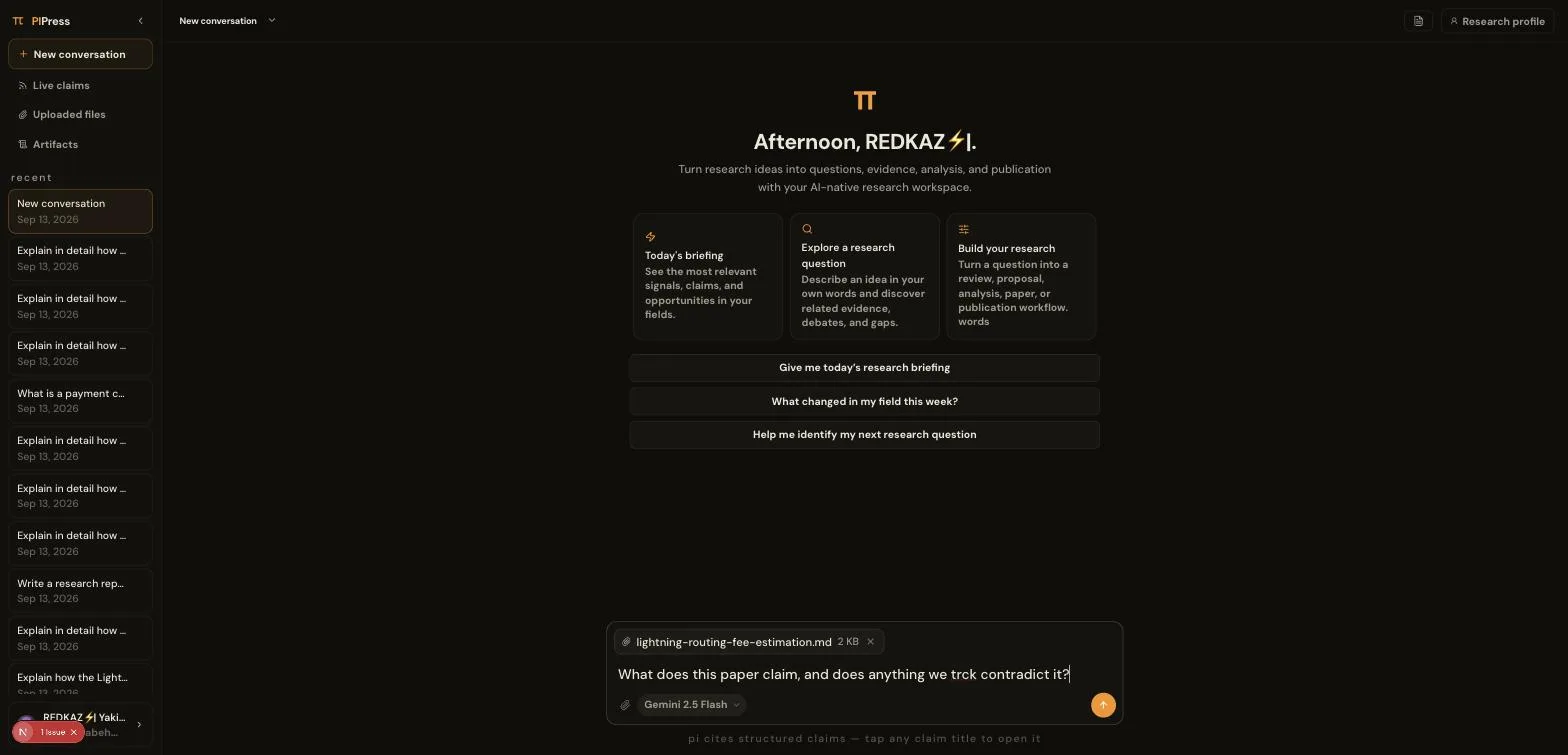
Drop a file anywhere in the app and it lands.
The target used to be a narrow strip near the composer, which meant aiming. Now the whole app accepts it.
Changed your mind mid-drag? Press Escape.
Live now → https://pipress.xyz
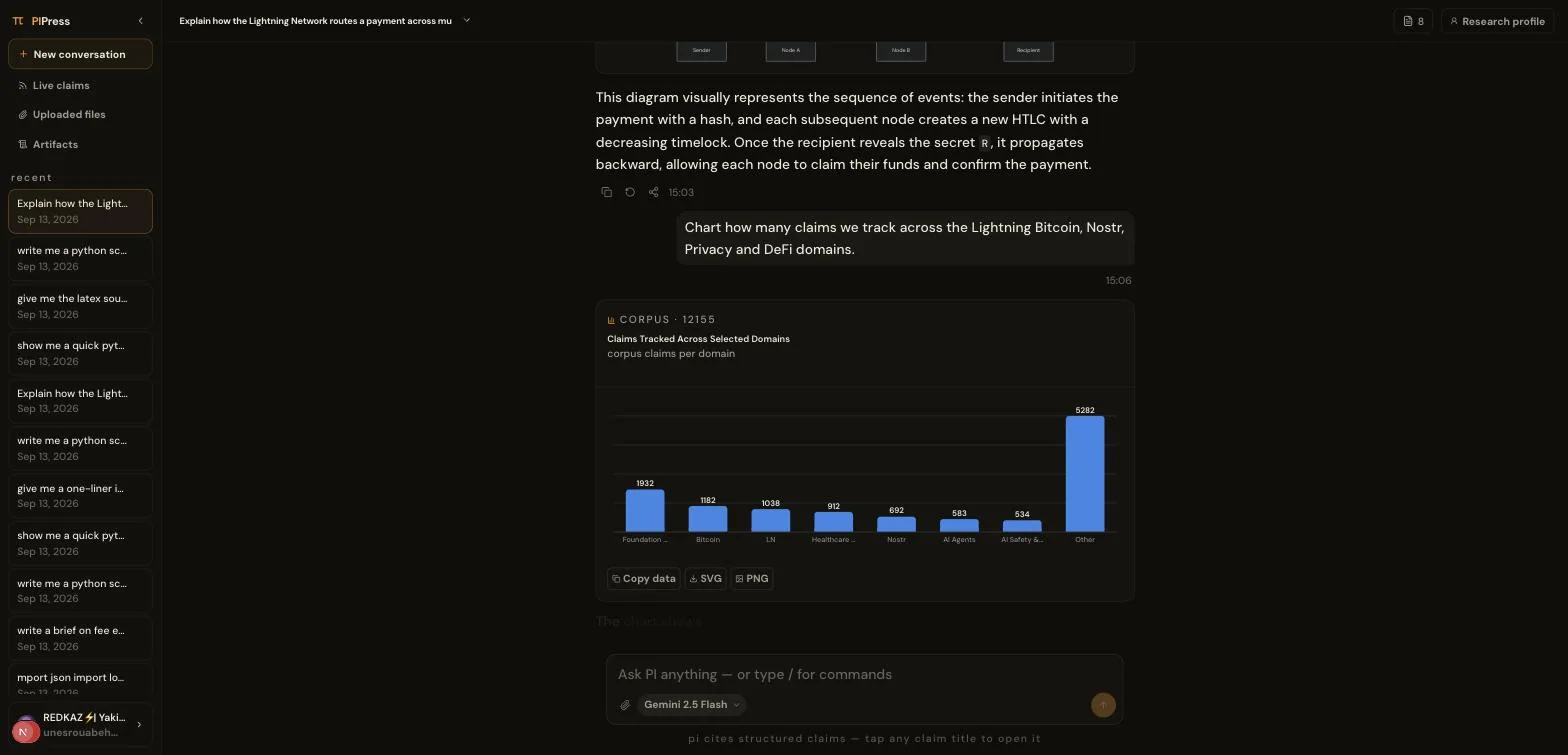
Charts are drawn from your actual numbers.
Not a picture that is roughly the right shape — real values, from your library and the Claim network, that trace back to where they came from.
Which is the only thing that makes a chart worth putting in research work.
Live now → https://pipress.xyz
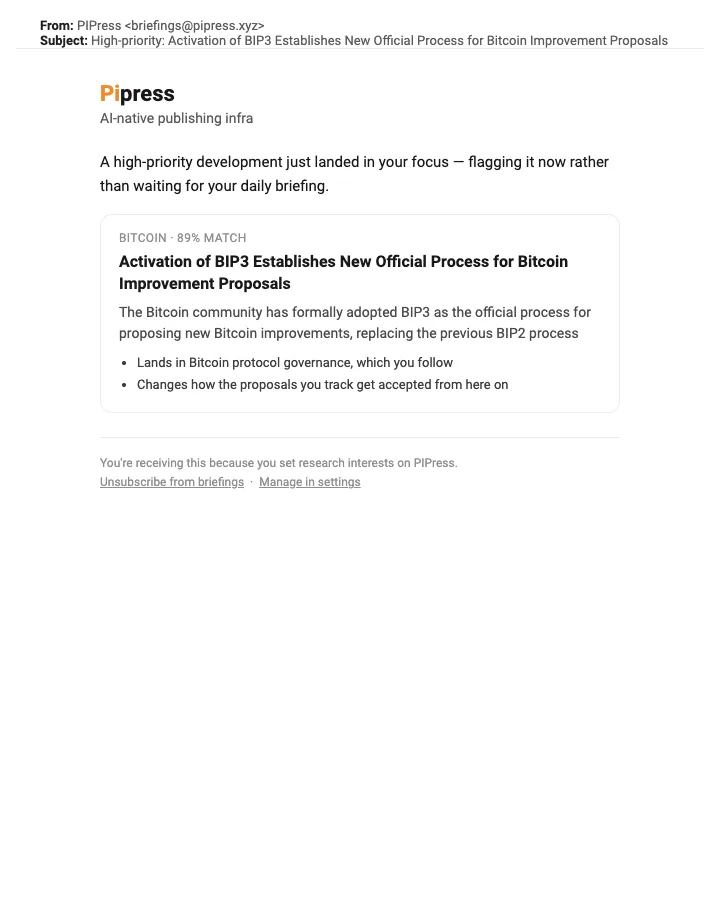
When something lands that is both important and personally relevant to your work, you hear about it the same hour — not in tomorrow's briefing.
Two deliberate limits: it has to match your research, not just be generally important. And there is a cap per day.
An alert system that cries wolf gets muted.
Live now → https://pipress.xyz
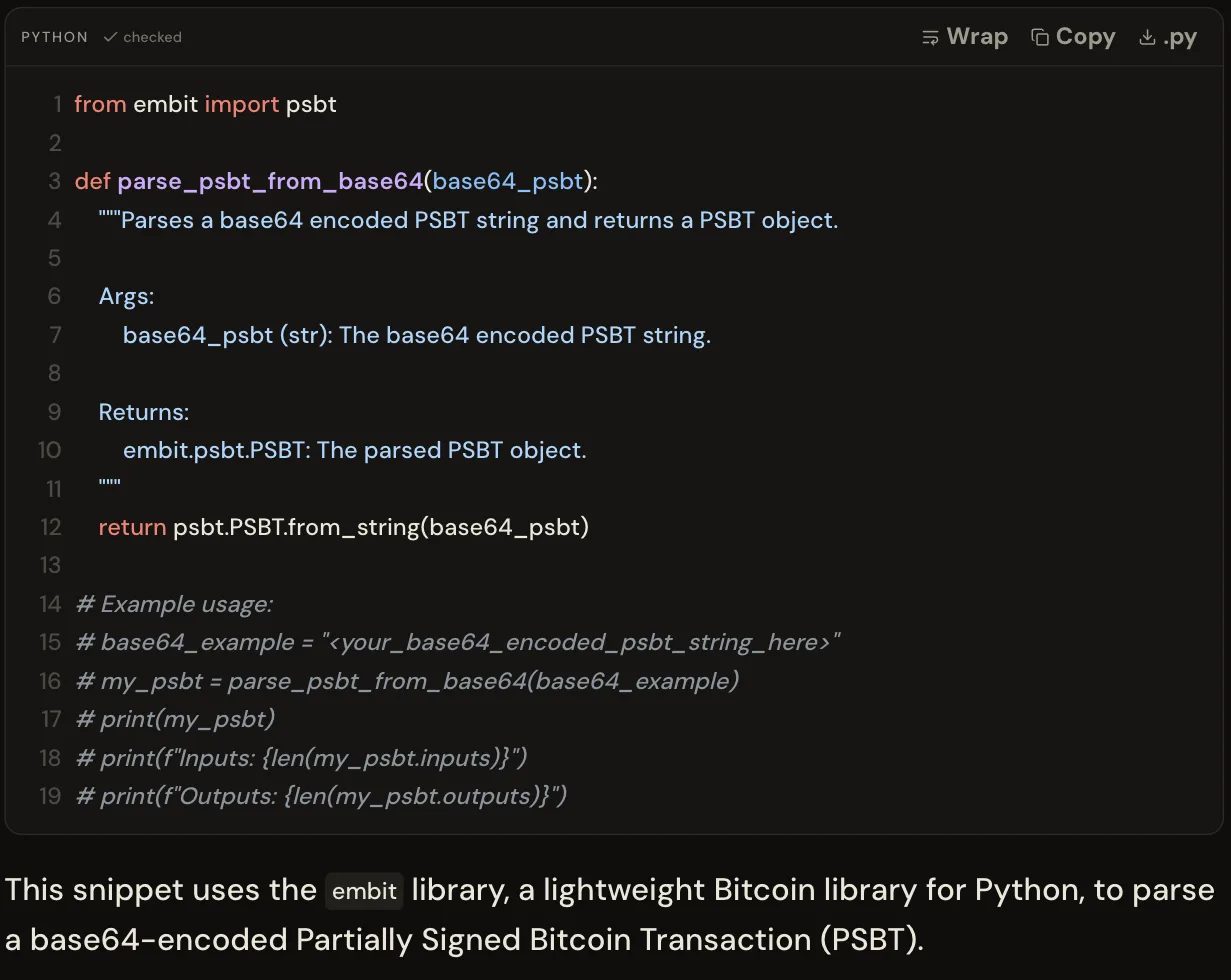
PI checks its own code, and shows it like an editor.
Syntax highlighting, proper formatting, and a check that the code is valid before it reaches you.
Live now → https://pipress.xyz
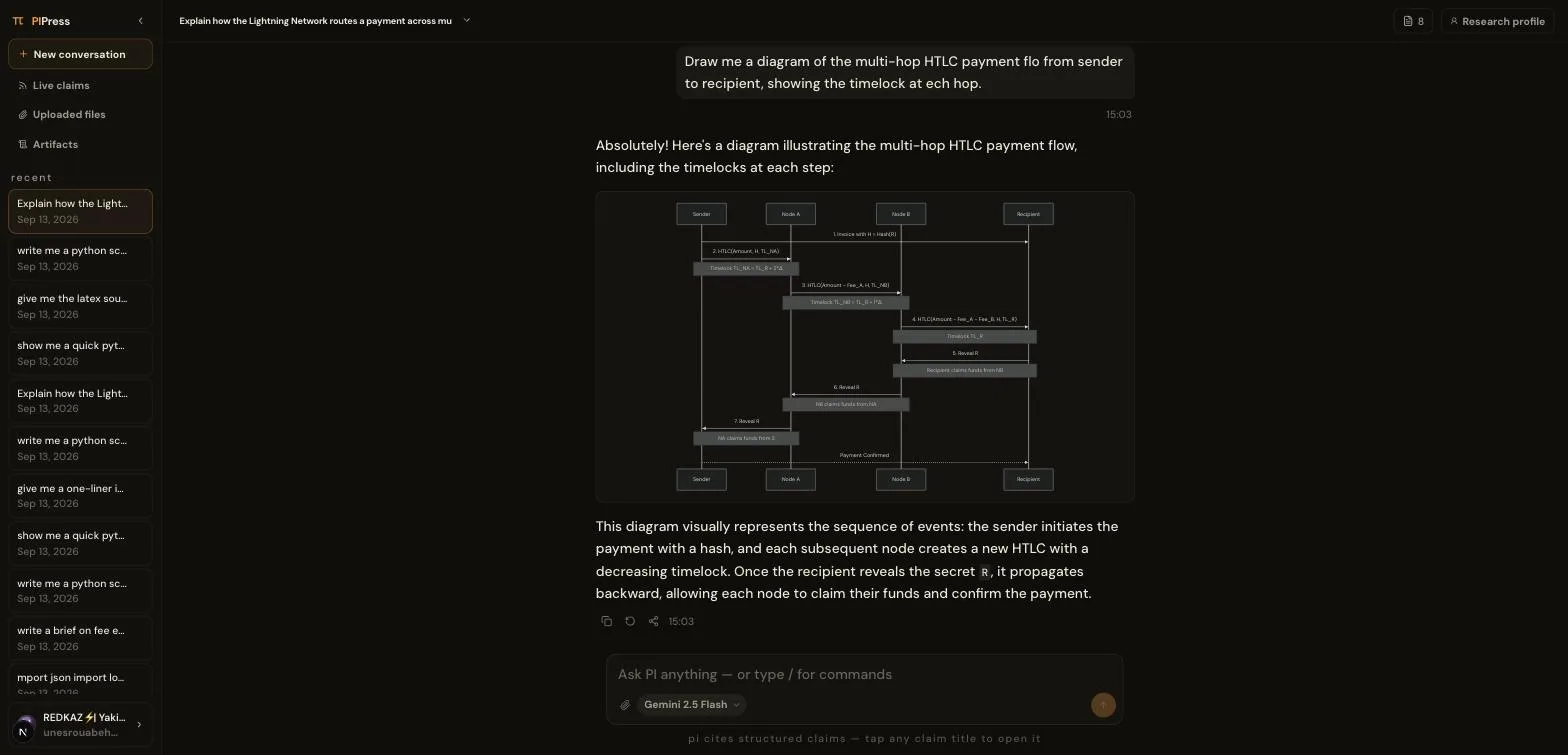
PI checks its own diagrams before showing them to you.
Diagrams are generated, and generated things have syntax errors. One malformed character used to mean an error block where a figure should be.
Now a figure that would not render gets caught and repaired first. Same for mathematics, and for code.
Live now → https://pipress.xyz
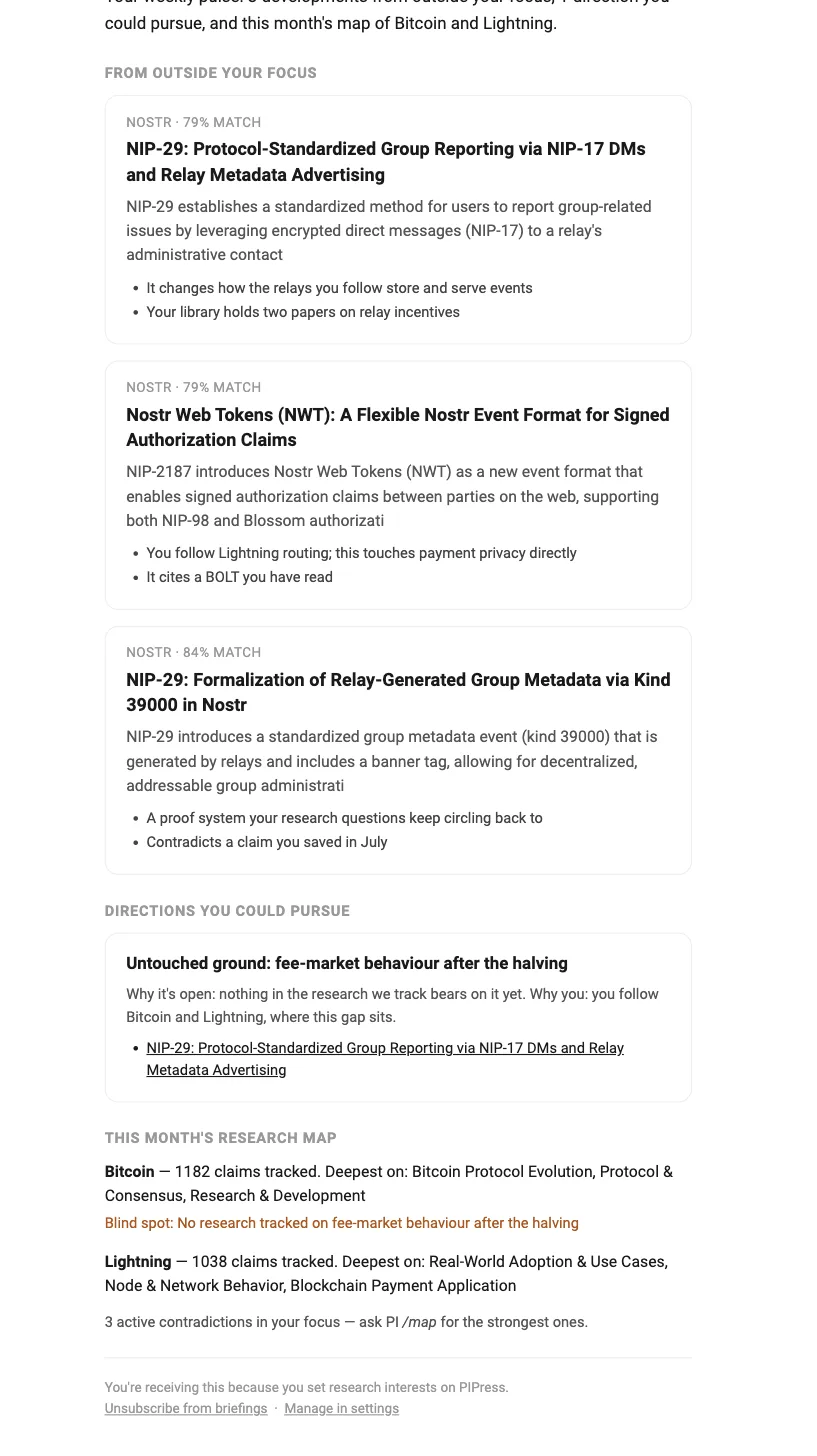
Once a week: not what happened, but what is happening.
What is accelerating, what has gone quiet, where two areas are converging, which directions are opening up.
You can read a month of daily briefings and still miss a trend. A trend is only visible across the whole month at once.
Live now → https://pipress.xyz
Sometimes you want one equation, not a whole document.
Ask to see the LaTeX for something and you now get a snippet, right there in the conversation. Ask for a document and you get a document.
A small irritation, removed.
Live now → https://pipress.xyz
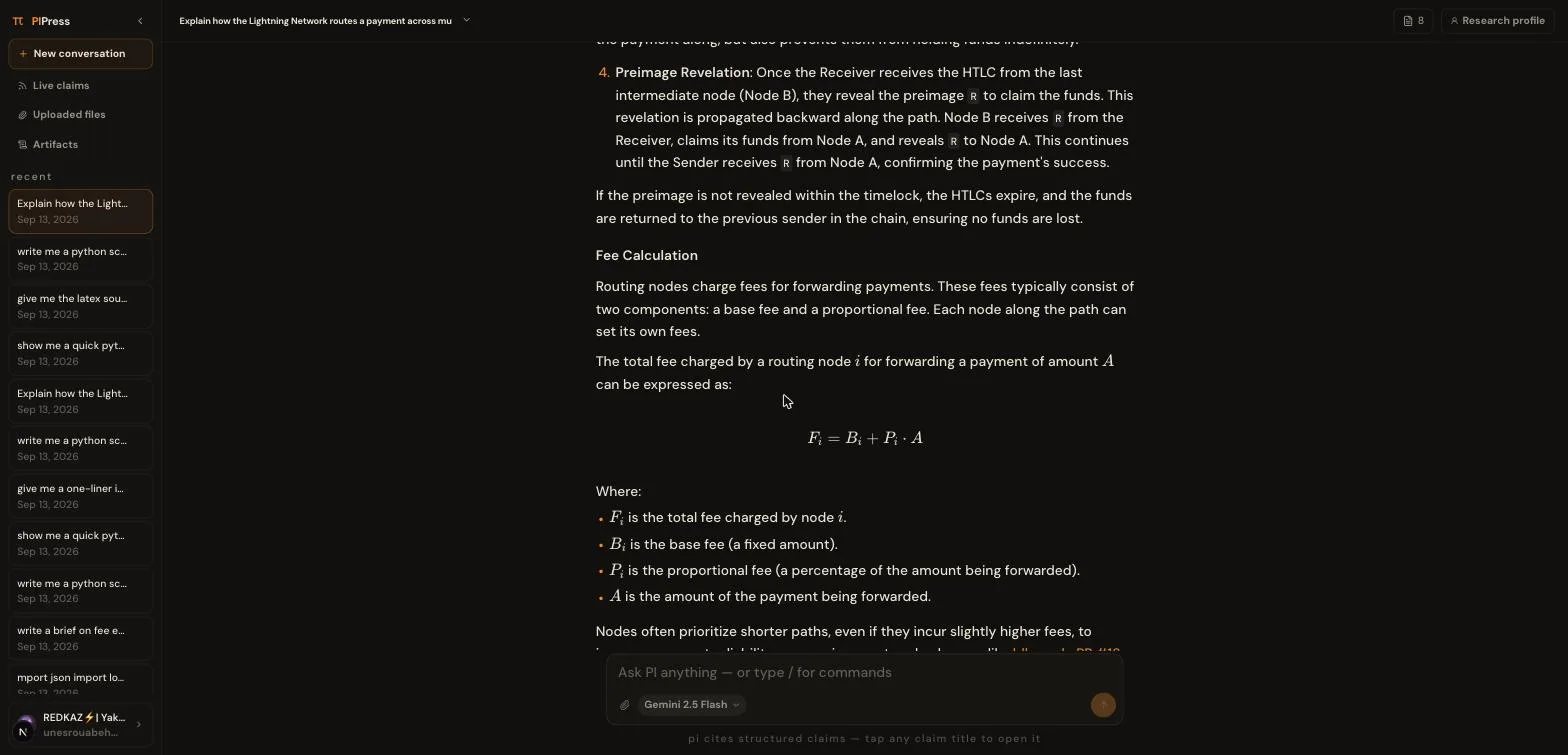
Download a properly typeset PDF of anything PI writes.
Compiled on our servers with a real LaTeX engine — not printed from a browser window. Mathematics is set as mathematics, citations are working links, figures sit where they belong.
If the compile hits an error, it is read, fixed, and run again.
Live now → https://pipress.xyz
A daily briefing of what happened in your fields — at an hour you choose, in your timezone.
Every item says why it is there: the specific connection to your research, not "this is trending."
Which is the difference between a briefing and a newsletter.
Live now → https://pipress.xyz
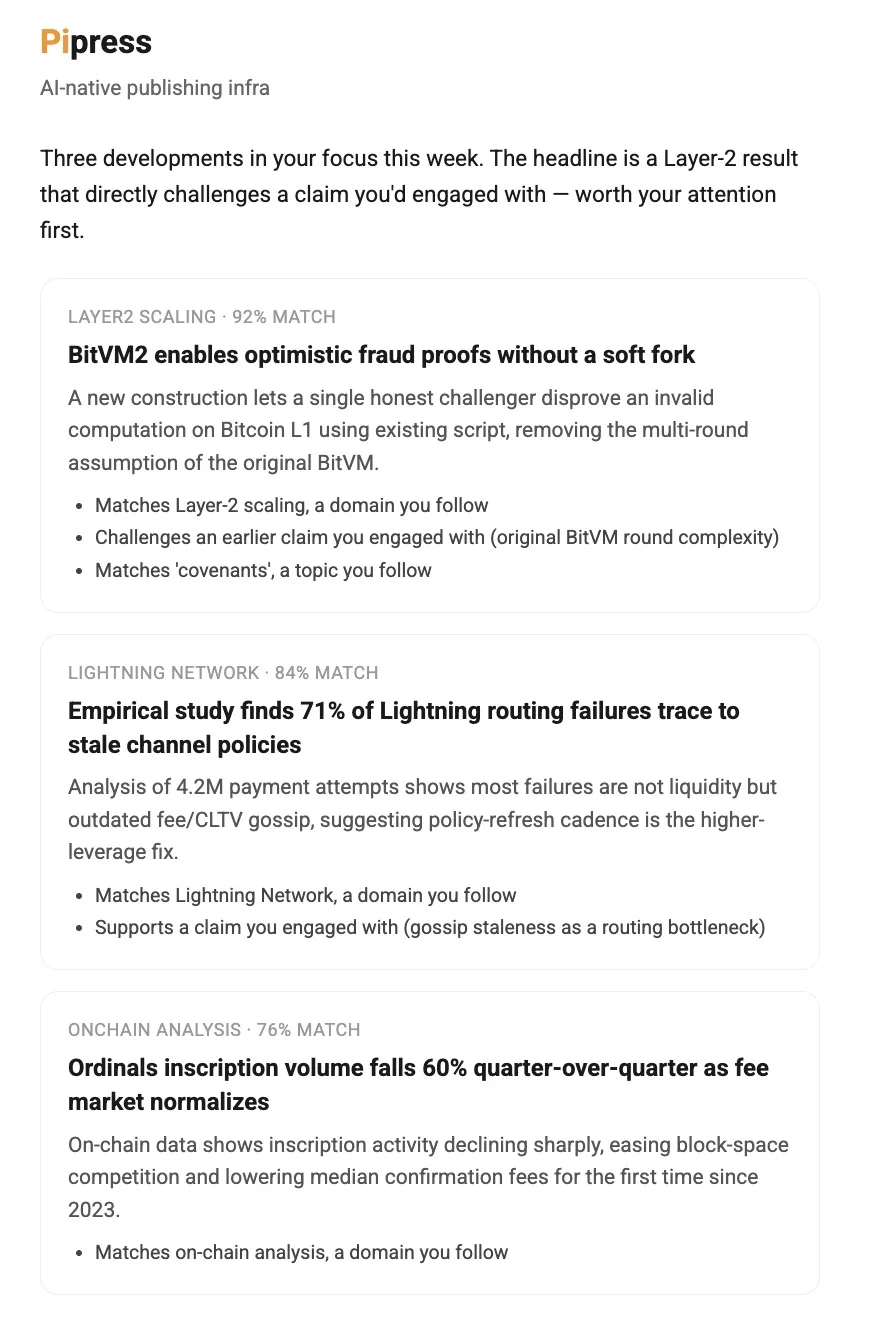
https://pipress.xyz/news/a-daily-briefing-shaped-by-your-work
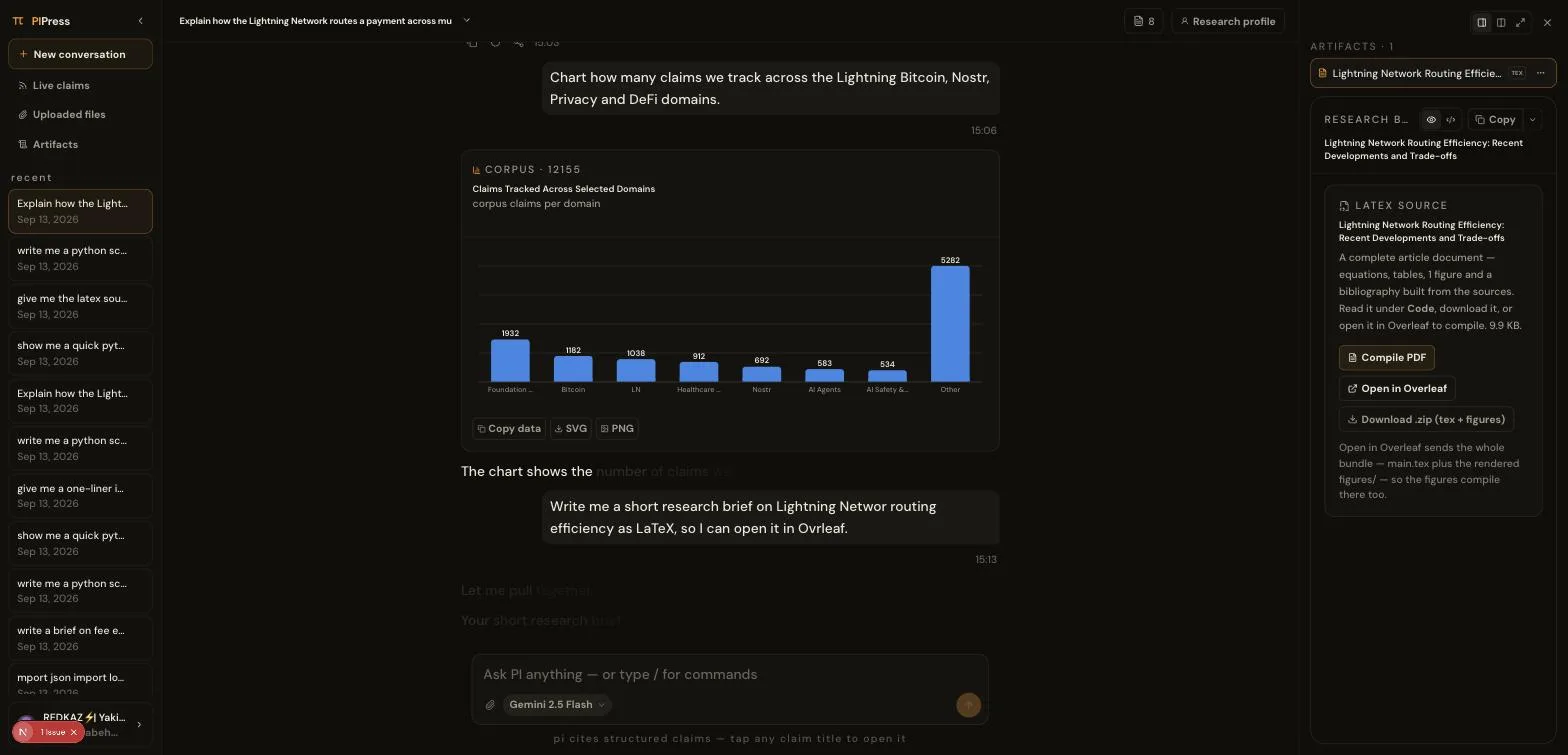
Open any document PI writes directly in Overleaf.
One click. The real LaTeX source — structure, figures and references intact — not an approximation of it.
If Overleaf is where you work, PI now hands off to it cleanly.
Live now → https://pipress.xyz
Mathematics now renders properly everywhere PI writes.
In the conversation, inside your documents, in the reading view, on the printed page. Real typeset equations — not images, not approximations.
PI also checks its own formulas before showing them. A formula that would not typeset gets fixed before it reaches you, instead of landing on the page as an error.
Live now → https://pipress.xyz
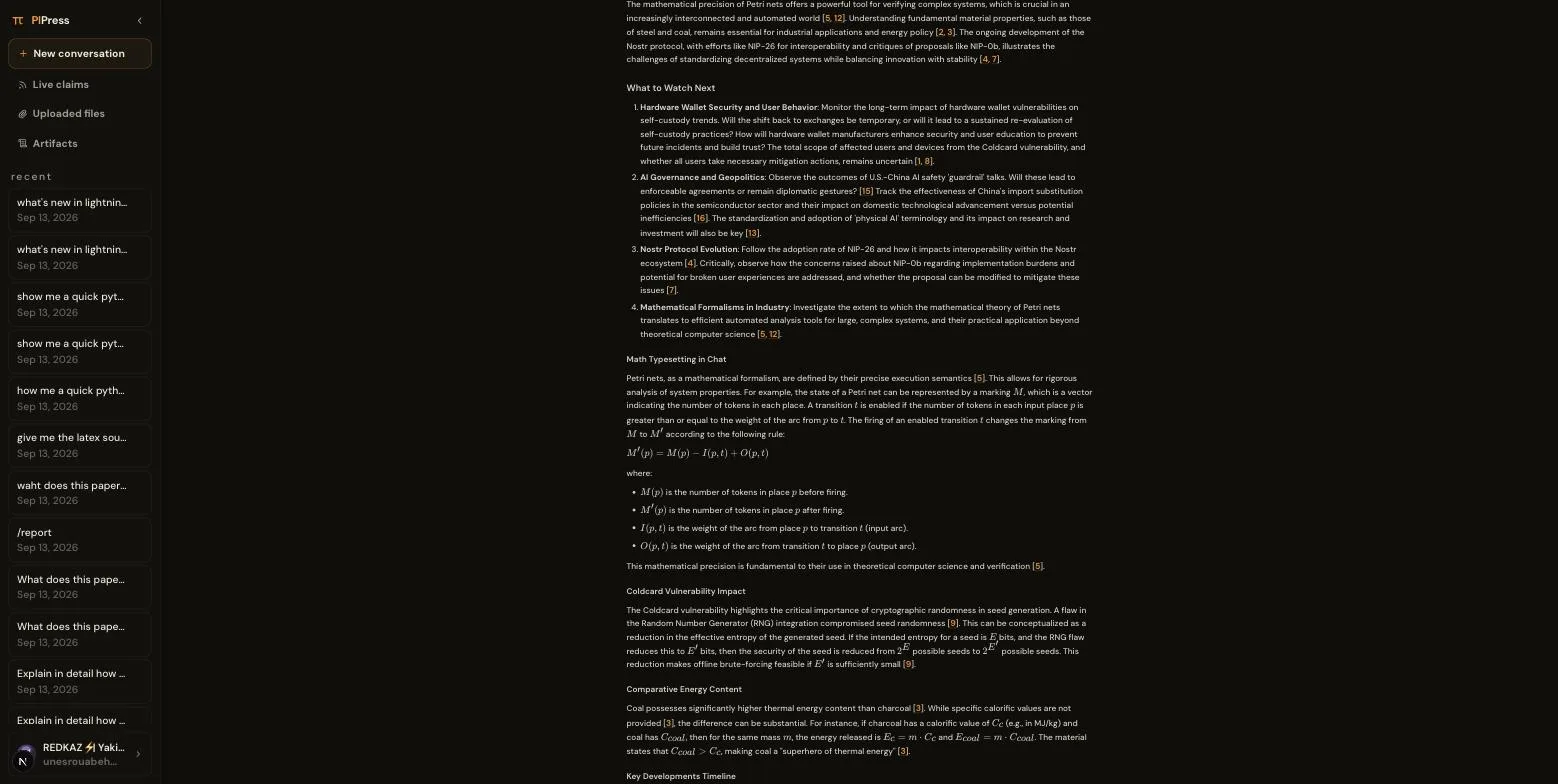
https://pipress.xyz/news/mathematics-renders-properly-everywhere
Sign in without a password.
Enter your email, get a link, you are in. Nothing to choose, store, or lose.
Or sign in with a Nostr key if you already have one.
Start free → https://pipress.xyz
AI Research Assistant → AI Scientist
AnthropicAI recently reported that ~950 Claude agents spent 21 hours exploring DNA data and surfaced a previously uncharacterized enzyme system that was then investigated in the lab.
This is an important distinction:
An AI research assistant helps us understand existing knowledge. An AI scientist begins to help create new, experimentally testable knowledge.
The next benchmark for AI for Science should not be better scientific writing. It should be verified discovery.
Springer Nature is increasingly defining AI use in publishing through explicit risk levels and role-specific rules.
Meanwhile, GitHub already allows enterprises to enforce which MCP servers agents can or cannot use through machine-readable policies.
These may look like two different worlds, but they point toward the same infrastructure shift:
Journal policies will eventually need two versions:
One that humans can read. And one that machines can execute.
Author agents, reviewer agents and journal agents should be able to load the rules of a publication before they act.
That may be one of the foundations of AI-native scientific publishing.
PiPress is live.
A research workspace that turns papers into claims you can check: whatwas found, the evidence, the counter view, and how certain it is. Every claim traced to its source.
The corpus already covers 39 domains, including Bitcoin, Lightning and Nostr research alongside AI, robotics and healthcare.
Free to start. #science #research #nostr

PIPress Workshop Coming to NACOS FULAFIA! 🎓 We're excited to announce that PIPress, an AI-native academic publishing platform built to make research writing, editing, and publishing faster and smarter, is bringing a hands on workshop to the NACOS FULAFIA (Federal University Lafia)
Whether you're working on a research paper, thesis, or academic project, this session will show you how AI tools can help you research faster, write with more clarity, and publish with confidence.
Don't miss this opportunity to level up your academic workflow, see you there!

Google meeting link : https://meet.google.com/fax-cnbm-ppn
9/16/2026
 Run /opportunities and PI ranks the gaps in the field against what you have actually done. Point at one — 'the second one' — and the proposal is written from that gap, with the case for you built from
9/16/2026
 A paper, a patent claim bundle, a submission package and a short post join the review, report, brief, proposal and code file. You still choose by asking. What is new is what the system checks before i
9/16/2026
 What a Claim actually contains — what happened, what it means, the evidence, the counter-view, what is still uncertain, and how it changed over time. Including the parts most publishing leaves out.
9/16/2026
 A view of the whole field at once — how Claims connect, where the evidence is strong, and who is doing the work. No account needed.
9/16/2026