Tell PI how to talk to you, once
your-lens-tell-pi-how-to-talk-to-you

PIPress
Building traceable, high-quality scientific knowledge for AI. From research ideas to trusted publication, accelerating open science and open-source innovation.
3 min read
Every researcher has a way of wanting things said. Some want the method before the result. Some refuse an abbreviation their field has argued about for years. Some want every number qualified by its sample size, every time, without having to ask. Until now you could tell PI once, in a conversation, and it would hold for that conversation.
Now you can tell it once and it holds.
A lens, in your words
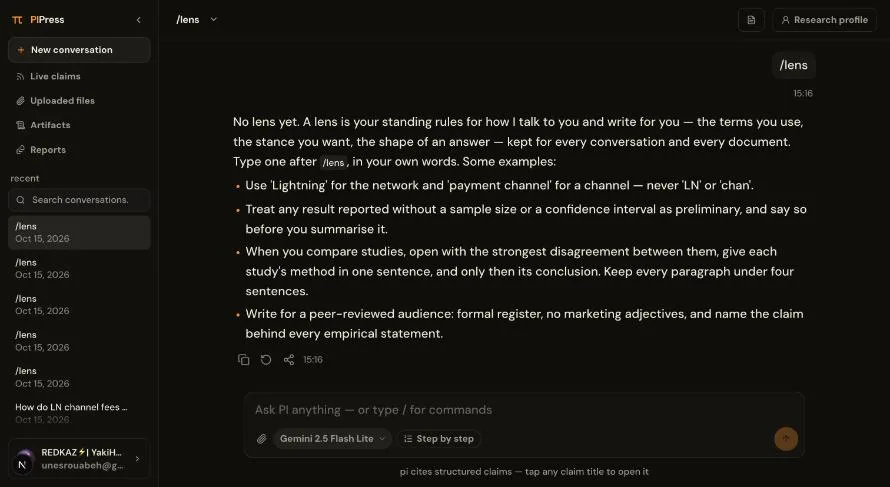
A lens is a few standing rules for how PI talks to you and writes for you. Each rule is a sentence or two, in your own words:
- Write "zero-knowledge proof" and "Lightning Network" in full on first use, never "ZKP" or "LN" in prose, and give the BIP number whenever you name a protocol change.
- Treat any result reported without a sample size or a confidence interval as preliminary, and say so before you summarise it.
- When you compare studies, open with the strongest disagreement between them, give each study's method in one sentence, and only then its conclusion.
- Write for a peer-reviewed audience: formal register, no marketing adjectives, and name the claim behind every empirical statement.
Type /lens in the chat followed by the rule. PI reads it back in one line and asks whether to
keep it; nothing is kept until you say yes. From the next reply on, in every conversation, PI
follows it. The same rules reach the documents PI writes for you: a brief, a review, a report
all take the words and the stance you asked for.
What a lens changes, and what it never changes
A lens changes how PI says things. It never changes what PI does. PI still grounds every statement in a Claim it can show you, still asks before it saves anything or searches outside the platform, still cites its sources. A rule that asks for any of that is refused with a short explanation of what a lens can carry.
Your research preferences, the areas you follow and how deep you want to go, decide which Claims PI shows you. Your lens decides how PI talks about them. The two do not overlap.
Longer guidance as a file
When a rule does not fit in two sentences, a whole way of reviewing a method paper, say, or a
house style, write it as a short markdown file and upload it: /lens-upload in the chat, or My Research
Profile → Your lens. The file follows the shape assistants now share: a name, a one-line description, then
the guidance. PI sees the name and the description on every turn and reads the full text only
when it applies to what you asked.
Seeing and changing it
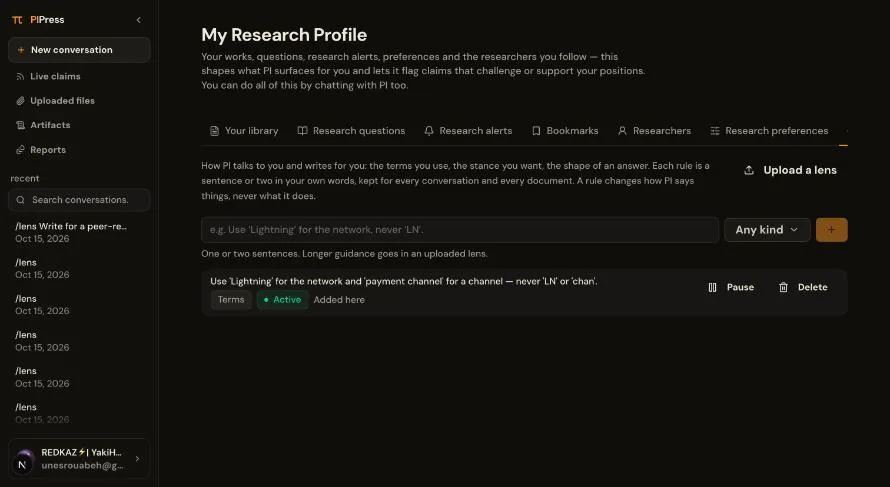
Type /lens on its own to see your rules. Type /lens delete spelling or /lens pause spelling and it is done before PI finishes its sentence; in plain words ("pause the spelling
rule") PI does the same, one breath slower. On your research profile every rule
and every uploaded lens has pause, resume and delete. You can keep up to ten rules and two
uploaded lenses.
Live now → https://pipress.xyz/pi · the guide: https://pipress.xyz/docs/guide/lens
Help keep these ideas circulating
This is an independent project. If you'd like to help support it, you can make a contribution. But there's no obligation at all. Reading, sharing, and coming back is already a form of support.
Read also
1
PI writes real research documents — with proper mathematics, LaTeX you can open in Overleaf, and a typeset PDF compiled …

2
Claims are published to an open network — readable without an account, without our permission, and not ours alone to wit…
3
PIPress now runs events with partners, starting with a two-day AI research hackathon in Kuala Lumpur. Registration is op…

Want to publish here too? No sign-up, and the text stays yours. Learn how to start
Replies (0)
Loading…