The Counterparty Ladder - How the Bitcoin IRA by Bitcoin Well helps your bitcoin journey
Bitcoin Well, 10/15/2026, 1 engagement

Bitcoin Well is on a mission to enable independence. We do this by making it easy to use bitcoin in self-custody. Whether you’re looking to buy, sell or use bitcoin, we never hold on to your bitcoin. Bitcoin Well is automatic self-custody.
Bitcoin Well, 10/15/2026, 1 engagement
Bitcoin Well, 10/8/2026, 2 engagements
Bitcoin Well, 10/5/2026, 1 engagement
Every custodian can show you a number on a screen. Worth asking what the number is made of.
In the Bitcoin Well IRA, your dashboard links to the on-chain address where BitGo holds your bitcoin, in an account titled to Heritage IRA for your benefit. Click it, and a public block explorer shows the balance.
Not our database. The chain.
That's what holding actual bitcoin in a retirement account buys you. You can check it on a Sunday without calling anyone.

10/18/2026, 6 engagements
1/In June 2022, Celsius paused withdrawals. That November, FTX halted them.
Same lesson both times: the company holding the bitcoin was also the company deciding whether you could leave.
That's the problem we designed the Bitcoin Well IRA around. How it works, in five posts:

10/17/2026, 3 engagements
Most bitcoiners we talk to save in bitcoin with after-tax dollars. Their most tax-advantaged account, the 401(k) or the IRA, holds none of it.
That's the gap the Bitcoin Well IRA fills. Real bitcoin, not a fund share, in a Traditional or Roth IRA, with the on-chain address in your dashboard. Rollovers from a 401(k) have no annual cap.
Keep your cold storage. This is the retirement slice.
Mark Furmanek of Heritage IRA walks through it live today at 2:00 PM ET. Link in the comments.
Not tax advice. Please consult a tax professional about your situation.

10/16/2026, 4 engagements
We launched the Bitcoin Well IRA this morning. Tomorrow, the founder of the company that administers it walks you through it.
Mark Furmanek of Heritage IRA, live at our Lunch and Learn, Friday at 2:00 PM ET. How bitcoin IRAs work now, what the setup looks like, and the parts people skip: security, custody, fees, beneficiaries.
Bring the hard questions. Custody included.
Link in the first reply.

10/15/2026, 2 engagements
Yes, we're the self-custody company. And yes, we just launched an IRA where you don't hold the keys.
Here's why. In McNulty v. Commissioner (2021), the US Tax Court held that holding IRA assets yourself at home is treated as a distribution. Keys in your drawer means the tax wrapper is gone.
So the real question is which custody respects the owner most. Ours:
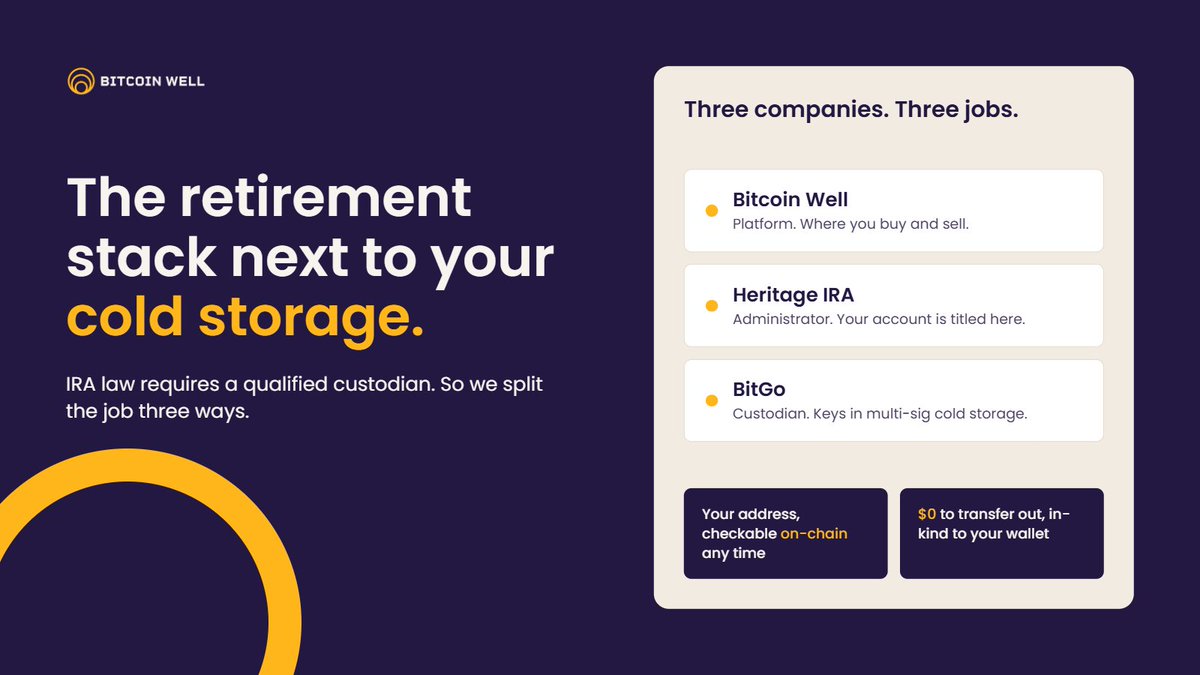
Three separate companies with three jobs: Bitcoin Well, Heritage IRA, and BitGo with your on-chain address in the dashboard, checkable any time. No fee to transfer out, and in-kind distributions to your own wallet are allowed (tax rules apply).
Keep your cold storage. This is the retirement stack that sits next to it.
Not tax advice. Please consult a tax professional about your situation.
10/15/2026, 1 engagement
The Counterparty Ladder - How the Bitcoin IRA by Bitcoin Well helps your bitcoin journey
10/15/2026, 1 engagement
Bank of America just paid $1.21 billion, the third-largest penalty in Treasury’s history, for failing to report more than $5 billion in suspicious transactions. It admits it “willfully” broke the law. It “prioritized its revenues” over compliance. It “knew for years.” It was already under an order to fix this from 2024.
Every few months one of these lands and we call it a scandal. Stop. A thing that keeps producing the same output isn’t malfunctioning. That output is what it’s for.
Banks are for taking your money. Governments are for taking your freedom. Both only work while they can convince you they exist for the opposite, which is why the fine goes to the Treasury and not to a single customer whose account ever got frozen by the same program.
Bitcoin doesn’t need you convinced. Holding your own keys is the only way out.

10/14/2026, 6 engagements
This week a court in London is deciding whose name goes on 61,000 bitcoin, eight years after the police took the keys.
Most of us will never face that version. All of us face the small one: whose name is on your bitcoin, and what happens to it when you’re not here.
That’s Friday’s Lunch and Learn. Mark Furmanek, founder of Heritage IRA, walks through holding bitcoin inside a retirement account: the rules that made it possible, what the Bitcoin Well IRA setup actually looks like, and the four things people skip until it’s too late. Security, custody, fees, beneficiaries.
Friday, October 16, 2:00 PM ET. Bring questions.
👇Link in the first reply👇

10/13/2026, 3 engagements
This is what the Ledger implant looks like from the inside.
A Reddit user opened a Nano X bought on a Russian marketplace, not from Ledger, and found a thin extra board wedged between the screen and the main circuit board, with its own antenna.
Ledger confirmed the mechanism overnight: the board reads the screen, waits for the 24 words to appear during setup, and sends them out over LTE on its own eSIM. The secure chip was never touched. It didn’t need to be.
This is why you always buy straight from the manufacturer. If you are worried and want to check, Ledger’s own guide is in the replies.
(labels in the photo: u/cheerful_afternoon on Reddit.)

10/13/2026, 23 engagements
52 years ago this week, the Nobel committee gave the economics prize to Friedrich Hayek. Two months later, at the banquet, he told them he would have advised against creating it.
His reason is on the card. The prize "confers on an individual an authority which in economics no man ought to possess," because an economist's real influence isn't over other economists, it's over "politicians, journalists, civil servants and the public generally."
Fifty-two years on, that authority has a building. One chair, twelve votes, and the price of money for 340 million people, set by the kind of credentialed expert the prize taught everyone to defer to.
Bitcoin's answer is Hayek's, written in code: nobody is competent enough to hold that job, so the job doesn't exist. The supply is a number, not an opinion.
He asked for an oath of humility. Satoshi shipped one.

10/11/2026, 10 engagements
American Express was fined $350,000,000 this week.
Not for moving dirty money. For not watching its customers closely enough. The regulator's own words: a failure to "sufficiently report approximately $13 billion of suspected" activity and "to provide important information to law enforcement."
The fine goes to the Treasury.
That's your bank's job description in one document: watch you, report you, and pay the government when it doesn't.
Bitcoin was built so that holding money didn't require being watched by whoever holds it for you.

10/10/2026, 10 engagements
80 bitcoin went into a hardware wallet bought from a reseller last week. All 80 left in one transaction this morning.
Just a reminder that the device isn't the key, your seed phrase is. If anyone touched it before you, it was never really yours.
Stay salty out there.

10/9/2026, 10 engagements
Netflix is making the FTX series. We fixed the poster.
Nobody in that building broke into anything. A million people handed it over, one login at a time.
Premieres November 19. The sequel premieres every time someone leaves their coins on an exchange.

10/9/2026, 8 engagements
Untakeoverable: The 1992 Nightclub Scene That Explains What Bitcoin Is For
10/8/2026, 2 engagements
Quantum fear is back on the timeline, so here's the calm version.
Use a fresh address for every transaction. You should have been doing that already. It's hygiene, not a shield.
If a computer ever shows up that can break a bitcoin key, a new address isn't what saves you. The upgrade is. And no such computer exists. Europol's cybercrime centre put out a whole report on this yesterday and its conclusion was one line: "Cryptocurrencies will not collapse due to quantum computing."
The accounts telling you to panic this week are selling you panic.
Buy on a schedule. Hold your own keys. Don't reuse addresses. Ignore the countdown.
That strategy was right before the fear and it's right after it.

10/8/2026, 2 engagements
The U.S. government moved about $470,000,000 of seized bitcoin and stablecoins today. Arkham tracked it to addresses it says are likely Coinbase Prime deposits.
Probably not a sale. Probably just the custodian: since July 2024 the U.S. Marshals Service has had Coinbase under contract to hold and trade the coins it confiscates.
So the honey pot got bigger. Coinbase already held $330,000,000,000 for clients by its own count. The ETFs sit there. Now the government's confiscated stack does too.
Here's the thing nobody at Coinbase will tell you. They don't have any technology you don't. Same keys, same cold storage, same multisig you can set up on a kitchen table.
What they have that you don't is a pot about 10,000,000 times larger.

10/7/2026, 14 engagements
This morning we posted Dr. Jeff Ross on why bitcoin exists: whoever controls the money controls your purchasing power.
Yesterday the Bank of Russia described what its newly registered custodians do. They "grant clients access to address identifiers where such assets are recorded."
In plain English: the bank holds the coins. You get a login.
The bank is Sberbank, majority-owned by the Russian state and under Western sanctions since 2022. A bitcoin balance there is a claim on Sberbank, and a claim on Sberbank is a claim on the state.
Every custodial balance is a claim on someone. Most people never look up who.
The whitepaper's first sentence was about money that moves without going through a financial institution. Russia's first regulated step was to put one back.

10/7/2026, 1 engagement
Bitcoin in Your IRA?!? Here's What Wall Street Doesn't Want You to Know https://t.co/DROn80WD6u
10/7/2026, 1 engagement
Canada's financial intelligence agency is the one your bank and your exchange report to.
Over the last five years, it wiped the supplier names off 100 of its own contracts, worth more than $26.7 million. The Hill Times says it's the only government agency to do that without giving a reason.
One of those lines: $1,576,009.59 for "data and database access services." Vendor: REDACTED.
Privacy for the watcher. Transparency for the watched.

10/7/2026, 3 engagements
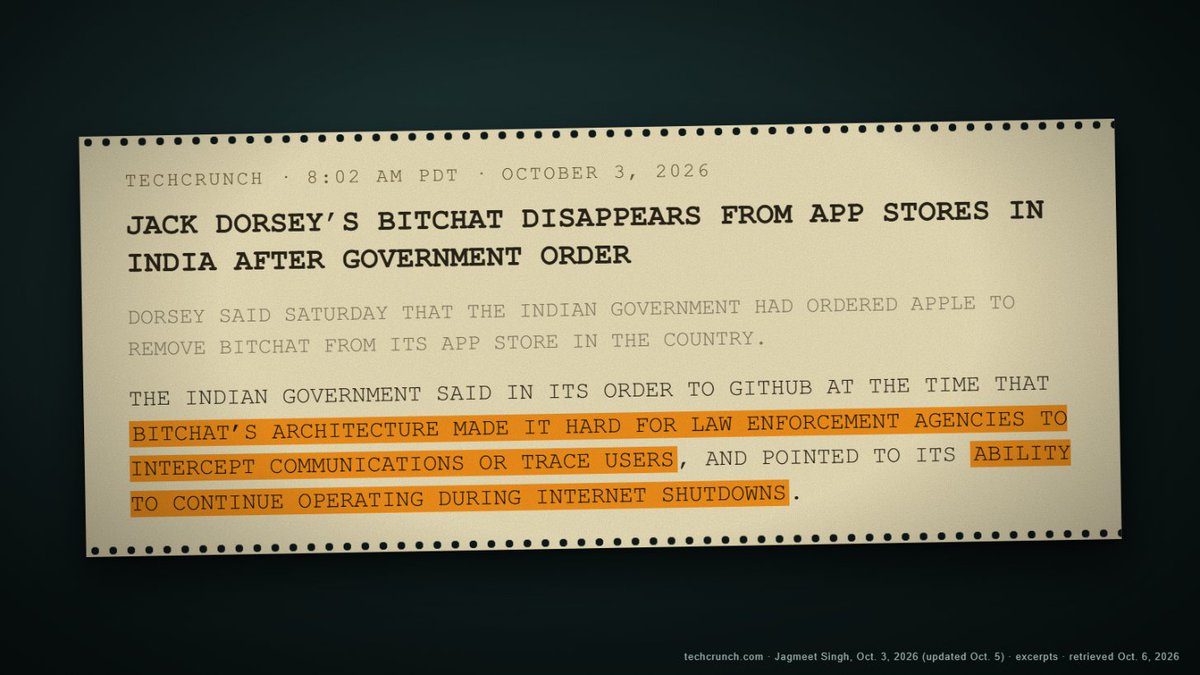
On Friday, authorities cut the internet around a protest site in New Delhi for 12 hours.
By Saturday, Bitchat, the messaging app that works without the internet, was gone from the App Store and Google Play in India.
India had already told GitHub why it wanted the app gone. Its design made it hard for police to intercept messages or trace users. And it kept working during internet shutdowns.
That's not a charge sheet. That's the feature list.
Bitcoin exists for the same reason. Money that works without anyone's permission, even when the people in charge would rather it didn't.
When the state tells you exactly why a tool scares them, believe them.
10/6/2026, 22 engagements
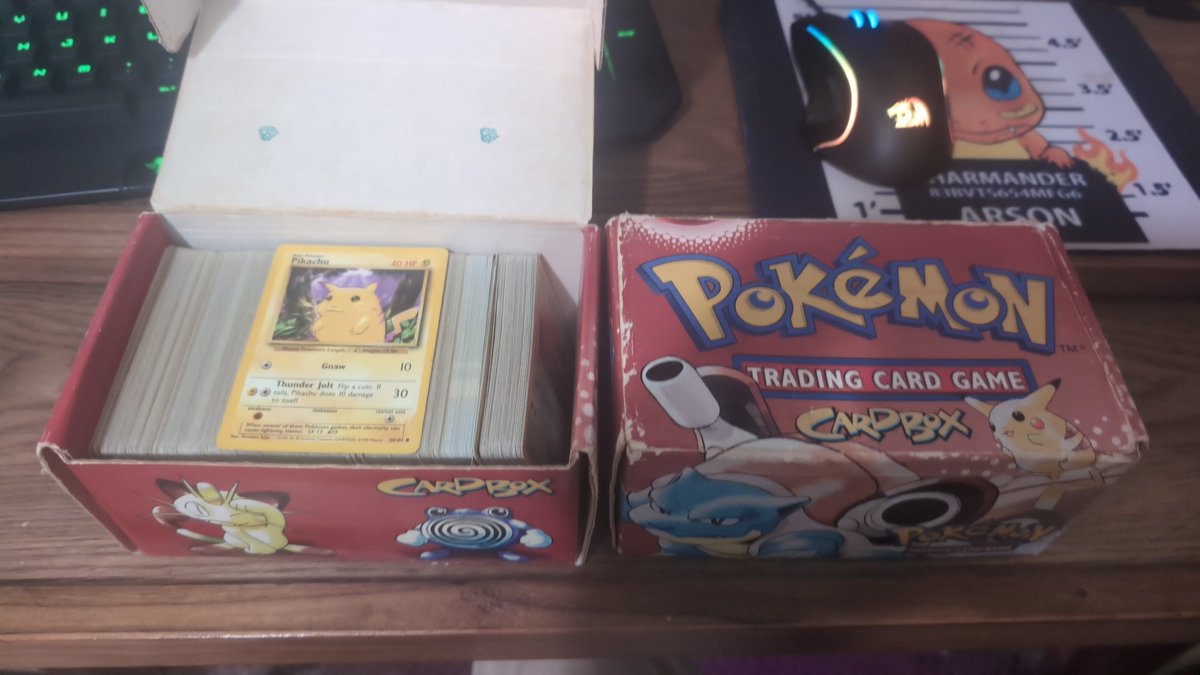
How much bitcoin you think you could get for these two vintage Pokémon card boxes?
Asking for a friend 👀
10/6/2026, 3 engagements
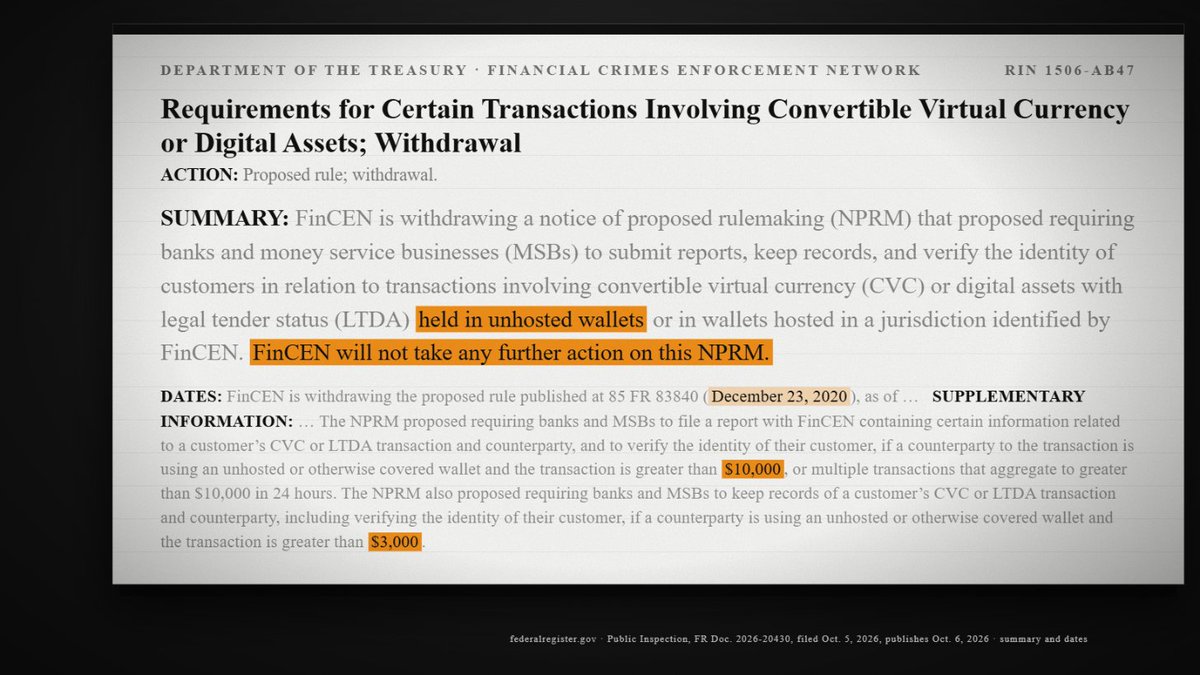
FinCEN filed this morning to withdraw the 2020 rule that would have put a record on every transfer over $3,000 to a wallet you control.
"FinCEN will not take any further action on this NPRM."
Good news. Your wallet never needed their permission anyway.
10/5/2026, 12 engagements
Why Are Banks Disappearing? Too Big to Fail Is Failing the Free Market
Your dollars can be used to pay off the government's debt. Your bitcoin can't.
This week the President told TIME: "certain levels of inflation will also pay off that debt very rapidly. Very rapidly."
He's right about the arithmetic.
Inflation doesn't pay a debt. It moves the bill. Every dollar Washington owes gets cheaper to repay because every dollar you hold buys less. Nobody votes on it and nobody sends you an invoice.
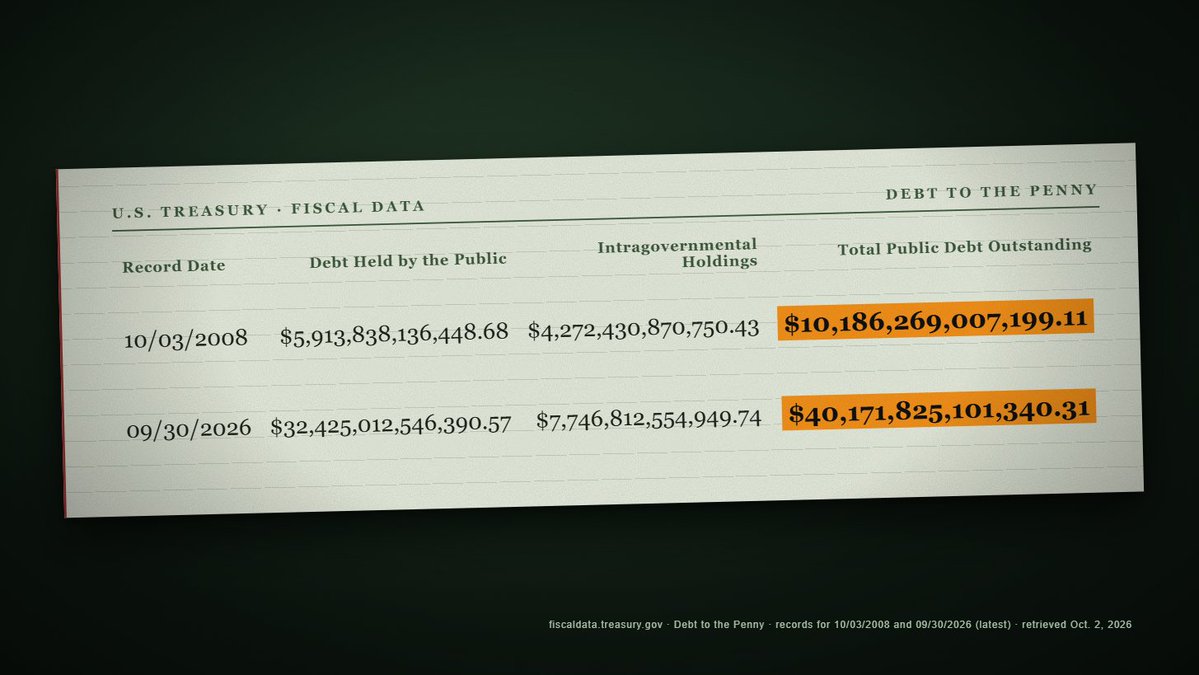
The day the 2008 bank bailout became law, Treasury's own ledger showed $10.19 trillion of public debt. On Wednesday it showed $40.17 trillion. Both parties built that number.
Mises called inflation a policy, not an accident. This week it was described as one, out loud.
A money with a fixed supply can't be quietly volunteered to pay the tab.
10/5/2026, 6 engagements
Who (or what) finally convenced you to buy your first sats?
10/5/2026, 1 engagement
Bitcoin has a birth certificate, and it's a bailout.
Eighteen years ago today, on October 3, 2008, Public Law 110-343 gave the Treasury Secretary authority to buy up to $700 billion of troubled assets from banks, "on such terms and conditions as are determined by the Secretary."
That's the clause. Not Congress. Not you. The Secretary.
The House had voted it down four days earlier. It passed anyway, and your taxes stood behind it.
28 days later, Satoshi published the white paper. 92 days later, block 0 locked a newspaper headline into the chain forever: "Chancellor on brink of second bailout for banks."
The rescues never really stopped. They just stopped making headlines.
Bitcoin is the money whose terms no Secretary gets to determine.

10/5/2026, 1 engagement
Your dollars can be used to pay off the government's debt. Your bitcoin can't.
This week the President told TIME: "certain levels of inflation will also pay off that debt very rapidly. Very rapidly."
He's right about the arithmetic.
Inflation doesn't pay a debt. It moves the bill. Every dollar Washington owes gets cheaper to repay because every dollar you hold buys less. Nobody votes on it and nobody sends you an invoice.
The day the 2008 bank bailout became law, Treasury's own ledger showed $10.19 trillion of public debt. On Wednesday it showed $40.17 trillion. Both parties built that number.
Mises called inflation a policy, not an accident. This week it was described as one, out loud.
A money with a fixed supply can't be quietly volunteered to pay the tab.
10/5/2026, 3 engagements
Your dollars can be used to pay off the government's debt. Your bitcoin can't.
This week the President told TIME: "certain levels of inflation will also pay off that debt very rapidly. Very rapidly."
He's right about the arithmetic.
Inflation doesn't pay a debt. It moves the bill. Every dollar Washington owes gets cheaper to repay because every dollar you hold buys less. Nobody votes on it and nobody sends you an invoice.
The day the 2008 bank bailout became law, Treasury's own ledger showed $10.19 trillion of public debt. On Wednesday it showed $40.17 trillion. Both parties built that number.
Mises called inflation a policy, not an accident. This week it was described as one, out loud.
A money with a fixed supply can't be quietly volunteered to pay the tab.
Who (or what) finally convenced you to buy your first sats?
Who (or what) finally convenced you to buy your first sats?
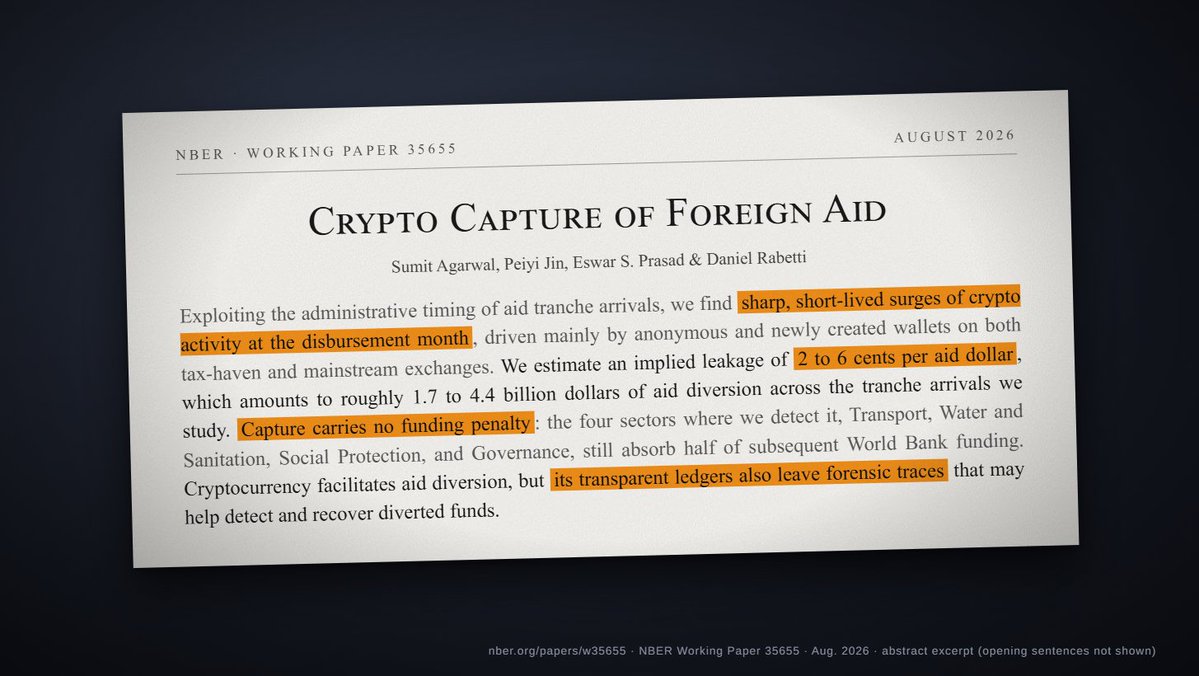
A new NBER paper found that when World Bank aid lands, new bitcoin wallets light up. Two to six cents of every aid dollar.
The crowd's conclusion: bitcoin is how they steal aid.
Except the World Bank's own researchers found the same pattern back in 2020, in offshore bank accounts in places like Zurich. Around 7.5% of aid to the most aid-dependent countries.
The thieves didn't change. The vault did. And this vault keeps a public receipt.
The line nobody's quoting is from the paper itself: "Capture carries no funding penalty." The sectors where they caught it still got half of the next round of World Bank money.
The leak isn't the scandal. The refill is.
Bitcoin has a birth certificate, and it's a bailout.
Eighteen years ago today, on October 3, 2008, Public Law 110-343 gave the Treasury Secretary authority to buy up to $700 billion of troubled assets from banks, "on such terms and conditions as are determined by the Secretary."
That's the clause. Not Congress. Not you. The Secretary.
The House had voted it down four days earlier. It passed anyway, and your taxes stood behind it.
28 days later, Satoshi published the white paper. 92 days later, block 0 locked a newspaper headline into the chain forever: "Chancellor on brink of second bailout for banks."
The rescues never really stopped. They just stopped making headlines.
Bitcoin is the money whose terms no Secretary gets to determine.
10/5/2026, 1 engagement
HODL Got Us Here, Now It's Holding Us Back w/ Kyle Huber https://t.co/oVRsc2HjCW
A new NBER paper found that when World Bank aid lands, new bitcoin wallets light up. Two to six cents of every aid dollar.
The crowd's conclusion: bitcoin is how they steal aid.
Except the World Bank's own researchers found the same pattern back in 2020, in offshore bank accounts in places like Zurich. Around 7.5% of aid to the most aid-dependent countries.
The thieves didn't change. The vault did. And this vault keeps a public receipt.
The line nobody's quoting is from the paper itself: "Capture carries no funding penalty." The sectors where they caught it still got half of the next round of World Bank money.
The leak isn't the scandal. The refill is.
HODL Got Us Here, Now It's Holding Us Back w/ Kyle Huber https://t.co/oVRsc2HjCW
Hmmm. Let's see... @grok Create a pie chart of what our X content consists of, but deliver it in the form of a video of a cabaret dance staring our CEO @adamobrien and make the pie chart in the video using our company's branding colors and style.
Judy Shelton, a longtime sound-money economist, just joined the Treasury as Counselor to the Secretary.
Her big idea, from a column last October: a U.S. Treasury bond you can convert to gold when it matures. Not the whole national debt backed by gold. One bond that pays in metal, so the dollar finally has a benchmark nobody can inflate away.
It's a good instinct. It's also been tried.
During World War I, the Treasury sold Liberty Bonds that promised repayment in gold coin. In April 1933, Americans were ordered to turn in their gold. That June, Congress voided every gold clause in the country, including the ones on its own bonds. The next year, gold was repriced from $20.67 to $35.
Then in 1971, the dollar's last link to gold was suspended. "Temporarily."
Now why would we trust the government to keep any of these promises?
Well, we shouldn't. Which is why we just keep stacking bitcoin.

10/5/2026, 2 engagements
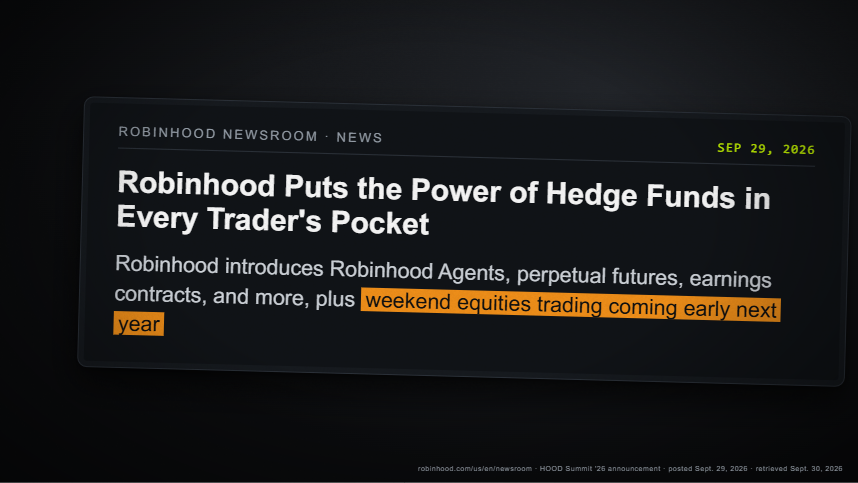
Robinhood just announced weekend stock trading. Coming early next year.
Bitcoin has traded every weekend since January 2009.
10/5/2026, 1 engagement
30 minutes.
@thekylehuber is about to argue that HODL is holding bitcoin back.
Drop your best case for never spending a single sat below. We'll put the best one to him live.
The Deep Dive, 2 PM ET. Link below.

9/29/2026, 4 engagements
When's the last time you actually spent bitcoin?
Not sold. Spent. A coffee, a hotel room, a haircut.
Today at 2 PM ET on The Deep Dive, @thekylehuber makes the case that HODL, the meme that carried us through 80% and 90% drawdowns, is now the biggest thing standing between bitcoin and its next wave of adoption.
He's spent bitcoin from Kenya to Bulgaria. Bring your best case for "never sell."
Link below.

9/29/2026, 5 engagements
Today Washington offered to release Iran's frozen funds in return for concrete nuclear steps, U.S. officials told Axios.
The same morning, Tether announced it has frozen about $550 million in Iran-linked USD₮ this year.
Two headlines. One lesson, and it isn't about Iran.
In 2023, $6 billion of Iran's oil money was unlocked as part of a prisoner swap. That October, after the Hamas attack, the U.S. and Qatar agreed to hold it back.
Frozen, unfrozen, frozen again.
A balance someone else can freeze isn't yours. It's a bargaining chip, and it belongs to whoever holds the switch. A treasury, a bank, a stablecoin issuer.
Bitcoin in your own wallet is the one balance nobody can put on the negotiating table.

9/28/2026, 12 engagements
HODL is the greatest meme in bitcoin history.
It got us through 80% drawdowns. It kept the network alive when nobody else would hold it.
It might also be what's holding bitcoin back now.
Tomorrow on The Deep Dive, @thekylehuber makes the case. He's spent bitcoin around the world and filmed the people living on it, from Kenya to Bulgaria. His line: bitcoin doesn't need more spectators, it needs participants.
Come ready to have your HODL conviction stress-tested.
Tuesday (tomorrow), 2 PM ET. Link below.

9/28/2026, 1 engagement
Your Bitcoin IRA Is Not a Get-Out-of-Jail-Free Card https://t.co/Bo3VtLwfis
Tuesday the Senate voted 49 to 50 on the rules for the companies that hold people's coins. The bill stalled. By Thursday the CFTC had reportedly sent its own rulebook to the White House for review.
In Washington a no vote doesn't stop the rules. It changes who writes them.
Bitcoin's rules were published in 2008 and have never needed a vote, a chairman or a review. You can read them tonight.

9/21/2026, 2 engagements
At 11:20 this morning the Governor of the Bank of Canada speaks in Halifax. On September 16 the Bank wrote that Canadians "can continue to count on price stability."
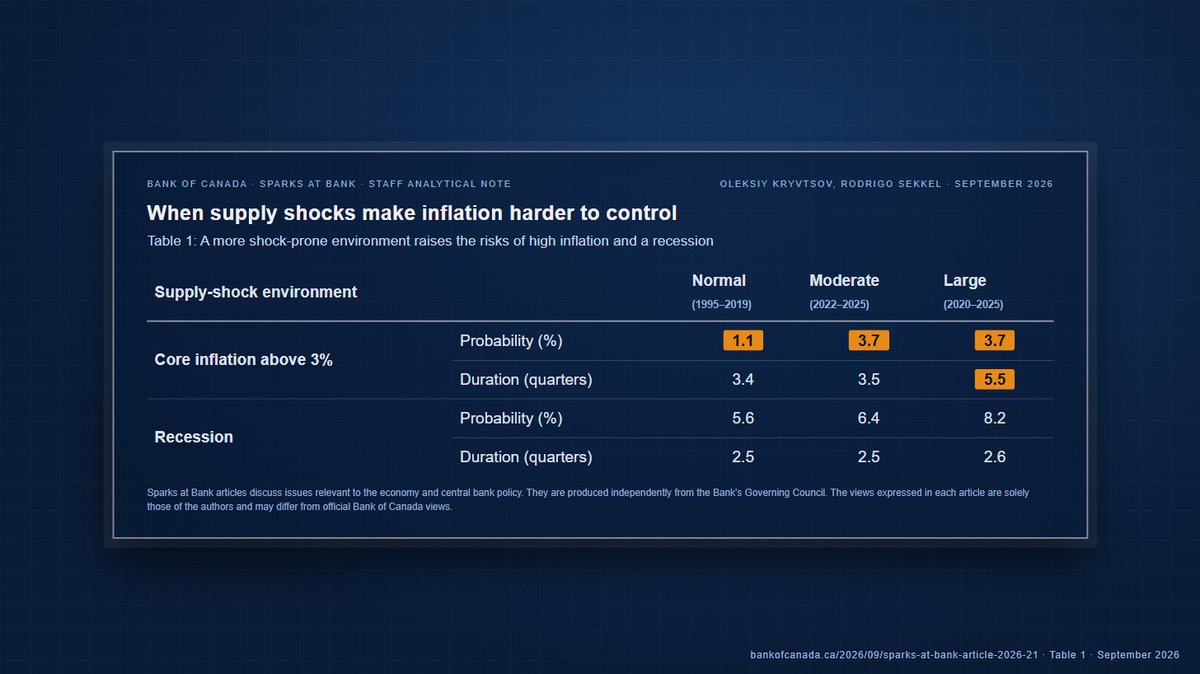
Five days earlier the Bank's own researchers published a table. In a shock-prone world like the one they say we're in, the odds that core inflation runs above 3% more than triple, from 1.1% to 3.7%, and it stays there five quarters instead of three.
The promise and the probability were published by the same building, a week apart.
Your dollar doesn't get to count on the promise. Only the probability.
On August 15, 1971, a Sunday night, the President of the United States went on television and told you what your money was going to be from now on.
"I have directed Secretary Connally to suspend temporarily the convertibility of the dollar into gold."
Then, to the people watching: "your dollar will be worth just as much tomorrow as it is today."
Temporarily has lasted 55 years and one month. Nobody voted on it. Gold was $35 an ounce that night. Bitcoin was 38 years away.
Since that speech the dollar has lost roughly 88 cents of every dollar of purchasing power. The people who wrote the speech called that "laying to rest the bugaboo of what is called devaluation." That sentence is in the transcript too.
Every fiat currency you can hold has a sentence like this somewhere in its past: a night when a man in an office decided what it was, and a promise that you wouldn't notice. Bitcoin's supply schedule has no office, no man, and no night. It has a number, and you can check it yourself.

9/20/2026, 4 engagements
what was the moment you decided to take your bitcoin off the exchange for the first time?
9/19/2026, 3 engagements
Julian Assange is back on twitter... I mean X. Here's the part of his story that belongs to anyone holding bitcoin.
December 2010. WikiLeaks had just published a quarter of a million U.S. diplomatic cables, and Washington was furious. So the money got cut off. Not by a judge. By the payment companies. Over the next two weeks PayPal, MasterCard, Visa and Bank of America each announced they would no longer process donations to WikiLeaks. No charge had been filed against the publisher. No court had ordered anything. A senator made some phone calls, the companies pointed at their terms of service, and a publisher's income disappeared in 14 days.
Someone on a forum suggested WikiLeaks take bitcoin instead. Bitcoin's creator said no. On December 11, 2010, Satoshi Nakamoto wrote: "WikiLeaks has kicked the hornet's nest, and the swarm is headed towards us." Within days he stopped posting in public. He never came back.
WikiLeaks started taking bitcoin in 2011 anyway. In 2017 @JulianAssange thanked the U.S. government for the blockade: it had "caused us to invest in Bitcoin -- with > 50000% return."
The swarm came. The network is still here. The companies that flipped the switch on a publisher can flip it on you, and they don't need a judge to do it. The one payment rail that never had a switch is the one Satoshi was afraid to test.

Even nation states can't use the gold they supposedly own.
Venezuela 'owns' 31 tonnes of gold. For almost eight years it couldn't have it.
The gold sat in the Bank of England while London's courts decided who the owner was. Today the FT reports it's moving to the New York Fed. Under the deal, Venezuela still can't sell it. It can borrow against it.
A country with an army, a central bank and a seat at the UN needed two governments' permission to touch its own gold, and got a loan instead.
Bitcoin collapses ownership and possession into one thing. Whoever holds the key has the coins, and there's no appeal.

9/18/2026, 59 engagements
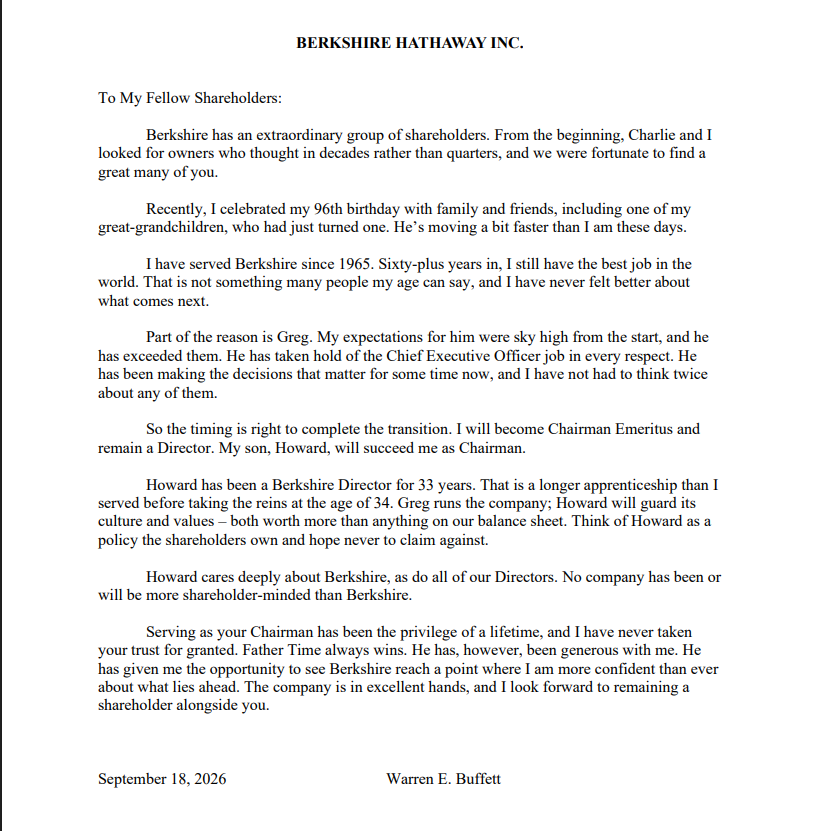
Warren Buffett stepped down as Berkshire chairman this morning. I'll be honest: I barely know the man. I know he called Bitcoin "rat poison squared" in 2018, and that was about it.
Give him his due. Sixty-one years, one company, and a letter today about "owners who thought in decades rather than quarters." That's a nod to low time preference and he's right about that. He played the game in front of him better than anyone alive.
But look at the game. Cheap credit, a Fed backstop, a dollar that shrank for everyone holding it and rewarded everyone holding assets. He didn't build that. He was very good at living inside it.
Bitcoin was written to fix the thing his fortune sat on. Of course it looked like poison to him because it would turn the mechanism that made him his fortune on its head.
Respect for the player, but we're here to end the game.

9/18/2026, 4 engagements
What She Couldn't Freeze: Chrystia Freeland, the Rhodes Trust and the Money the State Couldn't Reach
"Carrying unlimited risk for limited revenue is no longer a rational choice."
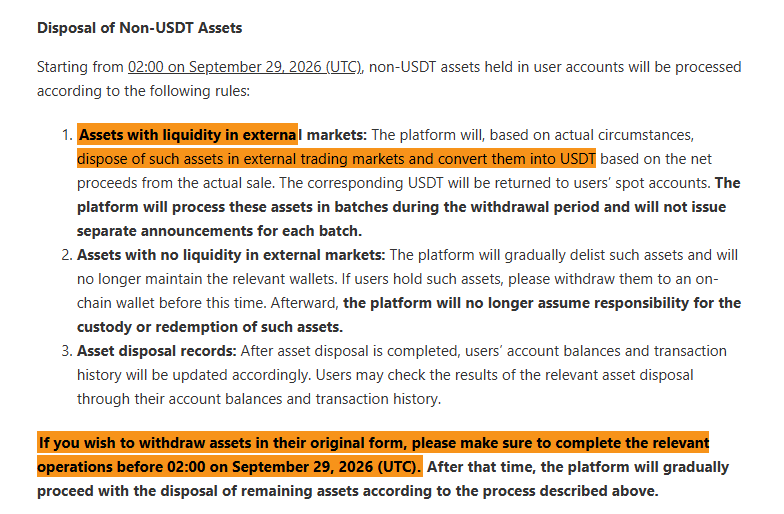
That's the founder of CoinEx, closing his exchange after nine years, with reserves above 100% and withdrawals open until December 22. It's the good version of an exchange shutting down.
Holding other people's coins is unlimited liability. Every hack, every fake government request, every regulator in every country lands on the company holding the keys. He did the math and left.
The same math applies from your side of the counter. If the risk of holding your bitcoin is too much for the exchange, it was always too much for you to leave there.
Meetings about your money this week:
Mon: 18 attorneys general write to the Senate about it.
Tue, 2:15 PM: the Senate votes on whether to proceed on it.
Wed, 2:00 PM: the Federal Reserve sets the price of it.
Meetings about bitcoin this week: none.
Block 967019 arrived on schedule while you read this.

Meetings about your money this week:
Mon: 18 attorneys general write to the Senate about it.
Tue, 2:15 PM: the Senate votes on whether to proceed on it.
Wed, 2:00 PM: the Federal Reserve sets the price of it.
Meetings about bitcoin this week: none.
Block 967023 arrived on schedule while you read this.

The Bitcoin Well IRA Is Coming: Real Bitcoin, in the Account the IRS Can't Touch
9/14/2026, 1 engagement
9/14/2026
Real bitcoin is coming to your retirement account. The Bitcoin Well IRA launches this fall for American customers, with Traditional and Roth accounts administered by Heritage IRA, custody by BitGo, an
Both sides of the Clarity Act fight agree on one thing: your money should stay with somebody else.
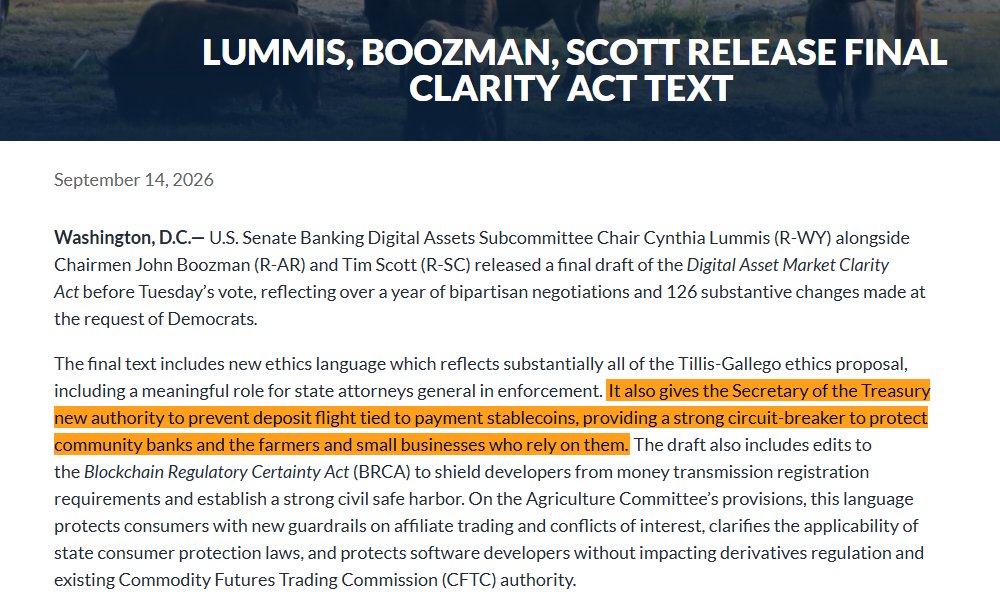
The banks spent August asking senators to close the stablecoin "yield loophole." The exchanges wanted rewards left alone. Sunday night the bill's sponsors split it with a switch. From their own summary: if the Treasury Secretary makes "a written determination that deposit flight is occurring from community banks on a substantial scale," the Secretary "is directed to promulgate rules restricting stablecoin rewards." For the first 18 months of the law, people leaving their bank is an event Washington slows down.
Credit where it's due: the same text keeps software developers, miners and validators out of money-transmitter law. Real win.
Now read the fight again. One side wants your dollars in a bank. The other wants them in a stablecoin, an IOU from a company holding Treasuries. Either way somebody else holds it, and somebody in Washington can reach it. Nobody in the room argued for your right to leave.
There's one exit that needs no vote and no written finding.
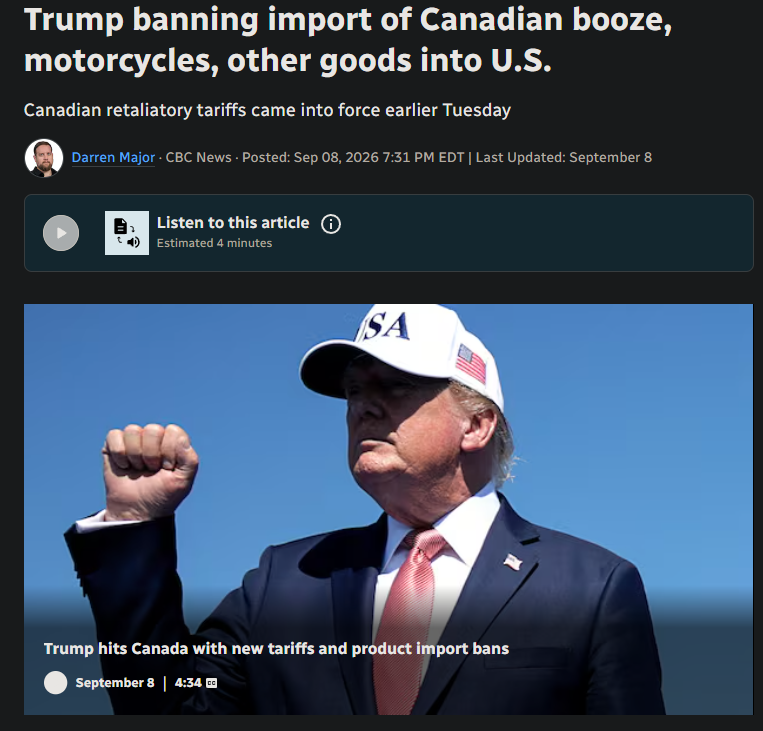
On September 8 Ottawa put a 50% tax on American cheese, appliances and clothing coming into Canada.
By that night Washington had answered. From September 29, Canadian whisky, wine, beer, whey and motorcycles may not enter the United States at all. Not taxed. Refused. The legal authority is a section of a 1930 tariff law that had never been used.
The Prime Minister says the goal is "ensuring that no country can hold us hostage."
Right goal. It applies to people too. Your dollar now buys what two governments allow, at prices two governments set, and the list changed twice in one day.
There is one thing on the shelf that neither capital gets a vote on. It crosses the border in your head.
9/13/2026, 2 engagements
The Federal Reserve wrote down a target for how fast your dollar should lose value. The date on the page is January 25, 2012.
Before that there was no number. The law told the Fed to pursue "stable prices" and for decades nobody wrote down what that meant. Then, on a Wednesday afternoon, a committee decided stable meant "inflation at the rate of 2 percent," published it, and promised to reaffirm it every January.
Two percent a year halves your money in about 35 years. That is the plan when everything goes right.
Since that page went up, the dollar has lost about a third of its purchasing power. The target was 2. The result has been closer to 3 than 2. The same committee meets again on Wednesday to set the rate for the year ahead, and nobody outside the room gets a vote.
A target for losing value is still a policy of losing value. It just has a number on it now.
Bitcoin's issuance schedule was also written down, in 2008. It has been hit every year since, and nobody has ever had to meet.

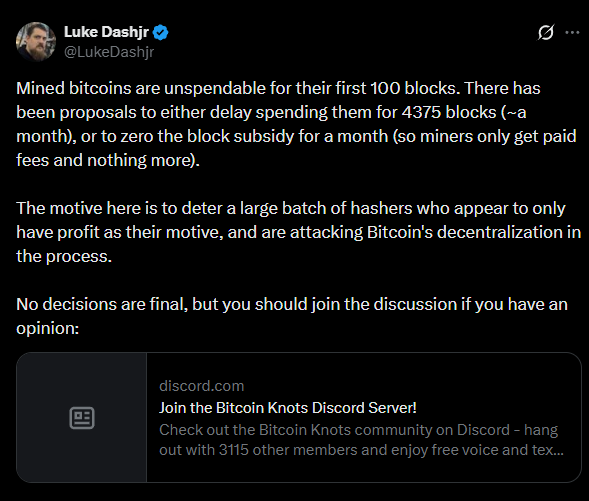
On Wednesday a committee at the Federal Reserve will vote on the price of your money. Markets put the odds of a hike near 80%.
On Thursday a developer on a Bitcoin fork floated pausing that chain's new coin issuance for a month, to push back on miners he says are there only for the fees. A month of new coins, held back by decision.
And it isn't surprising. The BIP-110 coin exists because its developers changed Bitcoin's rules once to create it. When the chain stalled in August, they changed the rules again to get it moving. A third change to discipline the miners follows logically from the first two, and there will be a fourth. The moment a money's rules bend for one good reason, it has a process for bending, and every future reason will find that process. That is the entire history of the dollar: not one bad decision, but a precedent, then a committee, then a calendar of meetings.
Which is why Bitcoin has the best defence ever built against people who need to be in charge of the money.
It lets them. Anyone who wants to bend the rules can take their ball and go home. Copy the code, change what you like, go play with your friends. Bitcoin doesn't stop you and it doesn't follow you. It stays exactly where it was, running the same rules it ran in 2009, for everyone who didn't leave.
The dollar has no exit like that. Its control freaks stay in the building.
The people who most want to change Bitcoin end up holding something else.
In 1992 the U.S. State Department told a Berkeley math student that his encryption code was a weapon.
Not a figure of speech. A letter, dated August 20, 1992, from the Office of Defense Trade Controls: Daniel Bernstein's algorithm was "designated as a defense article under U.S. Munitions List Category XIII(b)(1)." The same list as bombs. Using it at home was legal. Posting it where a foreigner could read it was arms trafficking, and the State Department told him not to bother applying for a licence, because the code was too secure to approve.
He sued in 1995. In April 1996 a federal judge ruled that source code is speech. In 1999 the appeals court agreed, and the export rules came down.
Every bitcoin key you hold is protected by the class of math that Washington classified as a munition within living memory. It didn't become legal to share because the government changed its mind. It became legal because one graduate student refused to register as an arms dealer.
The next time someone tells you self-custody is paranoid, remember that the official position, not long ago, was that the tools for it should not be allowed to leave the country.


9/12/2026, 4 engagements
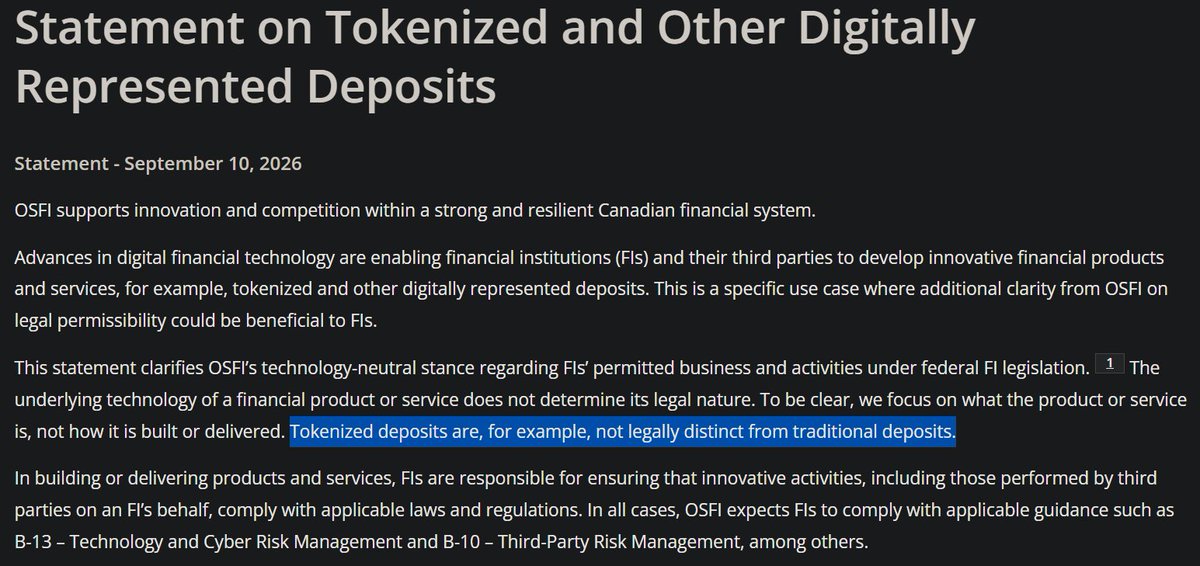
Canada's bank regulator, yesterday: "Tokenized deposits are, for example, not legally distinct from traditional deposits."
Correct. A deposit is money the bank owes you. Put that IOU on a blockchain and it is still the same IOU controlled by a third party. It just gains the buzzword "blockchain" for marketing purposes.
Bitcoin at an address you control is the one thing on the list that nobody owes you because you truly own it yourself.
9/11/2026, 1 engagement
The Rabbit Hole Has an Exit: 25 Years of 9/11, a Lifetime of Psyops, and Why I Ended Up in Bitcoin
9/11/2026
Zachary Addair traces his path from questioning 9/11 and opposing war to holding his own bitcoin keys. His argument: you do not need to settle every historical dispute to choose money governments cann
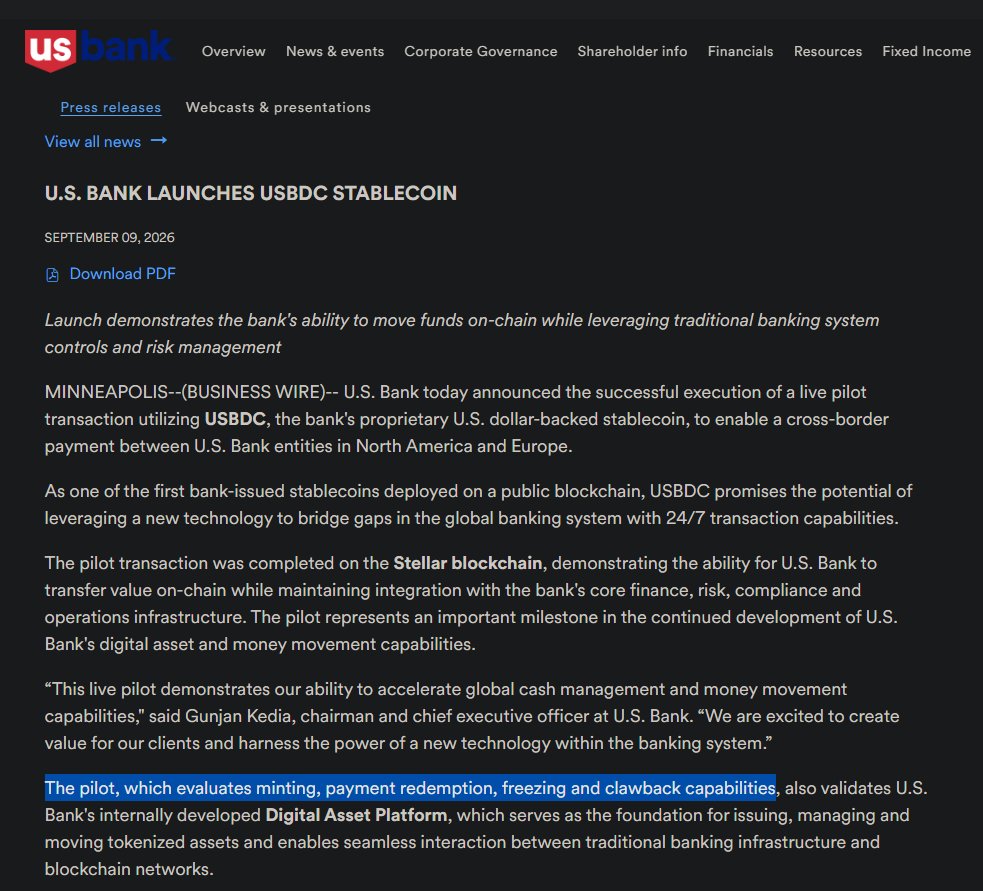
Two headlines from the last 24 hours.
Washington is talking about mailing every adult $5,000.
U.S. Bank tested a dollar it can freeze and claw back.
Money that can be promised from a stage and pulled back by a bank is the money your retirement account is denominated in. Every fund in it. Every bond.
This fall the Bitcoin Well IRA lets Americans hold real bitcoin inside a Traditional or Roth IRA. Not a fund that holds a company that holds bitcoin. Actual coins, at an address you can check on-chain, any day you feel like checking.
Three companies, one job each. We source the bitcoin. Heritage IRA administers the account. BitGo holds the coins in qualified custody.
If a $5,000 check ever lands, you'll already know where the money nobody can print more of lives.
Waitlist in the comments.
9/10/2026, 1 engagement
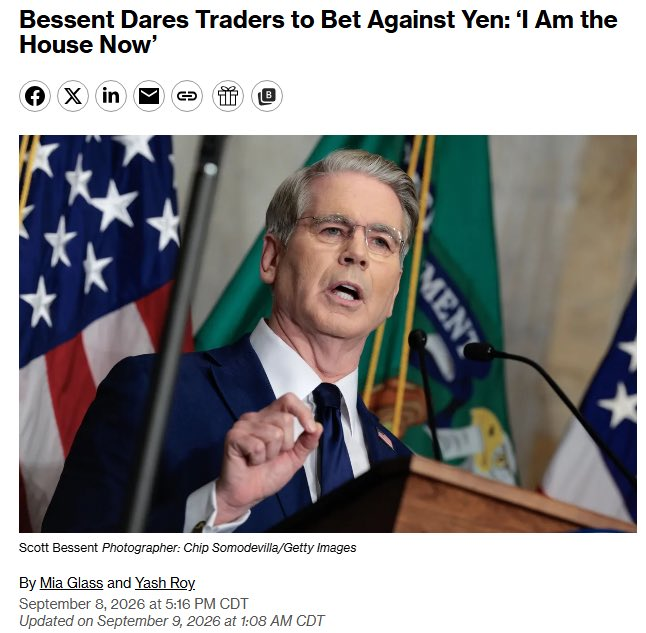
"I am the house now."
That was the US Treasury Secretary yesterday, daring traders to bet against the yen. In 1992 Scott Bessent was 29 years old and helped George Soros break the Bank of England for $1,000,000,000. He knows exactly what he is saying.
Here is what the house has been doing. The yen fell to 164 per dollar in July, its weakest in nearly four decades. Japan spent the equivalent of $98,600,000,000 in four weeks buying it back, the largest intervention on record, with the US Treasury joining in for the first time since 1998. To pay for it, Japan sold $87,800,000,000 of foreign bonds in August, and Japan's foreign bonds are mostly US Treasuries. Japan is America's largest foreign lender.
So America helped Japan sell America's debt to prop up Japan's money, then doubled its own bond buybacks to undo what that selling did to America's borrowing costs.
Every fiat currency is backed by another fiat promise. The yen by Treasuries, Treasuries by the dollar, the dollar by Japan agreeing to keep holding Treasuries. Pull one and the rest have to move.
The house always wins because the house writes the rules and can rewrite them mid-hand. Until the day everyone at the table notices the emperor has no clothes.
Bitcoin is the one table with no house. The rules are the rules, and nobody, not even a Treasury Secretary, sits on the other side of them.
9/9/2026, 2 engagements
Bitcoin Didn't Break. The $320M Shortcut Built on Top of It Did. https://t.co/zbOm4S4pLm
Happy Labour Day. Here is what a year of labour bought the average Canadian worker.
Statistics Canada, Friday: average hourly wages up 2.0% over the year, to $37.02.
Bank of Canada, Wednesday: prices "hovering around 3%."
Paid more. Bought less. A raise and a pay cut in the same envelope, in the Bank's own numbers.
You can negotiate your wage. You cannot negotiate the unit it is paid in. That gets decided at a meeting you were not invited to.
Bitcoin is the one thing you can be paid in whose rules were fixed before you were hired.

9/7/2026, 4 engagements
On April 5, 1933, it became a federal crime for an American to hold their own gold.
Executive Order 6102. Every person was ordered to deliver their gold coins, gold bars and gold certificates to a Federal Reserve bank by May 1. The government paid $20.67 an ounce. The penalty for keeping it: up to $10,000 in fines, up to ten years in prison, or both. (You were allowed to keep $100 worth. About five ounces.)
The following January, the Gold Reserve Act reset the price to $35 an ounce. The same gold, now in government vaults, was worth 69% more. The people who handed it in got none of the difference.
Nobody broke in. Nobody picked a lock. The confiscation was a form and a poster at the post office, and it worked because gold has to sit somewhere, and somewhere can be searched.
The order's title didn't say confiscation. It said "hoarding." Your savings became hoarding the day the government wanted them.
That is the whole case for money you can carry in your head. Twelve words, memorized, cannot be delivered to a Federal Reserve bank by May 1.

9/6/2026, 2 engagements
The idea behind every bitcoin key you own was rejected as a homework assignment.
Fall 1974. Ralph Merkle, an undergraduate at Berkeley, submits a project proposal for his computer security course: a way for two strangers to agree on a secret over a wire anyone can listen to. The professor turns it down. Merkle rewrites it shorter, resubmits, gets it back with notes in the margin, and drops the course.
He keeps working on it anyway. In August 1975 he sends the paper to the Communications of the ACM. The anonymous reviewer's verdict: "not in the main stream of present cryptography thinking." It took almost three years to get published. By then the world had named it: public key cryptography.
He wasn't done. In 1979 he worked out how to fold thousands of records into one fingerprint you can check in seconds. Bitcoin calls it the Merkle root. There is one in the header of every block.
You see, the experts weren't lying. They were describing the mainstream, accurately. The mainstream was wrong.
Bitcoin is built almost entirely out of ideas that were turned down first. That should make you more comfortable holding it, not less.


9/5/2026, 1 engagement
A Hard Month for Bitcoin Security, a Steady One for Bitcoin Well: Our August 2026 Update
Conbase @coinbase launched bitcoin trading in Canada yesterday. To use it you need $5,000,000 in financial assets, not counting your house. And you never receive a bitcoin.
It is 23 contracts that pay out in dollars, with up to 10x borrowed money, run by Coinbase's US futures arm. Not one coin moves. You cannot withdraw a bitcoin from it because there are none in it.
These contracts are a claim on Coinbase. A coin in your wallet is bitcoin. Only one of them can actually be yours.

Saylor Just Broke His Months-Long Bitcoin Buying Pause https://t.co/6Cjc3B2Yij
9/2/2026, 2 engagements
The list is a weapon
9/1/2026, 1 engagement
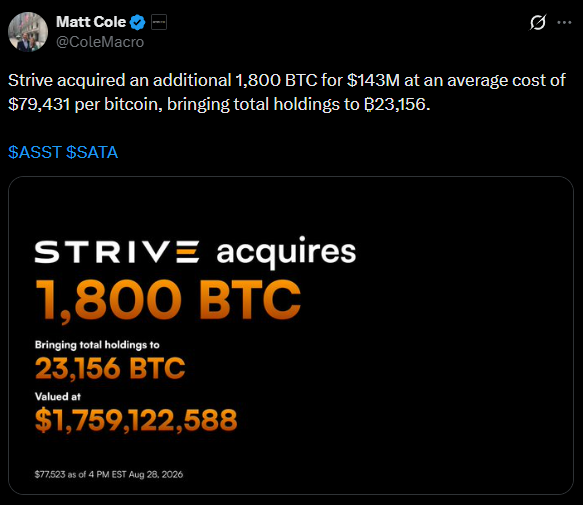
Strive, of @ColeMacro, added 1,800 bitcoin last week and is now the fifth largest publicly traded company holding it. 23,156 coins.
Fifth place. On the whole planet. Among every listed company there is.
That is about one tenth of one percent of all the bitcoin that will ever exist.
Strategy is the outlier up top at 845,050 coins, a little over 4%. Everyone else in the top five holds a fraction of a percent.
Congratulations to the Strive team, genuinely.
And for everyone reading it as a headline about institutions absorbing the supply: fifth place on this planet is a tenth of a percent. The field is far emptier than it sounds.
Coins in a wallet you control put you on the same board they are on.
Gold just had its worst quarter since 2013.
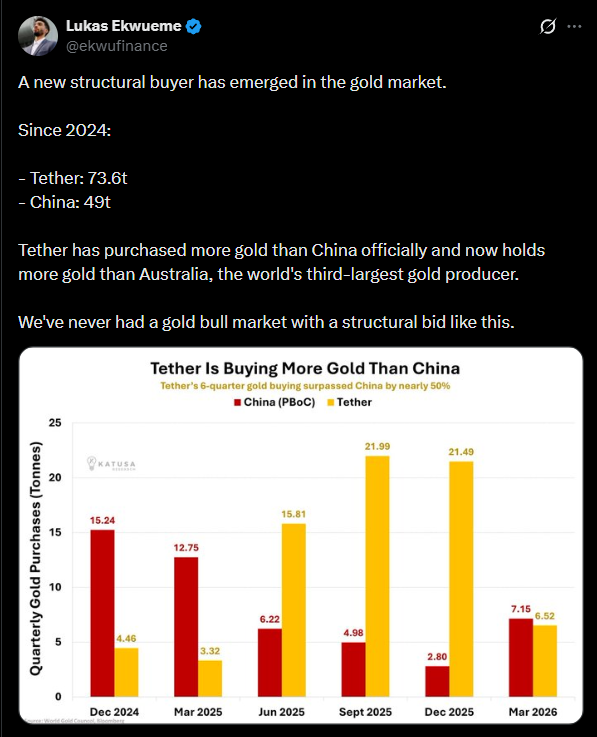
Tether bought 14 more tonnes into it. The pile now runs past 146 tonnes, roughly double what Australia's central bank holds.
The largest issuer of digital dollars on earth spent a falling market accumulating the one money that has never had an issuer.
You can read that as a trade or as a tell. Either way, the version of it available to you needs no vault, no attestation and no quarterly report from an accounting firm. Buy spot bitcoin and take it off the exchange yourself.
8/31/2026, 1 engagement
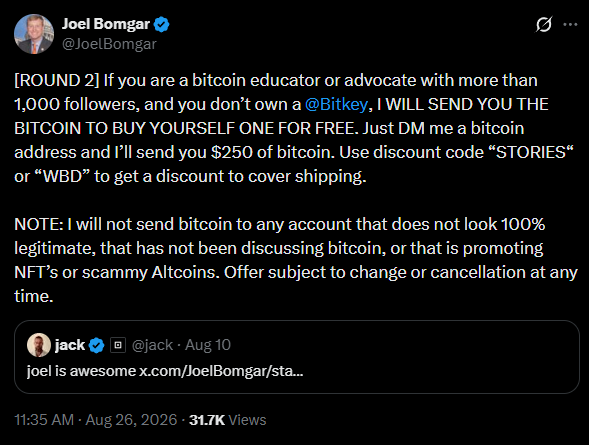
Somebody on X is paying strangers to stop trusting him.
@JoelBomgar is sending $250 of his own bitcoin to Bitcoin educators who do not yet own a hardware wallet, so they can go and buy one. No affiliate link. Nothing of his to sell.
Most of what passes for Bitcoin marketing is a company asking to hold your coins for you. Every so often you get the opposite, and it is worth naming when you see it.
8/29/2026, 2 engagements
The Treasury Secretary published a letter Thursday defending a currency operation. Buried inside the defence is one of the clearest descriptions of the system you will read this year.
His words: Treasury "exchanged existing Exchange Stabilization Fund foreign-currency assets for yen," and "no new congressional appropriation was involved." He notes the same fund was used to steady Argentina. He cites the statute it runs on, Section 5302, which he says lets the Secretary deal in foreign exchange with presidential approval.
Read it as a defence and it is a good one. Nothing was printed. No loan was made. It is legal, and the statute is right there in the footnote.
Now read it again as a description.
There is a pool of money at the Treasury deep enough to steady the yen and steady the peso, and moving it takes one Secretary and one President. Not a vote. Not a debate. No approval from you (and its really your money).
The statute has one more line in it that he didn't need to quote. Decisions of the Secretary on that fund are final, and may not be reviewed by another officer or employee of the Government.
The argument in Washington this week is about whether that power was used wisely. Nobody in the argument is asking whether it should exist.
You cannot vote that fund out of existence. but you CAN decline to keep your savings inside its blast radius.
Buy spot bitcoin. Take custody of it.

8/29/2026, 3 engagements
The Fed chair gave a speech this morning and announced nothing.
He said the economy "appears to have strengthened." He said financial conditions are "hard to describe as restrictive." He said the 2% target is "firm and fixed," and that if inflation is not moving there clearly and fast enough, "we have work to do."
No policy changed. No vote was taken. Nothing was built and nothing was destroyed. And the price of nearly everything you own moved in both directions inside a few hours, on tone.
That is the actual machine. The purchasing power of your savings is a function of how a small group of people choose to describe the economy on a random Friday.
Bitcoin's issuance schedule had no comment today. It has never had one.
Buy spot bitcoin, move it into your own custody, and let the adjectives land on somebody else's balance sheet.

8/28/2026, 3 engagements
Our CEO Adam O'Brien is live now talking about privacy and the debanking problem!
8/28/2026, 2 engagements
"Running bitcoin."
Two words, posted at 10:33 PM on January 10, 2009. No thread, no explanation. Hal Finney had downloaded the software on the day it appeared and switched it on, which at that moment put him among a tiny handful of machines anywhere keeping the network alive.
Hal died twelve years ago today.
He gets remembered as the first person to receive bitcoin, 10 coins from Satoshi two days after that post. That is true, but it's the smallest thing he did.
In 2004, four years before the whitepaper existed, he built RPOW. Reusable proofs of work. A system for turning proof of work into a token you could hand to somebody else, who could then hand it on again.
In August 2009 he was diagnosed with ALS. He kept writing code. When his hands stopped cooperating he wrote it with eye-tracking software, one letter at a time, and he was still working on Bitcoin years after most people would have been forgiven for putting it down.
None of that is the story of a recipient. All of it is the story of someone who did the work.
And the work is not finished. Nodes still need running. Code still needs reviewing. There are still people in your life who have never been shown how to hold their own coins, and nobody is going to show them if you don't.
Bitcoin has never once maintained itself. It runs because people decide to run it.
You can start running bitcoin tonight.

8/28/2026, 4 engagements
This week, @Core_LN is telling node operators to patch their code. Not to shut anything down.
The Core Lightning maintainers have spent two weeks hand-checking a flood of machine-generated vulnerability reports.
"Like many open source Bitcoin projects, CLN has received a number of AI-generated CVE reports from multiple sources over the past 10 days."
Watch what it did to curl, the small piece of software running quietly inside almost every device you own. curl ran a bug bounty from 2019, paid out more than $90,000 for 81 real vulnerabilities, and shut the program down in February. Its confirmed-vulnerability rate fell from roughly 15% to under 5%. In June the maintainers announced they would not read a single security report for the whole of July. The Internet Bug Bounty had already paused new submissions in March for the same reason.
Now the other half of the year. On January 27 OpenSSL shipped a patch for 12 zero-days, bugs nobody had ever reported, and an AI system found every one of them. Three had been sitting in that code since the late 1990s, through millions of CPU-hours of fuzzing, Google's included.
Both sides of security picked up the same new tools at the same time, and only one of those sides has to publish, get reviewed and be right.
That is now pointed at Bitcoin. Wallets, nodes, Lightning implementations, signing devices, most of it maintained by small teams and unpaid contributors. And Bitcoin is the one system with no database to quietly edit afterwards.
Our read is that the next twelve months put Bitcoin's stack through the hardest audit money has ever been given, and that plenty of it looks alarming while it happens. Twelve zero-days was not OpenSSL failing. It was OpenSSL getting harder in an afternoon.
Patch your node this week. That is the small job.
The big one is already running.

8/27/2026, 3 engagements
Two weeks ago the price of bitcoin was beyond boring.
VanEck's mid-August numbers, published August 18, showed realized volatility at 27.2% against a long-run average near 80%.
Spot volume in the 10th percentile of its entire history. Eight of twelve capitulation signals firing. Long-term holders had just sold 356,000 coins into the weakness.
Then August 19. Treasury scales up its bond buybacks. $2.99 billion of positions get liquidated, $2.6 billion of them short. And in that same window spot ETFs take in $2.88 billion, which is 88% of the week's flow, per CoinMarketCap.
$63,549 on August 11. $81,235 on August 25.
When almost nothing is for sale, every dollar of buying has to climb further up the order book to find a seller. A thin market does not absorb demand. It reprices against it. That is why $2.88 billion took this one up 28% in two weeks.
Treasury liquidity policy. Forced buying from liquidated shorts. Voluntary spot demand through the ETFs. Three separate engines, and not one of them needed the other two to fire.
That is the part that's new. For most of bitcoin's history these showed up one at a time, with months in between for the market to digest each one.
And the amount available keeps shrinking. The mortgages Coinbase and Better switched on this morning lock $250,000 of pledged coins against a $100,000 down payment until the loan is repaid. Every one of those written is supply leaving the market for years.
More weeks are going to look like this one, and sharper than anything before the ETFs existed.
$2.6 billion of leverage got closed by somebody else last Wednesday. The best way to enjoy price action like we saw last week is with coins you hold in your own wallet.

8/26/2026, 1 engagement
Bitcoin Just Pumped $15K and Almost Nobody Told the Real Story https://t.co/N8FStTiqMh
Is Bitcoin Mining Being Quietly Captured? https://t.co/xCUex8ZYgv
I dug my old Ledger out of a drawer this morning. Hadn't touched it in years. The screen is so faded I could barely make out the characters.
So the thing going around yesterday is true. The screen on the Ledger Nano S fades with age. Nothing gets hacked and nothing gets tampered with, an old display just goes too faint to read. @janrothen posted about it and is past 189,000 views. Nick Neuman at Casa said the same thing five days earlier, and the two of them independently landed on the same workaround.
Point your phone camera at the device and read the screen off your phone instead. A camera sensor gathers far more light than your eye does and holds it longer, so a display that looks blank to you comes back sharp in your hand. Dim the room, get close, pinch to zoom.
Now notice what a faded screen is not. Your bitcoin was never on that device and could not have been. It is a record on Bitcoin's ledger, and thousands of machines are holding a copy of it right now. The device signs. It does not store.
A faded screen is not a lost balance so much as it is an annoyance if you backed up your seed phrase.
Go make sure you can still read your ledger and move your seed to a new device when you get a chance. No rush.

8/26/2026, 1 engagement
"Every basis point of artificial yield suppression is a subsidy to procrastination."
Stanley Druckenmiller wrote that in a Wall Street Journal op-ed on Monday, about the Treasury's plan to at least double long-end bond buybacks to $4 billion per operation. He called the plan a mistake. He called it price management rather than liquidity management. He pointed out there was no liquidity freeze to justify it.
The timeline is arguing about CTA positioning and short squeezes. Meanwhile the man has published Austrian interest theory on the WSJ opinion page.
An interest rate is the price of waiting. Push it down by hand and the thing you have subsidised is the decision to do the hard thing later. Mises spent a career on that mechanism. He called it time preference.
Here is the part worth holding onto. The 30-year touched 5.337% on August 18, a level last seen in 2007. The plan was announced the next day and took it to 5.196%. It has not stayed there, and the first operation does not run until September 9. Nothing has been bought yet.
There is no basis point to manage on bitcoin already sitting in your own wallet. Hold spot.
8/25/2026, 1 engagement
We just restocked the rewards store, and three of the things you can redeem points for are hardware wallets.
Blockstream Jade Core at 34,000. Jade Plus Link at 85,000. Bitkey at 109,000.
Most loyalty programs reward you with credit to spend more with the company. Ours hands you the device you use to take your bitcoin off our platform entirely. We know how that sounds. We did it on purpose.
Also in there: Broken Money, The Bitcoin Standard and The Price of Tomorrow, so you can earn the argument and the hardware in the same week. A steel seed plate for 7,000. Shirts, a hoodie, sunglasses, a Leatherman.
And a Cybertruck for 69,000,000 points. Somebody is going to try.
The Wishing Well still pays sats straight to your Lightning wallet. And the new referral program earns you points every time someone you brought in buys or sells bitcoin.
Buy bitcoin. Earn points. Redeem the thing that lets you leave.


8/25/2026, 1 engagement
The person who named the cypherpunks is the one nobody can name.
Judith Milhon called herself St. Jude. She was a self-taught programmer in Berkeley, and in the early 1990s she coined the word cypherpunk, stitching together cyberpunk and cipher. It was in print within months. Every person who has ever used the word is quoting her.
Twenty years before that, in 1973, she helped build Community Memory. A public terminal in a Berkeley record store that anyone could walk up to and post on. No account, no permission, no gatekeeper deciding whose message counted.
She died in 2003, five years before the white paper.
She never saw a block get mined but she lived life on her own terms and would have made a killer Bitcoiner.

8/23/2026, 2 engagements
Saturday question.
What was the first thing you ever actually bought with bitcoin? Not traded. Bought.
Mine was a bottle of wine at the corner store using a Bitcoin debit card in 2018. Of course the person behind the counter had no idea.
8/22/2026, 2 engagements
Over the last twelve months your Canadian dollar gained 0.44% against the US dollar.
Over the same twelve months, Canadian prices rose 3.0%.
Both numbers are official. One is from the currency market, one from Statistics Canada. Winning that race and losing anyway is the normal outcome, because an exchange rate only ever measures one government's money against another's.
8/22/2026, 2 engagements
Coldcard shipped new firmware yesterday. 5.6.1 for Mk4 and Mk5, 1.5.1Q for Q.
Checking in on one thing, because a "firmware fix" headline can read like the story closed.
Updating the device does not fix a seed that was already generated badly. From the release: "Installing this update does not make an existing vulnerable seed safe."
So if your seed was created on a Coldcard any time from 2021 through July 2026, it is the same seed this morning that it was three weeks ago. The patch went into the device. It cannot reach backward into a number that already exists. You need a new seed, and the coins need to move to it.
One detail deserves more attention than it got. The people who used dice were fine. Fifty fair rolls, kept private, and the broken generator underneath them did not matter, because the randomness was theirs and not the machine's.
That is now the rule. Every new seed on 5.6.1 requires user-supplied entropy. 65 keypresses, 50 dice rolls, or 128 coin flips.
Go look at when your seed was made and keep your bitcoin safe!

8/21/2026, 2 engagements
Someone Put Bitcoin on a Game Boy. Let's Play It Live. https://t.co/fwYXyOvm8t
8/20/2026, 1 engagement
Stack Hodler wrote something at 3:30 this morning that is worth more than any price take on the timeline today.
He drew a line between saving and investing, and then admitted that fusing his whole outlook to a single asset had been draining, because it made him pretend to feel optimism he didn't actually feel.
Here is what we would add to it. The reason to hold bitcoin cold, in a wallet only you control, is not that it makes you richer this quarter. It's that it lets you stop looking. The people refreshing a chart at 2 AM are usually the ones whose coins sit somewhere they cannot fully reach, because what they are really checking is their exposure managed by somebody else. Take custody and the price stops being a grand news event and turns into weather.
He also said something worth holding onto. The same human ingenuity that produced digital scarcity is producing abundance everywhere else at the same time, and breakthroughs are accelerating across a dozen fields that have nothing to do with money.
That one lands harder around here than we would like to admit. Our own feed is central bank votes, currency decrees, firmware failures and debasement charts. Spend every day in that and you can start to believe the world only ever decays. It doesn't. And saving was never the pessimist's move anyway. You only put money away for a future you expect to be worth showing up for.
Save in the thing nobody can print. Then go be an optimist about everything else.
Thanks for the reminder, @stackhodler.
8/19/2026, 2 engagements
We are live with Bob Burnett of Ocean Mining!
Four pools build more than 70% of Bitcoin's blocks.
Bob Burnett sits on OCEAN's board and runs his own mining company. He also went on record defending how OCEAN handled the BIP-110 fork, after miners called for leadership to be removed and Adam Back called for docked pay.
So we asked him the uncomfortable version. Is mining being quietly captured, and would he tell us if it were?
Live in one hour with @boomer_btc, on X and on YouTube.

It Wasn't Just ColdCard: AI Is Finding Bugs in Every Bitcoin Wallet https://t.co/X53msliUOV
Jump out of the pot
8/19/2026, 1 engagement
8/19/2026
Adam draws a straight line from the 120,000 licence plate cameras Flock Safety runs across the US to the bank account you use every day. Both watch by default, both share data without a warrant, and n
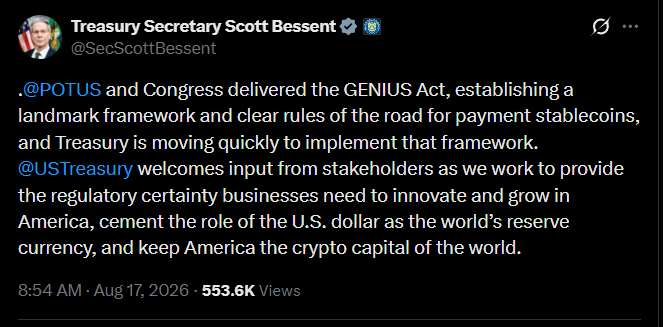
The Treasury just committed the United States to building the best Bitcoin onboarding infrastructure anybody has ever funded. I don't think they know that yet.
Look at what these rails actually are. Wallets. Keys. Settlement on a public ledger. A generation getting comfortable with money that lives in an app instead of a branch, and a real share of them learning what a seed phrase is, because that is how you hold the thing yourself.
None of that is dollar infrastructure. It is self-custody infrastructure that happens to be carrying dollars first.
And it teaches the lesson incompletely, which is the interesting part. A stablecoin has an issuer. Eventually somebody gets frozen, or a court order lands, or the reserves have a bad quarter, and the question arrives on its own. Who is on the other side of this, and can they tell me no?
One answer survives that question.
So, sincerely, thank you Secretary Bessent. Teach the world to hold its own keys and we will take it from there.
8/18/2026, 2 engagements
What BIP-110 Actually Proved: How to Read a Bitcoin Fork Fight
8/17/2026
 A piece of Bitcoin broke off in August and got stuck. Almost everything you're hearing about why is backwards. The claims are already leaking out of Bitcoin Twitter and into normie crypto spaces, usua…
Under 1% a year. That is how fast new bitcoin enters the world now.
In 2028 the rate gets cut in half again, on a schedule written in 2009 that nobody since has had the authority to change.
8/16/2026, 2 engagements
In 1993 the US government proposed putting an encryption chip in every telephone. Strong encryption, genuinely good, with one extra feature. The government would keep a spare key.
They called it the Clipper Chip. The pitch was that you could have real privacy and they could still listen when they had a good reason. Both at once.
In 1994 a researcher at Bell Labs named Matt Blaze @mattblaze published a short paper showing you could use the chip's encryption and make the government's spare key useless at the same time. The backdoor had a hole in it. One person found it by reading the spec carefully.
The program never recovered.
Nobody voted the Clipper Chip down. It died because someone checked in public and published what he found.
Every backdoor proposed since has arrived with the same promise, that only the right people will ever hold the spare key. Your bank holds one. Your exchange holds one.
A private key you generated yourself is a rare thing. It was never issued with a spare.

Two weeks of Bitcoin security news, and the lesson most people took from it is backwards.
A wallet generated weak seeds. Strangers with no boss and no mandate found it, published it, and got people's coins out before the attackers finished. Another group put 501 open-source projects through an audit and posted every finding in public. You know all of this because there was nowhere to put it except in the open.
Now name the last time a bank told you about a hole in its systems before it cost you anything. Not after the settlement. Before.
You did not watch self-custody fail this month. You watched it work in the only way that counts, which is out loud and early enough to act.
The alternative you're being sold has the same bugs. It just never has to mention them.

Miners usually show up in this niche as the villain. Last week they were the escape hatch.
When the ColdCard entropy bug broke, a rescue transaction could not touch the public mempool without showing attackers the public keys they needed to race it. So the transactions went straight to a miner and got confirmed without ever being seen.
No vendor could have offered that. The open network did.
@PortlandHODL of Bitcoin Red Team built the tool. Live now with @q_liketheletter.
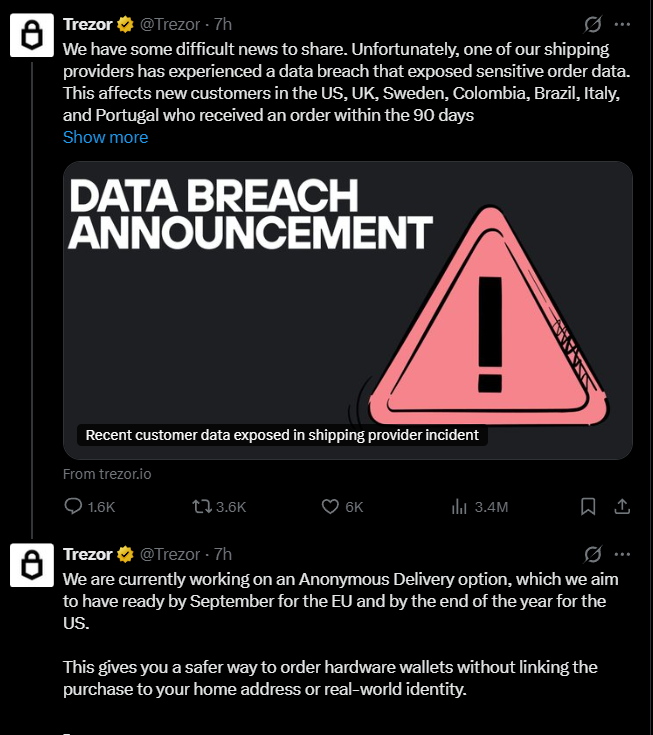
"Trezor got hacked." That's making the rounds today, and it's wrong.
Trezor wasn't hacked. A shipping provider they use, ShipMonk, had a system breached, and customer order data leaked: names, emails, phone numbers, and home addresses for roughly 13,700 people who ordered between May and early August. No keys. No seeds. No coins. The devices and firmware were never touched. Credit to Trezor for saying so quickly and in plain language.
So how worried should you be? Aware, not panicked. Your Bitcoin is safe. But your name on a list that basically reads "just bought Bitcoin cold storage" is worth respecting. It's fuel for phishing texts posing as support, and in rare cases, for someone who'd rather knock on your door.
I've seen this one before. I was in the Ledger breach back in 2020, when 270,000 owners had their home addresses dumped online. I honestly never noticed any extra fishing attempts beyond the thousands I already felt like I get on a regular basis, but you should be on guard and read every email that claims to be from Trezor with suspicion.
The takeaway isn't "self-custody is dangerous." It's that privacy is part of the stack. Buy privately when you can, never link your name to your holdings, and treat any urgent message about your wallet as a scam until proven otherwise.
Guard your keys. Then guard the fact that you hold them.
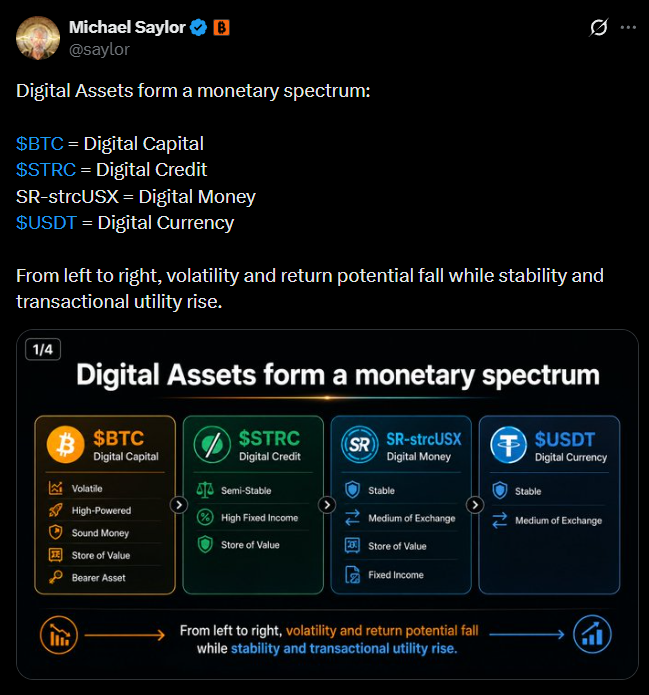
Give Saylor credit. He put Bitcoin at the top of his "monetary spectrum" and called it digital capital. He is right about that part.
Here is the step he will not take.
Everything to the right of pure Bitcoin on that chart is a layer of someone else's promise. Digital credit is money you are owed. Digital money is money someone issues. Digital currency is money you rent. Only the first rung is actually yours.
That is not a ladder of stability. It is a ladder of counterparty risk.
And this is Wall Street doing exactly what Wall Street was always going to do with Bitcoin. Wrap it, tranche it, stack layers on top until they've built something else that behaves like the system Bitcoin was built to escape. None of those layers are Bitcoin. They are the middleman, reintroduced with a ticker symbol.
Bitcoin is still the one thing you can hold without asking anyone. Their spectrum sells that back to you one permission slip at a time.
8/13/2026, 2 engagements
The Deep Dive starts in 2 hours.
Entropy and randomness are not the same thing, and the whole thing confuses the hell out of me!
Let's get some actual clarity!
Bitcoin researcher and filmmaker Alex Waltz (@raw_avocado) joins us to break down what real entropy actually is, and why it decides whether your keys are secure or a sitting duck.
10 AM EST. Last chance to register: https://t.co/GuSkOLHNaK
Bitcoin Lost $116M. Then $853M Ran to ETFs Instead https://t.co/uRVwZWEgsN
Entropy and randomness sound like the same word. In Bitcoin, mixing them up can cost you everything.
That gap is exactly what just bit some ColdCard users.
Tomorrow on The Deep Dive, researcher and filmmaker Alex Waltz (@raw_avocado) breaks down what real entropy is, why weak randomness makes a hardware wallet a decoration, and what the ColdCard story actually revealed.
Tomorrow, 8/13 @ 10am EST (yes its an early one!)
Register:

$116 million vanished from self-custody wallets this month.
A ColdCard firmware bug quietly broke wallet randomness for five years, and the coins behind those weak keys got swept.
Here's the twist almost nobody predicted: that same week, $853 million flowed INTO Bitcoin ETFs. The most custodial option on the board.
A bug in the hardware wallet, and the money runs to the bank.
Today on the podcast, Eric Yakes (author of The 7th Property) and Trey Sellers (Fire BTC) join us for a two-part conversation on the week that tested what "owning Bitcoin" actually means:
The ColdCard story isn't an argument against self-custody. It's an argument for understanding what you hold and how it's made. That's the whole conversation.
Follow today's guests: @ericyakes and @ts_hodl

Inflation "cooled" to 3.4%, they say. The target was never zero.
The Fed aims to devalue your money about 2% every year on purpose. That is not stability, it is a slow melt you are not supposed to notice. And it compounds: by their own index, the dollar has lost more than 22% of its purchasing power since 2020. What cost $100 then costs about $129 now. Their math, not mine.
That is the flattering version. Inflation was never the price of eggs going up. It is the supply of money going up, and the shelf price is just the symptom. Between 2020 and 2022 the money supply grew 41%, from $15.4 trillion to $21.8 trillion. More than $6 trillion conjured in about two years.
You can massage a basket of goods. You cannot un-print $6 trillion.
Bitcoin's supply grows less than 1% a year, toward zero, set by no committee and no election. One of these two moneys can be diluted while you sleep. It's not the one without a printer.


8/12/2026, 1 engagement
Japan has not been allowed to price its own money since the war.
The yen sliding today is not a fresh problem. It is the bottom of a very deep stack. In 1949 an American banker named Joseph Dodge, working for the occupation, fixed the yen at 360 to the dollar by decree. Japan was slotted into Bretton Woods at that number and held there until Washington broke the system in 1971.
Then in 1985 the US and its allies signed the Plaza Accord and pushed the yen from 240 to 120 in three years. It gutted Japan's exporters, so Tokyo answered the pain the only way a central bank knows how: cheap money, everywhere. That blew the largest asset bubble in modern history. When it burst, Japan got the Lost Decades.
And every decade since has been another layer laid over the last one. Zero rates. Quantitative easing. Yield curve control. Negative rates. Each intervention prescribed to treat the damage of the one before it.
This is what a managed economy looks like at the end. Not one bad decision. Seventy years of overruling the market, foreign hands and domestic ones alike, until nobody can tell what anything's real value is.
This summer two governments spent real reserves to set the yen level again. The market erased half of it within a week.
Bitcoin has no Dodge, no Plaza, no committee. No one sets its price and no one can. That is the entire point.

8/11/2026, 2 engagements
You cannot secretly hard fork a network by changing nothing.
That is the tell in the whole "the miners did a secret hardfork" story. A hard fork means changing the rules your node enforces. The miners changed nothing. They kept validating the same Bitcoin they always have. The side that wanted a new restriction didn't get consensus, so now it's calling the side that stood still the "forkers." That is completely backwards.
A proof-of-work change does not fire the miners. Bitcoin's miners keep mining Bitcoin, same chain, same hash function, same rules. Swap the proof of work and you haven't fired anyone. You've built a different coin and walked off with it.
That isn't a coup against the network. It's taking your ball and going home, then insisting the empty court is the real game.

8/10/2026, 2 engagements
BIP-110 Is Dead. What Its Two-Block Fork Proved About Who Really Controls Bitcoin
8/10/2026, 2 engagements
BIP-110 hit its activation height on Saturday, mined exactly two blocks, and stopped. No CEO intervened, no regulator ruled, no vote was held. A year of spam-war arguing got settled by arithmetic in a
Friday's BIP-110 Spaces turned into one of the biggest conversations we've ever hosted. So we're bringing it back for a proper autopsy.
After the weekend, the dust is settling so we're getting everyone back in the room to unpack what actually happened. What it changed, and where Bitcoin goes from here.
@knutsvanholm and @w_s_bitcoin are locked in, with plenty more guests joining them.
You'll want to be in the room for this one.
8/10/2026, 1 engagement
"Random" and "random enough" are not the same word. With your Bitcoin keys, the gap between them is everything.
Every private key you hold is really just one enormous, unguessable number. If the randomness behind it isn't truly random, nobody has to steal your keys. They can just guess them.
Wednesday we get into it. Bitcoin researcher and filmmaker Alex Waltz [@raw_avocado] joins The Deep Dive to break down what entropy actually is, how it differs from randomness, and why that difference sits underneath every wallet you'll ever trust.
Starts technical, ends personal. Aug 13, 10 AM ET. Free to join:
