People are scared. The Machine is clanking loudly — data centers, surveillance, control. How can we make machines that are not over us, but for us? Cypherpunk humanism shows us the way.

9/25/2026, 1 engagement

I’m here to chew bubblegum and talk about bitcoin and I’m all out of bitcoin
People are scared. The Machine is clanking loudly — data centers, surveillance, control. How can we make machines that are not over us, but for us? Cypherpunk humanism shows us the way.
9/25/2026, 1 engagement
I've been thinking about AI doom scenarios for many years. I've always been a skeptic — paperclip nonsense and all that.
But thanks to the Coldcard hack, and a recent reading of Ronald Wright's A Short History of Progress, I kind of see it now. (Great read by the way; crisp, well-argued, fascinating, crafted with care).
Civilization is precious, but fragile. It can die when facing unknown unknowns or exponential trends that catch us unawares, until it is too late. Arms races tend to be bad for civilizations too.
One known unknown when it comes to AI is this: whether it will ultimately create any attacker/defender asymmetries, or individual/institutional asymmetries. One factor here is just how far the open weight models can go, and whether they'll be permitted by authorities.
Alas, I can't write out the unknown unknowns. But I'm now more sure than ever that they're out there.
I'm an optimist at heart — unlike Wright. But I now see connections between my more conservative impulses (watch for Chestertonian fences; beware rapid change) and what is actually happening with AI and cybersecurity. This is only the beginning.
What a time to be alive and to be monitoring the situation!
8/4/2026, 1 engagement
guy who gets harsh soap in one eye and immediately puts it in the other — “to even things out”
(a parable about egalitarian leveling down)
3/31/2026, 2 engagements
The quickest way to a lefty's heart is to poo-poo libertarianism. For extra points, call it 'propertarianism'.
3/30/2026, 2 engagements
The digital computer is a lever. Software is a lever of levers. Agentic AI is a lever of lever of levers.
Act accordingly.
What does this mean for me, personally? For writing philosophy or running a classroom, not much. For dealing with the mountains of data I've hoarded over the decades, everything. Scripts, which I didn't have to write, handle it all for me, and now I have easy access to years of quotations, music, photos, papers, books, notes, correspondence — all locally hosted, all exactly fit for my own purposes.
It is good to have a lever of lever of levers on staff.
3/24/2026, 4 engagements
guy who writes everything in markdown now, but refuses to let robots write for him
3/19/2026, 9 engagements
Portfolio apps are great for monitoring the situation. But they track your IP, location, assets, even your identity. In the recent past, data from millions of users has leaked, resulting in phishing, identity theft, or physical wrench attacks. Darkfolio fixes this.
Darkfolio can't leak information it doesn't have. When you refresh, the server sends 7,000+ asset prices (stocks and crypto) every time. Your phone extracts what it needs locally, so a server never learns what you're monitoring. And you can run it all through Tor.
No accounts, no emails, no cloud sync. Even better, Darkfolio's developer,
, is pledging the first $10k in net revenue back to the cause of your digital privacy. It's live on the iOS App Store today.
Craig is a friend, but no one paid me to write these tweets. I am, instead, an enthusiastic early tester and now daily user myself. Darkfolio has what I always wanted from a portfolio app. It may be what you've been looking for too. Give it a try!
3/16/2026, 4 engagements
horror story in six words: "Can you jump on a call?”
3/12/2026, 4 engagements
Austrian economics stans would do well to drop the victimhood over being ignored, and instead claim victory, because the best of that tradition — above all, its microeconomic insight — was so well-integrated into mainstream economics.
You don't get Alfred Marshall and supply and demand charts, or neoclassical price theory, without Carl Menger (both a marginalist and an Austrian) and the subjective theory of value. Price lies at the intersection of supply and demand — i.e., subjective valuations.
Price theory as we know it now doesn't ignore what the Austrians learned. Instead, it gives it all more rigorous foundations and expression using calculus.
And fergodssake, Hayek won a Nobel prize (shared), and remains one of the most widely quoted and cited economists, by economists, to this day.
Mises, I'll concede was "quietly buried".
Imagine an Aristotle scholar complaining that logic classes don't focus on categorical syllogisms anymore. Of course they don't; we can do all that and more, now, using Fregean and post-Fregean notation and mathematics. We see the superset now, and teach it first.
3/12/2026, 2 engagements
When did mankind fall?
Catholics: 500,000BC. Adam and Eve. Chicago Conservatives: 1287. Birth of William of Ockham. Constitutionalists: 1861. First Lincoln executive order. Goldbugs: 1913. Federal Reserve Act. Bitcoiners: 1971. Fiat money.
Me: 2009. Node.js.
(and the rest of the AJAX/websockets/React/html5 nexus — a stack that enabled live updating of webpages, which in turn meant you didn't need to refresh to get notifications. made social media what it is.)
3/5/2026, 12 engagements
Agentic AI is all the rage. Here's how it's playing out, among those I know best:
3/4/2026, 4 engagements
There is no bigger red flag of charlatanism, for people in my line of work, than dropping a new take on unifying quantum and gravity. AI glazing is making this worse, because now the quacks can spit infinite technical slop for free, in addition to the usual metaphysical hokum.
3/4/2026, 2 engagements
need a bitcoin shitpoast? I gotchu fam. want an actual argument? we have that too. thousands of bangers for your use and pleasure, all trained on Resistance Money and on tweets from yours truly:
resistance.money/tweets/
3/2/2026, 10 engagements
Somewhere out there Senator Warren is unbothered, focused, moisturized, and drafting a bill to make math illegal.
3/2/2026, 9 engagements
You understand philosophy a lot better when you see it as The Inter-discipline.
Why is philosophy so hard? Because it has no defined techniques, problems, established knowledge base, or ends. Why does philosophy sit so uneasily within the humanities? Because it extends far beyond them.
Philosophy lives in the cracks. https://image.nostr.build/a1f9a884cc82043e7172aa9551d9f0005bb59a24f16768168235c74aeb2898de.jpg

3/2/2026, 11 engagements
Systematic philosophy and tight deadlines do not mix well. There's always a string to pull. But if you give that bad boy a tug, as intellectual honesty often requires, the whole thing starts to untie.
AI can be used to either extend your abilities or stunt them. The line between is fuzzy, but quite real. We'd do well to say the Serenity prayer here, and ask for wisdom to tell the difference!
2/25/2026, 6 engagements
The Sovereignty Go Up tech stack:
No censorship, no big data, no surveillance, no subscription fees, no blockades
2/24/2026, 27 engagements
When is automation bad?
AI is all very cool and fun to think about. But I view widespread use with growing unease because of what it does to our thinking. Why?
The labor theory of value — according to which, in at least one form, the value of an item produced is proportional to the toil in making it — is false. Some things are very costly to produce (imagine, for example, a statue made of your earwax), but have no value to anyone.
Some forms of automation are clearly good. I'm glad cars exist, and steam shovels, and dishwashers, and elevators. They multiply our efforts, reduce our misery, and enable meaningful work, play, creativity, and leisure.
Automation of creativity and cognition is not the good kind of automation. Indeed, it is dangerous. But why? It is not because effort alone is valuable (see point 1), nor is it because automation is bad (see point 2).
One way of phrasing the question at hand is this: where is the line? Where does the good kind of automation end, and the bad kind begin? Is there a line, after all? Does the line mark a difference of degree, of kind, or what?
Instead of asking whether work alone produces items of value, I'd like to shift our focus a bit: away from what is produced, and towards the person producing. My first hypothesis is this: whatever value there is in meaningful work alone manifests in developed human capacities, excellence, or virtue, not in the item produced. These are genuinely valuable, and their development and exercise can be hampered by automation.
Is automation as such bad, after all, then, since all automation displaces or leaves undeveloped at least some human capacities, excellence, or virtue? Perhaps so. To some degree. Philosophers might call this a 'pro tanto' bad: bad to some degree, and in some way. But something can be bad to some degree, and in some way, without being bad overall. Exercise, for example, is bad because it is temporarily unpleasant, but good overall because its effects make the effort worth it. One way of taking things here is to say that even the good kind of automation is pro tanto bad, but not bad overall.
My second hypothesis is this: what is displaced when automating creativity or cognition is far more precious than what is displaced in purely physical automation. Yes, there is excellence in shoveling well, which excellence is lost when using a steam shovel. But the loss of this excellence is far less tragic — indeed, not tragic at all — compared to the lost excellence of thinking well, as when someone has outsourced thinking to a machine.
So we have, then, one way to draw the line: look at what is displaced, and assess its value; when the human excellence displaced by automation is precious indeed, automation of its distinctive tasks is worse for us. We get the desired result, that automation of cognition or creativity is not so good compared to automation of physical labor, by way of the auxiliary hypothesis that the virtues of mind, as it were, are superior to those of the body.
I'm not totally satisfied with the proposal just yet. I don't like the implied hierarchy of human excellences, with the physical ones on the bottom, and the cognitive or creative ones closer to the top. And the whole setup, as though we were weighing things out, seems exsanguinating and false to my own experience in just the way cheap consequentialism does: the sort of thing Anscombe would rightly make fun of, and to great effect.
Perhaps automation of creativity and cognition as such is not so bad after all. Perhaps what matters is the context in which it occurs. To develop that idea, here is a third hypothesis. What matters here is not any one kind of hard toil, as such (for example: digging trenches, or writing long hand); what matters, instead, is that there be hard toil somewhere or other in a productive chain. It is the existence of such friction somewhere or other that enables the exercise of virtue, but not so important where the friction lies. So, the idea goes, automating some of your cognitive tasks — using a calculator, say — does you no harm, provided you are still doing something hard — thinking through a shopping list, say. You have not robbed yourself of opportunities to exemplify excellence in thinking, in using the calculator, the idea goes, since there are other opportunities to do so elsewhere in the chain of tasks.
Both practical and theoretical questions arise. I'll raise a few of the former.
Why would anyone choose to make life harder by foregoing automation? Even if there is some rarified sense, visible perhaps to philosophers and other weirdos, in which meaningful toil is good for us, who has the fortitude to choose it? Of course some people will make this choice. We all know a guy who still uses fountain pens despite the mess. But that guy is an outlier. There are questions here about human psychology, but also institutional design: do we want to build situations that nudge us towards friction because it is valuable? That create friction?
Where is the friction, where is the hard work to be done, in a world with increasingly sophisticated AI tooling? Prompt engineering? Hardly; a machine can do that for you just as well. In consumption? Not obvious. Customized slop built on the fly for just one pair of eyes is all too easy to slurp down; plug in and enjoy, no effort required.
Must we despair? I actually think not. My own experience with using AI tooling is of vast new landscapes of meaningful effort opening up before me. Vibe coding up little games, as I do daily, gives me new and more things to do in total, not less. It feeds my mind new and delightful frictions to work through — though it does decrease my need to ever touch actual code. The world that gives me unease is not one where everyone does this; that's actually a pretty cool outcome, and for the best.
There's one more angle I want to try out here. Why is slop bad? One answer is that it took no effort to produce. Via the labor theory of value, we can immediately infer that it is of little value itself. Because the labor theory of value is incorrect, this can't be quite right, I think. But deeper reflection on what 'no effort' means can uncover an insight. When we put effort into producing something, we don't thereby make it valuable, but we do send a signal. The signal is this: "I found this valuable to produce, so much so that I gave of my time and life and energy, just to make it." This signal is absent when slop is slung into the void. Indeed, something like a counter-signal is sent: "I found this project of so little worth that I was unable to actually make something myself, so I outsourced it all; but I still think you should consume it. Enjoy!" This counter-signal is kind of annoying, and I think often disrespectful to one's audience. There may be more than one way in which slop is bad; but this is definitely one of them. Slop is disrespectful.
There's another way slop debases us; it fools its creators. When you copy and paste your slop from the chatbot into your Substack or social media feed, you feel as though you've done something. "I made this." A quick dopamine hit. It's like getting a reward in a video game — a new spell, a new power, an upgrade to your base. Feels good. But make no mistake. The feeling is no more true to reality than the one you get from a video game reward, and if you indulge in it much your grip on reality will diminish.
Bonus: Bitcoiners are persistently confused, incidentally, on some of these questions — about labor and value, that is. They think that because bitcoin rests on proofs of work — cryptographic demonstrations of energy and compute deployed in finding new blocks and adding them to the chain — that the result must itself be valuable. Incorrect! See point 1!
2/23/2026, 6 engagements
What kind of bitcoiner are you?
As for me:

2/17/2026, 20 engagements
Five Theses on "Bitcoin is for Criminals"
Bitcoin is for anyone; so bitcoin is for criminals.
Some criminals are good; bitcoin is for them.
Bitcoin is useful in the crime of resisting monetary authorities; and that is a good thing.
That bitcoin is for criminals is not a shameful truth; it is bullish.
2/12/2026, 7 engagements
censorship is all around us, and pervades all big tech platforms. but because it consists in what is not seen, it is often very hard to see.
9/8/2025, 1 engagement
I don't always get quoted in my local paper of record. But when I do, I am unable to refrain from saying what I really think about crypto token pumpers
Source: https://www.straitstimes.com/life/the-crypto-bros-are-back-the-hubris-never-really-left

8/10/2025, 4 engagements
"Acquit Roman Storm, and I will end all tariffs."
Wow!

8/6/2025, 3 engagements
Gerrymandering illustrates how automation in policy can be better than discretion. If you give a legislature the power to chop things up as they will, they will do so in ways that benefit the dominant local party. A better alternative is for an algorithm to draw districts instead, regularly revising so as to keep seats across a territory in line with popular vote (so that, e.g., when 40% of Californians vote GOP, GOP gets 40% of the House seats for California).
Bitcoin obeys a similar principle. Rather than delegating monetary policy to trusted authorities, it automates that policy in highly predictable ways, and regularly revises (i.e., the difficulty adjustment) to keep things in line with what's expected. The outcomes needn't be optimal for this system to be superior, note; for there is no guarantee that those trusted parties will enact optimal policies, and they often fail in this task! The best argument for automated policy, then, is not that it is for the best always and everywhere, but that it is typically for the better.

8/5/2025, 2 engagements
some people out there don't know who Barbara, Celarent, Darii, and Ferio are, and it shows
The miracle is not over. Rather, it hides, and you have to look closely to detect its presence. Bitcoin, Tor, nostr, bittorrent, e2ee messaging, VPNs — all flawed tech stacks that nonetheless protect us from full disenchantment.

7/31/2025, 11 engagements
Schrödinger's bitcoin: an asset superpositioned between youthful ('we are still early'), and aged indeed ('bitcoin is here to stay').
We collapse to whichever position is convenient, of course, and return to the superposition when the move is complete.
7/29/2025, 8 engagements
Airport calls for "Friends of Bill W" is an interesting use case for bitchat. I could see that finding actual use, and for the good.
For those not acquainted with this subculture:
People in recovery often find airports challenging — this is a place where one is socially permitted to drink at any hour of the day — and call for help there to remain sober. An anonymous location-based, p2p chat app fits the bill.
7/29/2025, 3 engagements
It is a good day to rise with the sun and to visit the bank branch for a sixth time to see if I can wire out my “own” money to my “own” account.

7/20/2025, 5 engagements
“The trade-off is a massive one-time off-chain data transfer of ~5 TB for a SNARK verifier circuit with 5 billion gates.”
Loading quoted post…
This has always been what attracted me to bitcoin, and what I still look for on the internet today — something closer to the wild Usenet and IRC and forum experiences I had in the 90s than curated Instagram feeds or censored news and opinion on Twitter. Pirated music. Sharing ideas. An ever-shifting cast of pseudonyms.
Loading quoted post…
6/14/2025, 14 engagements
In-depth discussion of 'What Satoshi Did', published in the recent Satoshi Papers edited collection.

6/3/2025, 1 engagement
Nostr isn’t a drug; it’s food
5/28/2025, 3 engagements
Noah was a conspiracy theorist. And then it rained.
5/19/2025, 47 engagements
One of the best effects of the current American administration is to remind people that some laws are bad, and that some crime is good.
I fear they will forget the lesson very quickly, upon taking back power. But it is a good lesson!
4/30/2025, 1 engagement
bitcoin is for criminals
Source: HRF's Financial Freedom newsletter: https://mailchi.mp/hrf.org/financial-freedom-newsletter https://image.nostr.build/61d71a1d86a668de0960db8fc19fd793442bc7e5783418ab2059bd4686a7fb72.jpg

A big part of my job is career coaching: asking young adults what they want out of work life and how they'll get it. I get all sorts of answers. But never once has a student shared a dream of buying U.S. Treasuries.
3/9/2025, 1 engagement
I am officially neutral or slightly skeptical about a Strategic Bitcoin Reserve. But here's an argument I'd like to develop and evaluate:
Our world is increasingly multi-polar, with realignments of who knows what kind on the horizon. Borders will change. Cross-border payment systems will realign too. It seems useful to have on hand a way to transfer value across those new and shifting borders, without the cooperation of intermediaries. Bitcoin, unlike other digital monies, can do this.
So the reason to stockpile some bitcoin isn't merely that it is likely to become more valuable. It's that it is uniquely useful, and it is wise to stockpile useful tools you might need.
Objection: if the USFG really needs to pay mercenaries or buy munitions or spy software or whatnot, and doesn't have a way to wire dollars to sellers, it can just buy bitcoin at the very moment of need — no need to buy it now.
Reply: the objection only works if we assume that bitcoin's value will remain flat or decline. Otherwise, the counter is: acquiring some bitcoin now will allow the USFG to benefit from appreciation, and make any future purchases using bitcoin cheaper.
Another reason I prefer this style of argument over the proposal that the USFG should buy bitcoin now, merely for the reason that it will likely rise in value, is that it is explicitly framed around bitcoin's unique point of usefulness. The fundamental reason to buy bitcoin isn't that Number Go Up, it's that bitcoin can do things other tools cannot. This also supplies us with a plausible answer to the question: why bitcoin? why not TSLA? Or NVDA? Because bitcoin can do things these other assets cannot. Its value lies, not merely in expectation of future appreciation, but in utility.
Objection: acquiring bitcoin, in the hopes to someday use it for cross-border payments, is best done in secret. A Strategic Bitcoin Reserve is most useful when covert.
Reply: that's probably correct. But there are limits to what a democratic government can do, covertly. And acquiring bitcoin in public enhances any Number Go Up effect, by providing a clear and widely-known signal of bitcoin's value.
3/6/2025, 2 engagements
hey I know that guy
https://www.btcpolicy.org/articles/meet-the-fellows-andrew-bailey
3/1/2025, 1 engagement
Philosophers: "that noble tradition of thinkers who were so annoying that their countrymen would either execute them (Socrates), banish them (Aristotle), excommunicate them (Spinoza), or not have sex with them (Kant)."
From Robert Gressis' memoire, "The Most Awkward Man in Japan: Dispatches from a Philosopher Abroad" (2024)
(It's good, and much funnier than one might guess, given that it's written by a philosophy professor!)
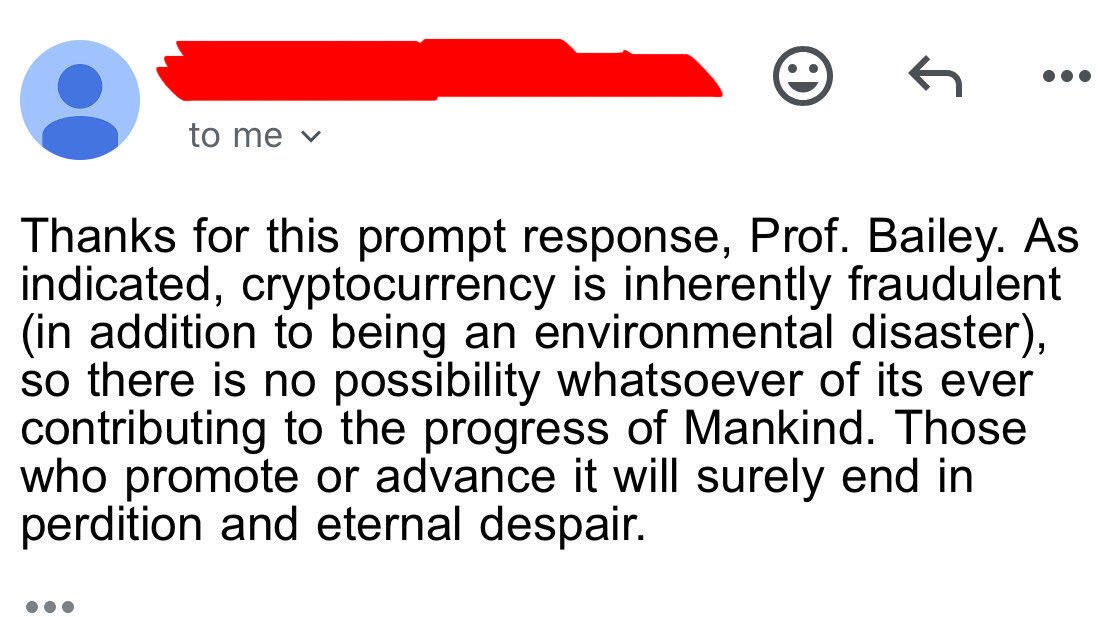
I get the most interesting emails! https://image.nostr.build/2350c367ac962cc0b12bf928c32e1ca7f0b1259f62d7167fee5d69c43ab77350.jpg
2/24/2025, 6 engagements
Will autocrats attempt to expand their power over payments?
Will central banks continue to print, and sometimes go belly up?
Will other cryptos prove to be fraud and delusion?
If you say “yes” to these questions, congratulations: you understand the case for bitcoin.
2/11/2025, 4 engagements
Nihilism — the view that nothing could really matter — is both false and mischievous. False: some things do matter, regardless of our attitudes. Mischievous: if you believe it, your life will become less meaningful and good.
Nihilism is, then, rather dangerous. It'd be good to have an antidote. There are many, in fact:
Some people have repugnant views and act on them. When censors block your access to those views, they block your ability to understand the world, to predict how it will unfold, and to act on the basis of evidence.
1/2/2025, 3 engagements
2025 draws nigh. What advice do you have for me, for the coming new year?
Every few months I post this, in the hopes that we’ll find a taker. Any book sellers out there interested in stocking ‘Resistance Money’ and selling it for bitcoin? We can get you copies from the press at a steep discount. No author kickbacks or royalties or funny business: we just want people to be able to buy the book for bitcoin!
12/30/2024, 5 engagements
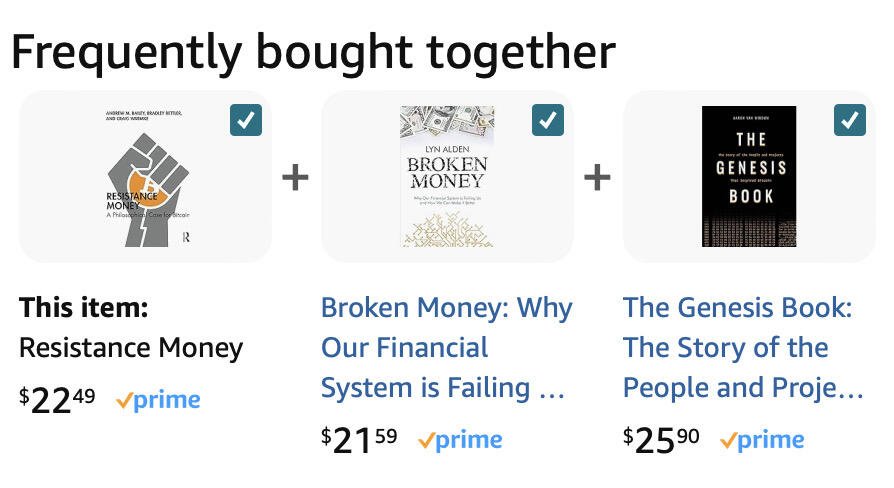
Hard to think of a better holiday bundle tbh https://image.nostr.build/849172d15ecd738c4ba9bcbcbdd3299a841f3e39d63f48d9a4dae28fc0cdf58f.jpg
12/27/2024, 1 engagement
Pretty convincing argument tbh https://image.nostr.build/fb5c26f0fd60a0c955bc91d62deb62ac6fdc719425228d9962d5331667091c78.jpg
Thank you, eggyolk! The two features this review identifies — writing to clarify rather than to wow, offering understanding rather than polemics — were top of mind for us as we wrote the book. https://image.nostr.build/b30b2212518b9fee9d54beff1b93e6096e413e08c91483d0f5821f92ba2fc25f.jpg

Many such cases.
Loading quoted post…
12/2/2024, 1 engagement
10 THESES ON DEBANKING
Debanking, in the target sense, is when lawful payments or enterprises are blocked from banking services, because they are, to use a nice phrase from Nick Carter: "politically disfavored".
Debanking can occur at the explicit and written direction of regulators, or through more hidden means, as with off-the-record phone calls or vague gestures at limiting 'risky' activity so as to avoid costly audits — or worse.
Off-the-record governance of this kind undermines the rule of law, trust in institutions, and innovation. It's hard to build a law-abiding business when you don't know if you'll get kicked out of the system, for secret reasons you can't even share in public.
Some recent cases of debanking involve lawful but, to many, distasteful enterprises – crypto token pump shops, for example. Others involve family and friends of unpopular politicians. Yet other examples are more sympathetic: human rights activists, independent journalists, or whistle-blowers.
Since these examples run the ideological and moral gamut, it's probably most useful to keep 'debanking' as a purely descriptive term, rather than to gatekeep its application to, say, just the sympathetic cases.
Debanking in the modern era began with Operation Chokepoint, under the Obama administration. Though the first Trump administration ended that program, it implemented debanking structures of its own, including the campaign against Libra/Diem in 2019. The pattern continued under the Biden administration with the inauguration of Chokepoint 2.0. There is, by now, little doubt that politicized debanking happens.
What's at issue now is what to do about it.
Modern banking systems are neither entirely public nor entirely private. They are, instead, a curious hybrid. This hybrid character undermines arguments like 'it's a free world, and payment rails are privately owned, so financial services should be able to block customers they find risky'.
There is something of a paradox, then, at the heart of the issue. Here's how Justin Slaughter puts it:
It is by no means obvious how to design a system that respects both constraints.
There is no purely political or policy solution to this paradox. Congress, the Fed, Article 3 courts, the Executive, CFPB, FDIC — any of these institutions could in theory be used to untangle the mess. But in truth, empowering them further is unlikely to have that effect, since they are themselves political institutions.
The way forward lies, instead, in developing and using payment and banking rails that are genuinely open for all — beyond the easy capture of regulators or corporate structures alike. Thus David Marcus: “you have to build it on the most neutral, decentralized, unassailable network and asset..."
12/2/2024, 1 engagement
“The ratio of Blackberries to iPhones used to be 100:1, so we are due for a correction and return to the mean.”
— Person who draws lines on charts
11/26/2024, 3 engagements
A friend was planning a trip to Japan to celebrate some recent wins. The application was complicated, and took significant work.
Visa denied; no reason given.
He'll have to wait six more months before he can apply again. Damn.
Check your passport privilege all.
Why share? Does it connect to my family's troubles with American immigration? Sure. But it's something I care about independently too. My developed world friends are often wildly unaware of how hard it is to travel without a fancy passport. Which is frustrating for everyone else!
11/23/2024, 1 engagement
People ask how many bitcoins I have. My answer is always the same:
How dare you speak to me?
11/21/2024, 1 engagement
What is the optimal portfolio of group chats? Some principles:
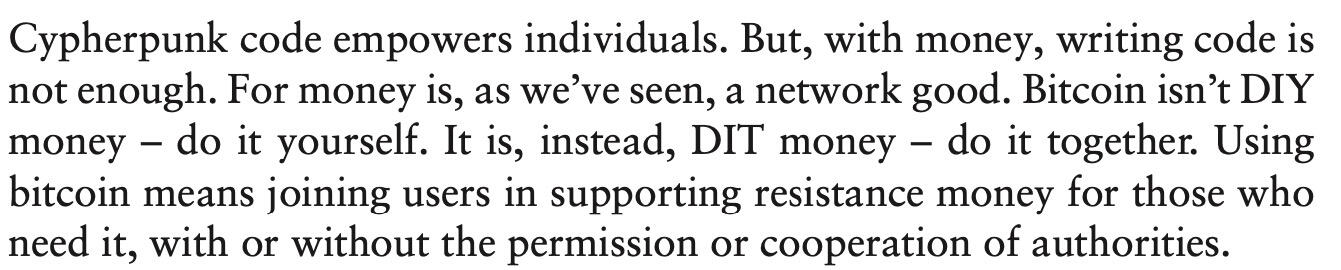
When you use bitcoin, you're not just empowering yourself. You're joining a network, and empowering others who use it too. All this without the permission or cooperation of authorities.
(excerpt from ‘Resistance Money’, p. 274) https://image.nostr.build/e218deb16a804c40c0253068bfdef961069273c45cc901730bbcd6b3c050b786.jpg
Many recommend it as an investment. But is bitcoin actually good for the world? What are its costs or benefits? How should we evaluate them? This presentation addresses such questions through the main findings of 'Resistance Money', a recent academic book.

11/18/2024, 4 engagements