Wall Street, Banks, and American Foreign Policy
library-wall-street-foreign-policy
Max
Praxeologist ~ Cryptoanarchist ~ Cypherpunk Message me on nostr:nprofile1qqs8t4ehcdrjgugzn3zgw6enp53gg2y2gfmekkg69m2d4gwxcpl04acpzamhxue69uhhyetvv9ujuurjd9kkzmpwdejhgtcppemhxue69uhkummn9ekx7mp0w3radp
4 min read
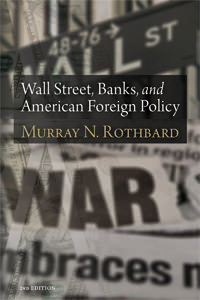
Murray N. Rothbard's Wall Street, Banks, and American Foreign Policy argues that lending to governments gives bankers a standing interest in state power, including power used abroad. Investment houses that underwrite Treasury bonds earn fees on deficits and depend on taxpayers to redeem the debt, while commercial banks lending on fractional reserves need a lender of last resort. His narrative runs from Civil War finance to the 1984 election. The incentive he describes is plausible and often documented, and in each case the open question is whether that stake decided policy or sat beside other reasons.
His premise is categorical: bankers are "inherently inclined toward statism," and commercial bankers are always teetering near bankruptcy. That is an axiom drawn from his monetary theory, stated as a rule about bankers as such. As an account of motive it has force, since a firm whose revenue rises with public borrowing has reason to court the officials who borrow. A banker who funds a candidate or sits on a board beside a future cabinet officer has an incentive and a channel, but showing that he set policy requires evidence from the decision itself.
In Rothbard's account of Civil War finance, Jay Cooke helped pay for Salmon P. Chase's political rise, and Chase, as Treasury Secretary, gave Cooke a monopoly on underwriting the federal war debt. The national banking system the two men built then tied each bank's notes to federal bonds sold through Cooke. Each step turns a private balance sheet into a stake in public borrowing, though Rothbard assembles the chain from secondary histories. His later claim, in the First World War chapters, that finance before the Federal Reserve could not have supported the war is an unproven counterfactual.
In Guatemala, after the Arbenz government expropriated uncultivated United Fruit land, Rothbard traces the company's ties through law firms and bank boards to Allen Dulles, and through a Council on Foreign Relations study group led by a United Fruit consultant. The State Department's Foreign Relations of the United States account independently records CIA planning, United Fruit's support, propaganda and diplomatic pressure, and Arbenz's departure from office. It also records the planners' anticommunist and security concerns, leaving the company's interest one consideration among several, of uncertain weight.
The lost land gave United Fruit a motive, and lawyers and directors connected to officials gave it access, while the decision rested with the Eisenhower administration and the CIA ran the operation. Personal and board ties establish access, and a decision requires its own record. Rothbard's count of eight Council members among twelve top officials includes men who joined within a few years after the coup, and Walter Bedell Smith's later seat on United Fruit's board shows where an official landed afterward without revealing what moved him beforehand.
Rothbard's account of Vietnam describes an elite that split. Robert McNamara turned dovish, and his hard-line successor Clark Clifford changed his mind after examining the war. At Johnson's March 1968 meeting of senior advisers, Abe Fortas and Maxwell Taylor alone still held the hard line. Advisers who divide and reverse themselves behave like a coalition of interests, which fits an incentive model and sits poorly with any picture of one directing hand. Justin Raimondo's introduction overreaches in holding that theory can establish the conclusion before the evidence, since the cause of a particular intervention rests on the records of that decision.
Rothbard concedes that no hard facts show a Standard Oil motive behind Theodore Roosevelt's antitrust campaign, and he says David Rockefeller and Henry Kissinger, in lobbying Carter to admit the Shah, may have foreseen the hostage crisis that followed, a possibility he leaves unproven. He errs in crediting Nixon with establishing diplomatic relations with Communist China. The State Department's history of China policy separates Nixon's 1972 opening and the 1973 liaison offices from formal relations, which began under Carter in 1979.
The main narrative closes with the 1984 candidates, several of them Trilateral Commission members, and Rothbard's conclusion that the financial elite could sleep well whoever won. His essay first appeared that year in World Market Perspective and became a Center for Libertarian Studies monograph in 1995. The Mises Institute's 2011 second edition contains Anthony Gregory's introduction to that edition and Raimondo's, which is labeled 1995 but includes a reference to 2005. Gregory's discussion of later bailouts and administrations is his own commentary on events after Rothbard wrote. The Institute distributes the edition as an official PDF.
Help keep these ideas circulating
This is an independent project. If you'd like to help support it, you can make a contribution. But there's no obligation at all. Reading, sharing, and coming back is already a form of support.
Read also
1
Tributes and essays honoring Hoppe; study selectively for arguments on migration, reputation, law, and culture, while we…
2
Mises's 1962 essay on economic method defends deductive theory of purposeful action against positivism; best for readers…
3
Mises's treatise connects purposeful choice to prices, monetary calculation, enterprise and capital, stating premises op…
Want to publish here too? No sign-up, and the text stays yours. Learn how to start
Replies (0)
Loading…