Individualism and Economic Order
library-individualism-economic-order

Max
Praxeologist ~ Cryptoanarchist ~ Cypherpunk Message me on nostr:nprofile1qqs8t4ehcdrjgugzn3zgw6enp53gg2y2gfmekkg69m2d4gwxcpl04acpzamhxue69uhhyetvv9ujuurjd9kkzmpwdejhgtcppemhxue69uhkummn9ekx7mp0w3radp
4 min read
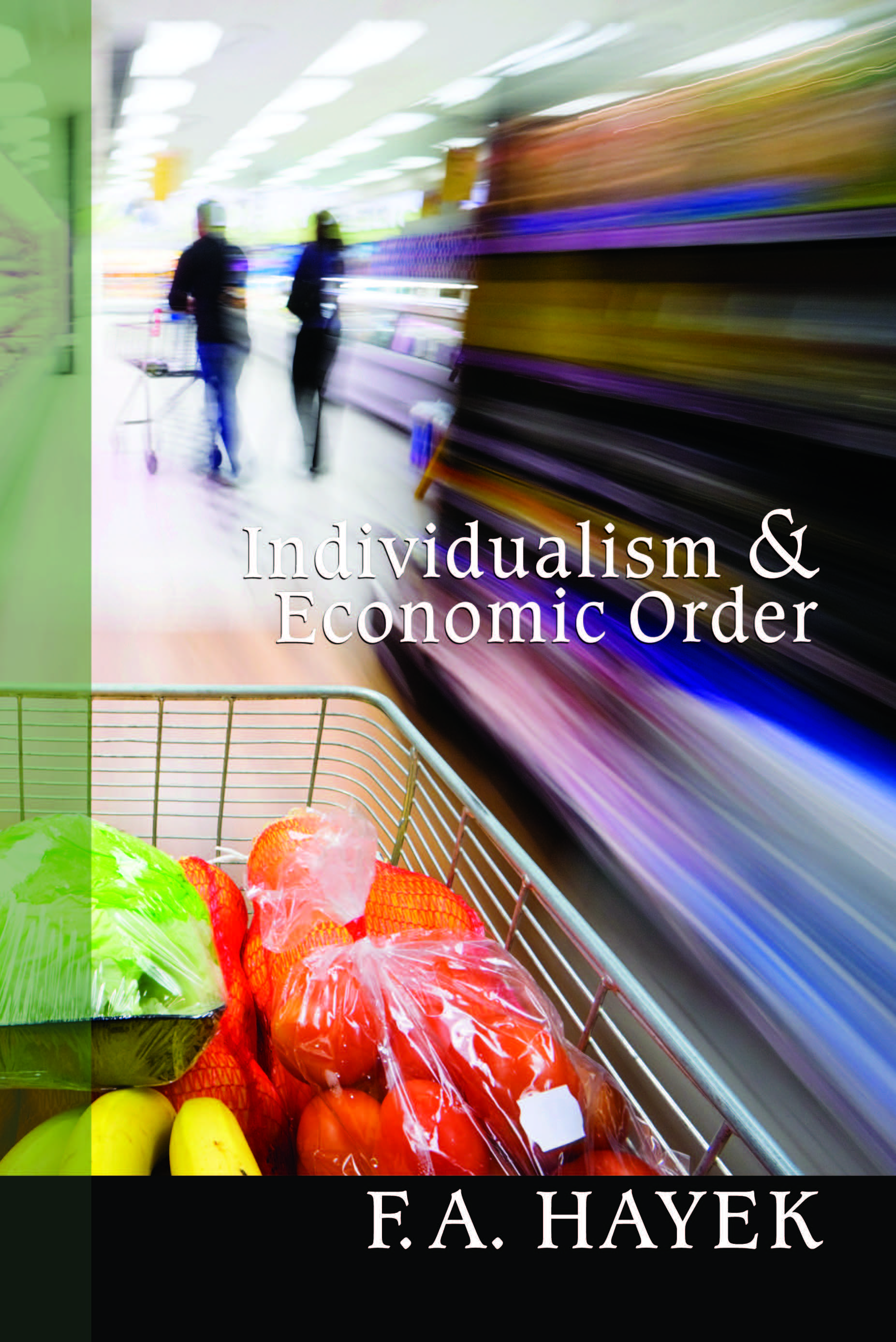
Individualism and Economic Order collects twelve essays by F. A. Hayek, published by the University of Chicago Press in 1948; this Mises Institute scan reproduces the 1958 third impression, with a preface dated June 1947. Knowledge is held in fragments by many people, and Hayek judges institutions by how well they put it to use and expose it to test.
Individualism: True and False builds a theory of society on that issue. Its individuals are social and fallible, and because nobody can know who knows best, they must remain free to try their own methods under general rules. Voluntary association fits inside that order, and the case covers the altruist as fully as the egoist. Classical liberals, on Hayek's account, sought institutions that reconcile conflicting interests, expecting no automatic harmony. Hayek's 1947 paper on free enterprise and competitive order gives the design legal content, since rules on corporate liability and on contracts in restraint of trade decide who can enter a market. The framework admits sanitary services whose benefits escape paying customers and inheritance taxes that could disperse property.
Economics and Knowledge keeps the pure logic of choice as indispensable for formal consistency but places the empirical content of economics in hypotheses about how people learn and how knowledge travels, so the tendency toward coordination becomes a conditional claim. In The Use of Knowledge in Society, a hypothetical rise in the price of tin tells users to economize without their learning whether a new use or a failed source caused it. The Meaning of Competition argues that perfect competition assumes the knowledge rivalry discovers through advertising, undercutting, product variation and reputation. A monopoly resting on efficiency does comparatively little harm, provided free entry leaves a more efficient rival able to displace it.
In a 1940 review of Oskar Lange and H. D. Dickinson, Hayek tests market socialism against this account. He assumes managers as competent and eager to cut costs as capitalist entrepreneurs, and he concedes that with constant data, trial and error could approach equilibrium. As conditions change, prices fixed for set periods and broad categories blur differences of quality and location. An outsider with a cheaper method must persuade the authority before undercutting can test it, while retrospective audits teach managers to prefer defensible decisions to successful ones.
A Commodity Reserve Currency, from 1943, turns from critique to proposal. Hayek supports the plan of Benjamin and Frank Graham, under which money would be issued against warehouse warrants for a fixed combination of storable raw commodities, twenty-four in Benjamin Graham's version, and redeemed in the same unit. Issue and redemption would fix the aggregate price of the whole collection while each constituent price moved freely. Rising demand for liquid assets would accumulate stocks of widely useful materials, so that hoarding worked like an order to hold commodities for the hoarder's account; when that money returned to spending, redemption would release whatever stocks had built up. Private brokers and warehouses would carry the trade under a mechanical rule, which Hayek prefers to arbitrary discretion.
The Ricardo Effect, from 1942, argues that a general change in wages relative to product prices alters the relative profitability of methods that use labor and capital in different proportions. With the money rate of interest first set aside, his opening example has product prices rising against fixed money wages, which favors methods that turn capital over quickly, a shift he connects to investment demand in industrial crises. A closing section concedes that technological change makes it hard to judge which new price relation corresponds to the old one, a difficulty he leaves open.
Hayek's 1939 essay on interstate federalism sketches a federation that would secure peace, with common law and free movement of goods and of factors such as labor and capital. Inside that single market, member states would lose their power to shelter favored producers through trade restrictions, and mobility would erode the privileges national regulation sustains. Because protection can hide in sanitary rules and inspection fees, the federation would hold a negative power to restrain state barriers without acting in the states' place, while smaller units keep room to experiment within common monetary arrangements. Members' diverse interests also limit which common plans could command agreement. He accepts limits on federal power because securing peace takes precedence over economic policies that its members cannot agree to pursue.
The text is available as the Official Mises Institute PDF.
Help keep these ideas circulating
This is an independent project. If you'd like to help support it, you can make a contribution. But there's no obligation at all. Reading, sharing, and coming back is already a form of support.
Read also
1
Hoppe's four pieces, collected in 2018, connect property norms with state incentives and libertarian strategy, then clos…
2
Gene Callahan explains purposeful choice, money, entrepreneurship, and capital, guiding readers through Austrian economi…
3
Diffie and Landau connect key exchange, wiretap law and surveillance institutions, showing why encryption, legal doctrin…

Want to publish here too? No sign-up, and the text stays yours. Learn how to start
Replies (0)
Loading…