Transcription of speeches at Nostrasia | Nostr 201 App Review by Pablof7z, G Sovereignty, arkinox, Jeff G, and NVK
SRPPWefwXw4otCBCOr3Jr

YakiHonne
YakiHonne is a Bitcoin-native, open-source social payment client on Nostr — sovereign content, Lightning payments, and programmable infrastructure for the open internet.
34 min read
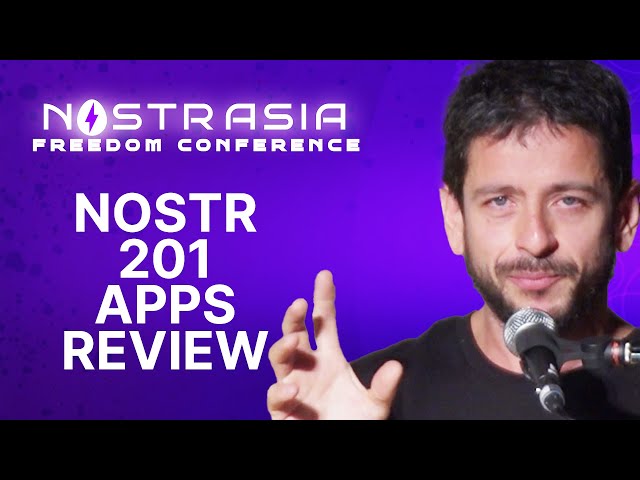
The YakiHonne community is excited about Nostrasia, and they have diligently transcribed Nostrasia's inspiring speeches. Additional speech transcripts will be made available over time. The Japanese and Spanish versions are initially translated and proofread by community members with the help of AI tools. All YakiHonne users are invited to join in the review process. Those who successfully complete the review will be granted a special reward of 3000 Sats. To get started, simply reach out to us (Comment here, DM, or TG) to sign up, and the first person to contact and submit their review will be the lucky recipient of the reward. And hey, if you're up for it, we'd love to have these speeches translated into even more languages. Join us!
🌟中文版: Nostr 201 App 回顾 🌟日本語: Nostr 201 アプリレビュ 🌟Español: Revisión de la aplicación Nostr 201
The concept for this panel is called Nostr 201. Yesterday, Nostr focused on building Nostr 101, presenting various microblogging applications and typical use cases. Today, I suggest we delve deeper into why we build on Nostr. Let's start by introducing everyone. Sound good?
Yeah, sure. I'm G Sovereignty, and I do various things. I'm working on Nostr Podcast, and I talked about it yesterday. Sometimes, I just make fun of Pablo.
I'm Pablo, the guy everyone makes fun of. I don't build Nostr Rocket because I enjoy shipping things. I've built numerous applications, like a highlighter, and so on.
I'm Arkinox, working on Onosandai and Yondar, and the cyberspace protocol.
I'm Jeff G, working on Listr and Ostrich Work, among other things still in progress.
I'm NVK, figuring out how to monetize my hobbies.
So, where do we begin? How about we learn about the cyberspace protocol? That sounds weird.
Yeah, it's weird. So, man, I don't want to give a thesis seminar here. Yeah, okay, I won't. I'll keep it simple. So, cyberspace is a protocol built on top of Nostr that enables a permissionless and thermodynamic metaverse. What that means is, it's permissionless, like Nostr; it inherits that property from Nostr. So, you don't need anyone's permission to use it or act within it. It's a 3D virtual space, and then all of your actions in cyberspace are done via proof of work.
You publish a Nostr event to perform an action, and the proof of work on that action is the magnitude of your event or your action. The proof of work on the event is the magnitude of your action.
The reason why I set it up like that is that it's actually patterns after reality itself. In reality, you can expend energy to perform actions.
You have to expend energy to perform actions. Everything you do, you have a cost paid to the universe in entropy. In reality, everything is permissionless. Like, I can punch Pablo in the face, and he can only oppose me by also expending energy. He actually can't do it at the same time. Yeah, I mean, but the point is that you can't prevent anyone from acting in reality.
So reality is permissionless, and it's also thermodynamic. With cyberspace, I'm creating this protocol that inherits the same two properties as reality, and I refer to it as an extension of reality. I believe that makes it a consequential metaverse, the first of its kind. Every other metaverse is bullshit because they're all based on access levels and permissions and artificial authority vested in.
What does this look like? Is it like Minecraft kind of thing or is it just tech-based?
So Onosendai.tech is the current tech demo. If you go to Onosendai.tech, you can check out what it looks like. The look of it is not specified in the protocol, so someone else could make the Unreal Engine 5 version of cyberspace if they wanted, which would be really cool. I'm going for a retro 80s vibe, so everything kind of looks like wireframes and neon.
If somebody does Call of Duty on it, do you actually die? How about carrying ammo? Can you carry all that ammo?
Well, you have to do proof of work for how much you can carry, okay, but it's all regulated by proof of work.
Yeah, that sounds interesting.
So, wait a second. That idea of the Unreal Engine 5 of it, because I think I've got a mental picture because I've played around with it, how are events placed? How are things put around this 3D space?
So you also use proof of work to claim space in cyberspace. You can actually do that right now by going to construct.onosendai.tech. So you mine an event called a Construct A-331, and the amount of proof of work on that event is the size of the space that you claim. Once you claim that space, you can't do it yet because I'm still working on the spec, but you'll be able to put objects and interactive stuff inside your construct.
That's how you create interactive objects. You could theoretically create a game or some other utility or a shop or whatever you want. I want to just mention that a lot of people think that I'm working on this for purposes of gaming, and I don't think about this in terms of gaming at all. This is like a fundamental utility that humanity can use for anything.
What kind of mining do you have?
It's just NIP 13.
So, don't you think that the issue here is that you're just competing for resources that people would probably be putting towards Bitcoin mining, for example?
I am increasing demand for hash power, yeah. But, people are not making SATs, right? Like from that, because right now you can put very little sort of mining capability towards making SATs on Bitcoin, right? Through mining pools and stuff. So like, have you thought about maybe changing it to, let's just bike shed your wonderful project, like maybe, Fidelity, bonds or something like that. Seriously, because then like you're essentially leveraging like all the Bitcoin proof of work, right? That you do, you get by using the Bitcoin money, right?
So you use money to power it instead of proof of work?
Well, it's a proof of work.
I get it. Part of the reason why I want to use proof of work in the way that I do is because it is keeping it very, very simple in terms of implementation and onboarding and usage. Settling every action you do when you're doing multiple tens of actions per second, settling that to the time chain in some way or handling invoices for all of that could be problematic, yeah.
I asked because, like, many years ago, when Cloudflare was sort of coming out, we thought that, 'Why don't we just do proof of work on the browser?' We, I think, with, was it, we created a project. It was like, Cloudfire or something like that, and you could mine, like, would force your browser to mine a little bit, right? Expend some proof of work so that you could prove that you were not a spammer, right? Or like, fake accounts trying to DDoS our website at that time.
And we found that most users are just not willing to go there, but they're willing to park some SATs.
Yeah, I mean, I've already had a lot of people mining constructs for cyberspace, so it's going well. Yeah, I just want to see if this will work. It's obviously an experiment, and I think that, you know, if the proof of work does work out in the way that I'm hoping, then it'll actually only complement Bitcoin in terms of the hash power distribution.
I think that's very cool. Thank you.
And have you thought about changing not using NIP 13, using some kind of non-Bitcoin hashing?
I mean, actually, I need to use, I want to use Bitcoin hashing, SHA-256, because I want people to be able to repurpose their ASICS if they want to power their cyberspace interactions. I actually have a buddy who, who has an S9, we're going to try to get it to cyberspace events so that he can, like, Zoom through cyberspace at ultra speed.
That is pretty cool. I mean, he's going to be op.
You know, like old Bitcoin hardware sort of, you know, it becomes pointless pretty fast. I mean, electricity versus what you get out of those, it's a very fast-dying proposition here. So, yeah, it's fun.
And when you think about, you mentioned that you don't see gaming as the goal of this, what do you envision if it works in five years or 10 years? Like, what would that look like?
I see cyberspace primarily as a place of business and also of, like, people coming together and communicating and organizing. It creates an environment outside of physical reality that you can be around somebody and interact with them without having to be physically near them on the planet. And I know we have, like, a lot of other ways to do that through video chats and text messaging and stuff, but the fact that, you know, you can't be in a place in cyberspace without expending the energy to get there. There's no teleportation or you can't be in two places at once. It makes the space consequential. It makes your travels and where you're at consequential, and it makes who you're with consequential.
So, yeah, I think business, like, lightning stores that are virtual and in cyberspace, where you could actually go there in cyberspace and then the proprietor is controlling an avatar in that store and you could talk to them and you could buy products by zapping them, right? You know, in this 3D experience. That's kind of an idea of what I hope to see. But I mean, if people make games too, that's fine. I just think that it's going to be very, like, the games are going to be computationally expensive on purpose, so I don’t know if it’s a good idea.
But do you guys remember the other the KVM like stuff like was it KVM? I can't remember now like all the 3D sort of like want to like make 3D web, back in the like '90s like Yahoo had like a whole sort of I remember vhml.
I mean like, you know this was like people tried to go there I mean the hardware was just not there yet but no well neither was the just doing it in the browser I me it was very rudimentary but somebody cool.
I don't know like he got that sort of you know Cypher more like cyberpunk than Cypher Punk Vibes.
Sure yeah yeah cool appreciate it.
Why are you building it on Nostr? Like what properties of Nostr?
It's the permissionless and permissionless nature of it. Nostr is like a communication protocol; it's a permissionless communication protocol. I just found that the combination of being able to easily add proof of work within Nostr and the fact that it's kind of got this standard that other people can utilize for interoperability. I just feel like it's just the best; I can't think of anything else out there that would kind of be up to the task of supporting this sort of mesh-based reality built with these other event kinds and how you can trivially link them in a hash chain. Yeah, it's just like the right tool for the job. But I mean, maybe there's something else out there, but I just want to be part of this ecosystem because I feel like it's going to benefit everybody.
Everything benefits from each other. But I think the main thing is the permissionless and the thermodynamic properties make it a really, really good fit.
Do you see any issues with the lack of timing? Because I know that for the movement you're tagging like the previous events so that's fine, but do you see the root event having like a weird time being an issue?
Yeah, I'm going for soft consensus on what I call your Action chain, which is the events you publish. It's a hash chain, so every event references the previous event. It's soft consensus because it's not in the time chain. It's not anchored anywhere, so your action chain is really only your truth that you publish. But the good thing is that there are a lot of restrictions on what constitutes a valid action chain, and it's pretty easy to screw it up if you try to do like a timing attack or modify your events. If you fork your action chain at all, it invalidates the whole thing, so you can only publish one event referencing the previous one. And since Nostr events don't really get deleted, it's really easy to find out if someone forked their action chain. So there are all these conditions that make a valid action chain, and every event has to follow the next one in terms of the timestamp, so the timestamp kind of doesn't matter, and it's all kind of, yeah, the event matters.
I don't think a lot of people, I mean maybe in this specific room, but the people watching even understand the fact that like Nostr has no time, and it's the most fascinating thing. Like all messaging requires time in order to work, right, mostly because they don't have an encapsulated red sort of message, right? And like Nostr exists in this sort of completely timeless universe. That's why you could use it in space. You can send a message from, you know, the aliens are coming, you know, you send a message and it gets relayed a year later, shows up on Earth. They send the spaceship through time, right? You can exist in multiple timelines because it is a self-contained node. So it's kind of interesting that you're adding sort of, you're kind of like re-adding a little bit of a constraint on time again, but it's relative time. It's not absolute time.
That’s why I call it soft consensus because it is relative, but you have to commit so much proof of work, and you have to commit to this hash chain that it makes it difficult to really kind of game it in order to gain an advantage against someone else. It could happen. There is one particular attack that I kind of found when I was kind of thinking through this, which I refer to as an echo attack where you'd be able to publish valid events but you would withhold them, and there'd be events that affect someone else like ghost blocks. So yeah, basically, that’s a ghost block.
It’s essentially like you mine the blocks but you don't release them and then you mine on top of them and you create a long chain, yeah, and then you like boom.
The nice thing though is that you can't fork your action chain, and so if you notice someone near you not publishing events suddenly, you kind of know that they're doing that. And so what you can do is you can publish Echo resistance, which is an additional form of proof of work on your action chain, and that makes it so that all those events that you publish are immune to whatever effects their events would have. So once they do publish it then you're like well I'm immune because I publish this extra proof of work for it. Very cool that's definitely categorizes a weird project.
Fantastic any other stuff for you yeah I know it's like the other stuff really is it? It's the 90% right.
It’s really awesome that it's modeled on reality like proof of work is how we like your opening statement basically like proof of work is how we do things in reality like and that's how we punch Pablo. I think like having that at the core is that's like the real that's the key it's the invers Fiat.
You might find this interesting. So, Bitcoin captured the time dimension in a digital system; it's the time chain. I feel like cyberspace captures as well as it can the spatial dimensions in a digital system, and now, because they're both thermodynamic, we have all dimensions of reality captured in a digital system, which I think is super interesting if you think about it from a dimensional perspective.
Have you considered using NIP 3 to anchor the root event? NIP 3 is an open timestamp, so you anchor it like you cannot fake the timing of the event.
I looked into open timestamps in NIP 3, and you're going to be publishing too many events too quickly to use it for all of your events, but I like the idea.
I think that makes a lot of sense, and I also think that you could potentially anchor like a batch of events or just the most recent event at any arbitrary interval.
You don't even need that. I mean, if they're linked together like, but the root event would be great. Yeah, just a root event. That makes a lot of sense. I think I'm going to consider adding that.
So, you have an event, a chain of events because I've been thinking about this as well, right? And so are you putting like a replaceable, so what I'm doing with my thing is like I also have event chains, and I'm using like a head event to point to the latest tip of your chain, just as a convenience thing, really, to know that you're at the top, like a replaceable event to point to the head of the chain so that, like, you know you've reached the current tip.
I remember talking to you about that, and I haven't quite figured out how to make that work for it, so maybe we should talk more about that. Okay, so I think it's a good idea, but I'm not exactly sure how to implement it.
Oh, well, that's pretty trivial, actually.
Well, I know, but I guess I just want to think through all, like, the we arrived at that point of the bikeshedding now. No, it's I mean it's fine, just grab the laptop. I'm just very thorough when I'm thinking through how this stuff, you know, works, and I haven't digested that idea.
So I wanted to ask Pablo or anyone, I haven't really looked at open timestamps. What exactly is it, like hashing a bunch of stuff into an op return or something? What's happening now?
Yeah, so it commits to an op return. It's really old, so it doesn't use tap anything. So basically, what you get is you submit to a calendar. The spec is really weird, but you submit to a calendar that whatever you want to hash for NIP 3. You just hash the event ID, simple, and what you get back is a bunch of instructions on how to construct the proof. It's basically like the instructions on how to get to a Merkle leaf, so it's appendix, and it gives you like a bunch of hashes. And then you get the one that you wanted to hash, and then you need to. So it gives you the proof on NIP 3, Base64, put it on the content, and then for NIP 3, you need to commit the verified, so you need to wait until that op return is mined, okay, and once it's mined, that's what you proba block nonce is part of the recoverability, right?
I don't know what goes inside the verified, but I'm guessing, yeah. Well, for the people that don't know, like mean open timestamps, like if you had to oversimplify, it's like how can I get the most amount of data, right, and stick it into the 32 bytes that go into an op return. So that's why you have all this hashing and rehashing of exactly, but then just the very last little bit goes into the chain.
Didn't Pablo say he was working on modifying Updating NIP 3?
No, so NIP 3 was basically unimplementable, and then fiatjaf tried to use it and realized that it didn't make any sense, so he rewrote it and then he implemented it.
Which is an awesome language nobody uses.
I heard that all the Google people love it, so I'm guessing it's fantastic. Actually, nobody uses Google either from this guy, that's it. So he implemented a Go library to do open timestamp and a Commit line that is very useful, and now I'm reimplementing the library that Peter Todd wrote because it's really old. It's the end of it, yeah, so because I want to make NIP 3 great again, so I'm going to add NIP 3 support to NDK, so you could say something like event stamp, and you get a proof.
That’s pretty cool, right? Because I think there's a lot of things that we can do if we have like this anchoring to bit, you have to simplify the Bitcoin Insanity into a very simple call like, there is no other way or people won't use it. That's why I kind of avoid being exactly right, like anybody who has constructed a Bitcoin transaction by hand understands that realization is not trivial, and money is gone.
It’s not that bad, right? You just like using the CLI, it gives you all the instructions for what you need to do. There with CLI. I mean, you know, you mean like the Bitcoin CLI, but it's different for open timestamps like you need to. Okay, no, we're talking about, like, putting. Wait, you know what you mean.
All right, so next weird project, I mean, we could stay on you, right? I already forgot the name of the project, Yondar. Okay, so explain what it is. Sure, so I mean, so Yondar is my mapping client. I just announced it yesterday. You can go to Yondar.me, and you can put places on the global map. You can just basically it's like Google Maps but without Google, so you can create places instantly.
I love that.
It's just the initial version. I'm going to be adding, dude, I love augmented reality navigation to it, which I already have, and so there's an old version of Yondar. It's like a web 2 version, but that one actually has the augmented reality. It's all web-based, so I'm going to be bringing that to the very practical person. Very practical person in terms of just being practical here, so like I use, you know, I'm here in Japan. I can't understand the characters, right? So I go to places; I save them on Google Maps. I've been doing that for years. I have these clusters of neighborhoods that clearly I like because there's all the pins on it, right, like it would be really cool now if I can sort of like I have these pins but they live as Nostr nodes, and then everybody has their pins on it. And now you just reconstructed the most amazing map ever, and you can put your places, your pins on the map into a list and share that as a world for other people to, like, filter down all the noise and just focus on those pins, and you can also have a private list too for all places that you don't want people to know that you go, exactly.
Also, the really cool thing is that it's built with the same, you're using the same thermodynamic protocol in Yondar.
Yes, so, cyberspace is technically also part of Yondar because cyberspace actually has two halves to it. There's a purely virtual space where all points do not correspond with a point of reality, and then there's the augmented reality side of cyberspace where all points do correspond with a point in reality. So Yondar is the real side.
So what you're really saying is that people can have the Pokemon game, remember that the virtual one but like in the AR one that you're doing in person?
Yes, but now it costs you proof of work to go get the Pikachu.
Yes, if they want, if they want to build that.
I mean, like, it'd be fun if people were really into that.
It’s cool. I mean, Pokemon Go is a huge inspiration, but I've been working on augmented reality before that was a thing. I promise you I can prove it; I have a commit history, okay?
We’re not judging on those terms.
Yeah, I know you're just judging me on other terms. I get it.
What exactly was it an inspiration for?
Was what inspiration?
Pokemon, Pokemon Go.
I mean, it was just cool to see augmented reality become mainstream. That was really the first thing that people saw. And so, the reason why we started Innovator, which is my augmented reality company, is because we saw the value in augmented reality as a communication tool. But nobody was doing anything substantial or meaningful with it; it was all gimmicks, and we wanted to.
Can you explain a little bit the difference between the, you know, like corresponding to places in physical space or virtual space versus the rest of it? Because, like, I think that piece you've got a couple diagrams on the site or I don't know where I came across them that make that make sense, but I think hearing that just kind of doesn't make any sense.
Yeah, I get it. So every coordinate in cyberspace can be derived from a 256-bit number. And the very last bit, the one or zero, determines whether it's in data space or idea space. Data space is the real side of cyberspace, like in reality, augmented reality. And idea space is the purely virtual side of cyberspace. So that last bit in the coordinate tells you which plane it's called a plane, that's what I call it. So you can take any 256-bit number and then translate that into one of the planes of cyberspace and then find the 3D coordinate as well.
Are those related? Sorry, I'm imagining planes like, you know, above one another and like that point can, you know, punch through both pieces of paper, you know?
Yeah, so actually, if you want to travel between planes in cyberspace, you create an object that I haven't finished the spec for called a portal. And the distance between the entrance and the exit is the longer the distance is between the entrance and the exit on the two planes, the more proof of work it requires to create the portal. So if it's a direct hole punch between the two planes, it'll be a minimal, easy.
What are the uses of? I mean, I think the obvious one with Yondar is like the real world, you know, corresponds to real physical space in the world. Do you imagine that the other plane is literally just sort of a virtual but much larger kind of copy? Like that's just a subset of what is in the virtual-only space?
Kind of, but I do think that they both stand on their own. So the interesting thing about the real space, the data space, is that there's a very limited amount of virtual space on the surface of the planet that we would consider usable. Because the actual cyberspace size, it fits the whole earth in it in like a cube. And so if you want to claim space on the surface of the Earth where people are going to be walking and seeing things, you have to do a lot of proof of work to get that exact surface area. So if I want to—I recommend everybody go mine cyberspace real estate in Times Square right now, and then you can sell ads and you will be rich, I promise.
So what you're saying is that if a big mining pool comes in, they can use a Dyson Sphere to kill everybody. I mean, only virtually, you just virtually respawn.
But now you get the same key, yeah, so it's okay. So it's not quite full.
You lose all of your proof of work stuff except for your constructs. I thought that would be so, it's Counter-Strike; you come back naked. It's Counter-Strike, yeah. Very cool. Just as long as you don't kill us all today.
It’s okay; I don't plan on it, yeah. Another cool thing about cyberspace is the idea that AIs could exist in a place. You could have an AI controlling proof of work systems to move through cyberspace, and it can—you can limit it so it only interacts with people in its vicinity. So it's like those AIs that are in the bar, you know, like a John Wick kind of style. You know, there's a bartender AI, and he lives; he could have like a geocentric, like spatially restricted AIs.
It's definitely out there, yeah. That's why I always use your stuff, like the other stuff, like this, whatever Arki is working on.
You know, it's so early; now is the time to make the weird stuff, you know? Cause then there's going to be stage C, D, E in the conferences, and the weird stuff just keeps being pushed to the further away stage until it's out on the tent.
Now is like the opposite side of the other stuff, so that's your stuff. So explain NostrRocket; I think you're going to love this.
How is it the opposite side, well? It's like the whole DAO thing. I think it's very far from what he's building. It's like human organization. I don't know; it's like very different, but he's also in the other stuff, right?
It’s definitely other stuff, yeah. NostrRocket is basically a way to organize human action towards shared goals. I hate talking about it.
I'm his like hype man, and I just kind of translate for him when he's going blah, blah, blah.
He should be your co-founder translation; I basically am at this point. Yeah, so think about how do you organize people to do things; you make a company, right? Companies are now obsolete. Thanks to NostrRocket, it is a completely flat, completely sovereign, individually sovereign organizational structure where people opt in and contribute to a project without any permission or coordination. And then they earn like—like merits or they earn ownership of that project through their contributions.
How do you account for that? Like, say, for example, is it—you know, if I made one commit or if I made 10 commits or, like, how do you know—you know how much that's, you know, the value of your work, and so you—you basically state that.
And people agree or don't agree—a request, you put in a request to get merits, and then they can approve or reject it. So if it's on the roadmap, then it will probably get approved—map road.
But, you know, like companies work because, like, it's essentially a benevolent dictatorship, right?
Which I love.
But no, there is no other way to write good code.
I totally disagree. Okay, it does work, and it does solve problems, but I think we can do things from the ground up the way that humans solve problems the same way that ants kind of find the food; you go out and you solve problems that are like very close to you, and that gives you gives you like a path that other humans can follow just like ants follow the same path.
Who had that quote? Somebody said the specialization is for insects; humans should be generalists.
We kind of are just big insects, right?
Well, no, but maybe you are; I mean, I see which you're going.
Arkinox, don't put the mic down; you going to talk more about this.
I just know, I like the mechanics; they are great, right? I think like there are two approaches for making things right; like you have the cathedral, and you have the bazaar; like those things sort of tend to encompass the most amount of things. Of course, there's a lot of weird stuff that doesn't fit quite right, but you know, that's the reason why, for example, FreeBSD works and Linux doesn't, right? Like you know, always. You got to get it in there, FreeBSD. But jokes aside, it's cool that you're building infrastructure right for making the bazaar style like exist and work like within a Nostr sort of framework and to make a global marketplace for labor that anyone can opt-in to.
No, like, I mean I like the idea, and I've gone through this few times. I think I stumbled over the same thing that MVK is stumbling over, which is like it's horrifically inefficient, and humans are horrifically lazy. And so I think the whole idea that like you're going to go and you're going to find these things and you're going to submit—like maybe it's just the tooling is really—you have to make that really good to make that work, but I just don't see people being like, okay, now I'm going to go submit my work task for this 12 minutes that I spent doing you know XY or Z, you know, typo fix in a readme or something right well.
I mean, it's just like sending pull requests.
So like one interesting thing that happened when stocks came about right so like Holland, you know, there, 1400, 1500, something like that Indian company. Anyways, they figured out, you know, like we can essentially like optimize for capital creation, right, like by selling shares right? And if people want to do it as through work, right, like they do the work, they get the money, they give the money, and then like it's essentially proof of work to a certain extent and what's really cool about that is if you had an amount of work that bought that share at any point in the existence of that entity, right, like you make some money back. But the cool thing is if you stop buying shares eventually you find some dilution, right? And this is how you normally sort of like start like because if the company is good right, they even if they dilute their shareholders right, the price still goes up and sort of like it saves the people at the bottom right that they got a little bit diluted but it really rewards the people who are recapitalizing the company to do new cool things right? So anyways, like are any of these dynamics like into this.
Totally because you could kind of think of it, the same way but like the shares are produced in response to problems being solved and those problems are in the critical path towards more users and more revenue.
So you are diluting essentially every request or whatever you want to call it is like diluting the existing sort of shares.
But it's the shareholders who are approving the request to dilute their own shares. So Berkshire, it's kind of interesting right; their shares are like, you know, 500k per share, right, but what's cool is that if you have a share, you have voting rights but you can't convert that to, you know, like I don't know a million non-voting shares, but you can go back so you can—you can split your share to sell pieces of it if you want to but you lose your voting rights.
Okay, this in NostrRocket the way we deal with that is because you don't want people to have, like, voting rights and then vote for something that's good for them but bad, doesn't work, it does not work. I totally agree; this is why benevolent dictatorships are okay, yeah.
We love you, Fiatjaf.
So, peace; he's the CEO, he's not a dictator. So you have, like, in NostrRocket, there is a concept called lead time which is difficult to explain but easy to read, but basically…
Try in farmer terms. How—okay, so you have merits; you can either sell them, or if you apply lead time, you can't sell them, but you get more voting power.
It's almost like the same thing as Berkshire, and it's funny, these things, like, people naturally gravitate to these things, like insects do that, you know, like seriously, like they, there is just, like, a spontaneous order tends to sort of like exist in trends right that are sort of inherent to the speech type.
Yeah, like simple rules that lead to complex outcomes. So, yeah, do you want to say because you're putting your projects on NostrRocket?
Yeah, Cyberspace Protocol, Yondar, and Onosandai, the Cyberspace client for VR, those are all NostrRocket projects. So, technically, I don't own those anymore. I'm giving them to everyone who wants to contribute, and if you contribute, you can become just as much of an owner of the projects as I am. I will continue to increase my ownership by contributing to the projects, not because I created them, but because I'm actually working on them. And that's what Nostr does: you kind of let go of that control, but you gain the incentivization of other people to join.
Last question: how do you, because I think you pitch NostrRocket much better than this guy, how do you set the vision? Because I didn't buy the insect thing, we're not insects; that's why. So, how do you set the vision?
So, for example, in your case with Yondar and Onosandai, like, how do you say, 'Okay, this is where it needs to go,' given that you're not the owner and all this stuff?
Yeah, technically, if it's under NostrRocket, I shouldn't be completely dictating the vision. It's according to the people who want to contribute. I can tell people what I think, but there's nothing in the NostrRocket protocol that prevents them from also helping set the vision by putting in pull requests that add new features or take it in a different direction. And if I don't agree with where that's going, I can either suck it up, or I can fork the project again and start over with a new.
So you branch off of a certain commit on, like, NostrRocket and then create, like, you keep everything, and you duplicate the shares. I could do Yondar 2, the rebellion, and then I could just start my own if I didn't like where I was going. This is kind of interesting because, you know, Git is decentralized. Right? GitHub is not, but everybody lives in GitHub because, right? I mean, don't worry, Microsoft will ruin it. But if we continue on this trend, that we do have a GitHub-like sort of good solution on Nostr, it gets weird in a cool way, right? Because now, like, those commits are intrinsic to the protocol itself, and you can sort of quantify, qualify, and create all the interesting economics on it that'll blow the doors open.
But, you know, like a good commit probably removes a comma, you know, as opposed to like adds another 10,000 lines of code, all right.
We are getting kicked out, okay, thanks everybody, thank you.
About YakiHonne:
YakiHonne is a Nostr-based decentralized content media protocol, which supports free curation, creation, publishing, and reporting by various media. Try YakiHonne.com Now!
Follow us
- Telegram: http://t.me/YakiHonne_Daily_Featured
- Twitter: @YakiHonne
- Nostr pubkey: npub1yzvxlwp7wawed5vgefwfmugvumtp8c8t0etk3g8sky4n0ndvyxesnxrf8q
- Facebook Profile: https://www.facebook.com/profile.php?id=61551715056704
- Facebook Page: https://www.facebook.com/profile.php?id=61552076811240
- Facebook Group: https://www.facebook.com/groups/720824539860115
- Youtube: https://www.youtube.com/channel/UCyjDDtWFCntGvf4EyFJ7BlA
Help keep these ideas circulating
This is an independent project. If you'd like to help support it, you can make a contribution. But there's no obligation at all. Reading, sharing, and coming back is already a form of support.
Read also
1
This article demonstrates the languages supported by YakiHonne Long form Editor: starting by English

2
3
Creating and using Smart Widgets on YakiHonne is a powerful way to engage with your audience, promote your brand, and dr…

Want to publish here too? No sign-up, and the text stays yours. Learn how to start
Replies (0)
Loading…