Transcription of speeches at Nostrasia | Nostr Discoverability Doesn't Suck by Pablof7z
Me7OmoBuRx8nP18pI39iz

YakiHonne
YakiHonne is a Bitcoin-native, open-source social payment client on Nostr — sovereign content, Lightning payments, and programmable infrastructure for the open internet.
21 min read
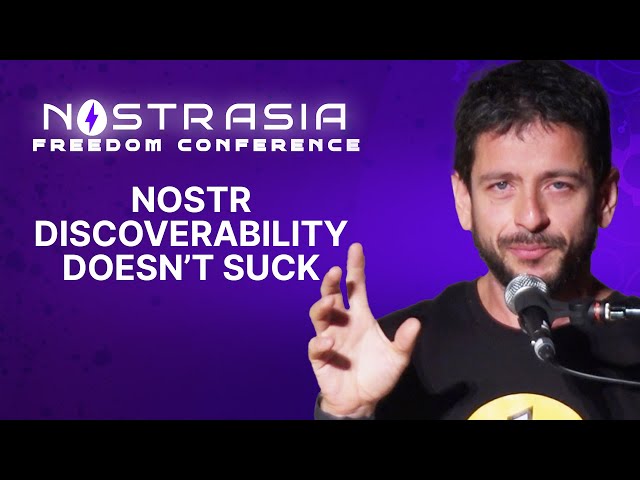
The YakiHonne community is excited about Nostrasia, and they have diligently transcribed Nostrasia's inspiring speeches. Additional speech transcripts will be made available over time. The Japanese and Spanish versions are initially translated and proofread by community members with the help of AI tools. All YakiHonne users are invited to join in the review process. Those who successfully complete the review will be granted a special reward of 3000 Sats. To get started, simply reach out to us (Comment here, DM, or TG) to sign up, and the first person to contact and submit their review will be the lucky recipient of the reward. And hey, if you're up for it, we'd love to have these speeches translated into even more languages. Join us!
🌟中文版: Nostr 的可发现性并不糟糕 🌟日本語: Nostr の見つけやすさは悪くない 🌟Español: Nostr La capacidad de descubrimiento no apesta
Okay, so today I'm going to be talking about discoverability. What do I mean by Nostr discoverability? It is just finding stuff, finding content, finding people, finding new use cases, finding applications, finding whatever.
When I was telling my friends that I was going to be talking about Nostr discoverability, they said it's like one slide just says it sucks. It's completely broken, and fair enough because it's quite true. We have a lot of challenges with regards to discoverability. Like the onboarding experience currently is very subpar. Like these guys were saying just now, there's a lot of content diversity. People come in, it's all bitcoin talk, PSPTD, and PSP stand, and it's just "number go up" and all the typical memes. And a lot of broken interoperability. Clients are still not great at finding events. There's a lot of stuff that you reply to something; it shows weird in one client. It's kind of to be expected because Nostr is like this beautiful chaos, and we're so early in the development of Nostr. But this is just all stuff that has not been fleshed out. It's still early, as we always say. But if we look into the future, we see that Nostr has some really cool properties with regard to discoverability.
The case that I'm going to be making today is that Nostr has some properties that allow it to be just orders of magnitude better with regards to discoverability than the legacy web, the captured web, or whatever you want to call it.
So let's think about how the captured web, the current legacy web, how it does discoverability? Everything in the current web is very anti-natural. Everything is a top-down approach. Everything is synthetic, so discoverability is all synthetic. It's just we are so used to how it works that we don't see that it's not the natural way of doing things. So search engines are a very obvious one. The coercive algorithms that Twitter has, that Facebook has, which the algorithms we always not discuss a lot about. But algorithms are basically a way of a top-down approach, telling you, "I've decided that this is the content that matters to you, so here, have the content. I'm gonna feed it to you."
App stores are an aberration. They don't make any sense other than to solve an underlying problem. Each one of these industries is a multi-billion dollar industry unto itself. So how are we here? We're barely or underfunded decentralized protocol. We are like 10 people here, and we all fight about the nibs and whatnot. How are we going to displace these industries or at the very least replace them? I don't think we're going to replace them. I think we're going to just make these things obsolete because we're fixing an underlying problem of data flows, and I think we're going to redisplace them by playing a different game, not competing head-on. We're changing the structure of the game, and we're designing our own playing field.
So let's back up a little bit to the properties of Nostr because this stuff is kind of technical, but it's like one slide. But how does Nostr work? In Nostr, everything is an event. Just the subs are events. Like, deleting something in it is an event. It's the only construct that we have, are events.
Now events can reference each other. So they create like this weird soup of chaos, right? Like you can have a like of a deletion, and the deletion is of a zap, and like you can create any kind of weird construct, and this weird soup makes a bit of like it unconstraints the flow of the data. The data can just go anywhere, and it's just like a stew. So I've been calling it like a bit of data liquidity. Like the data becomes fluid, and it goes from one place to another, completely unconstrained, because before we had the data was siloed in the platform that was creating the data. So this is a bit abstract. So let's take it a step back and let's look at an example.
How does it work currently, the production and consumption of the data, and how can it work in Nostr, and how does this affect discoverability? So on the left side here, we have a typical Twitter interface. There's a bunch of tweets, and someone links to a YouTube video. So some of the followers of this person go to YouTube; they watch the video. There's a discussion that ensues on YouTube, and this data is part of data that was some activity happening on Twitter. But then that attention and that energy flows into YouTube and then stays constrained within YouTube. And this is a little bit weird because when you think about it in these terms, you realize that there is a discussion that is going on about a video or a book or a song or whatever it might be, and the fact that the origin of the discussion is a certain media type or it's happening on a certain platform constraints that discussion to that platform. And if you think about it, that's super weird. Like why? Imagine if you were talking with a friend, and because you're talking about a concert you need to go to like this one room, and you can only talk about the concert in that room, and then when you talk about a painting or the plans for next weekend, you go to this other room. It's very strange. If I follow you because I'm interested in your conversation, in your thoughts, I want to see your thoughts about the video, the concert, or whatever it might be.
And what's interesting is that the platforms, because this is happening, the platforms are competing in a sheer game for your attention and your energy. And that's why we see all these perverse incentives, like what Elon is doing now with Twitter, where if you put a URL in your content, your tweet might not be seen as much or is boosted, or these things. This is very strange. It's just been normalized, but if you think about it, it's really weird, and it has profound effects on discoverability of content. That's what we're going to see here.
Now, in another world, I link to a video, I publish a video event, whatever it might be, like on NIP-94, for example. And the discussion of the video is just kind of ones that are tagging a video. So as we are having a conversation about a video or a song or whatever, the discussion is going into the fit. So if I'm having a discussion about a book and I'm tagging the book, my notes, my discussion about the book is kind of on. So people that are following me are going to see that, and maybe they'll find a new book that they didn't know about. So this is organic amplification of the reach of content. So it solves distribution. It solves discoverability in a very different way. It's just if there is activity, if there is engagement with a piece of content, it just naturally happens to be dispersed through the social network. It doesn't require an advertisement. It doesn't require a search engine result. It doesn't require a top-down approach of "this is the content that is good for you, my little child."
So there's an important aspect of when we marry and we unleash this chaos of data, there is a big technical tax that applications must pay because of this. And there was a very funny example that happened a few months ago. The tax is that if, say, for example, I make a comment about a song, or I make a comment about a book, or about whatever, a coin showing transaction, any kind of Nostr event, or an IoT, a light being turned on, and I made a comment about that, it means that that data has to go to Damos and Amethyst and Primal and Snort and all the clients, all the kind of one-centric clients. They must understand what each different kind number represents, and obviously that doesn't scale because there's like a lot of numbers, like millions of numbers. And that would mean that Damos has to know, "Okay, kind 31337 means 'softer' song." It's just impossible to handle all the different kinds. So what's amazing is the context, right?
And here's the funny example that a few months ago, I wrote a music client, sort of like a Spotify client, based on Karnage's design called, and as a test, I uploaded a song, Lana Del Rey song, because I listen to a lot of Lana Del Rey, and went into "softer." And on the chart part of the client, he responded on the Lana Del Rey song that just was named "test." He responded, "Is this Lana Del Rey?" The event that he created with Nostr was properly tagging the song. It's just Damos or Amethyst or no other client, because I was just making up, the client knew what the hell that was. So for followers, that was like, "Is this Lana Del Rey?" with zero context. And before, and already talks kind of cryptic sometimes, so it could be one of these weird messages that he's sending.
So there are two solutions to this problem that make it from a challenge into a really amazing construct. And both of them are really simple. The first one is NIP-31. NIP-31 is simply an ALT tag. If you remember the days of the 56k modems or 28k modems and images downloading very slowly, images would have a text that would explain this image once it finish downloading. This image is going to be a cat licking a baby or something. So the NIP-31 is simply a human-readable tag that any client can implement, and they don't need to know that kind 5,000 is a DBM job request or kind 8,000 means this other thing. It's just literally on the event; it says, "This is a song, 'Summertime Sadness' by Lana Del Rey." That's it. Just that's the context.
So going back to the example, it would say, "This is a song," and the response is, "Is this Lana Del Rey?" which would be obvious, but yes, and context is very important. But we can go even a bit further than that, leveraging Nostr in a very funny and cool way. Now, the context is great; like you see, "Okay, this is a song." But maybe you don't know the song. What if you can tap and just listen to the song in a Nostr client that knows how to talk that specific kind? And this is possible, and it's really funny because it's quite simple, but it feels like if you imagine, it feels very magical.
So if you think about NIP-89, which is the proposal to make this happen, it's a little bit like glue. It ties everything together in a bit more of a seamless experience where you don't need to know that if you want to watch a livestream, you go to "soft stream," and if you want to create a highlight, you go to "highlighter.com." To all these different clients, you can just leverage Nostr for that.
And NIP-89 is very simple. It's just an application which developers can say, "My application can handle songs," or, "My application can handle creating, categorising people," or, "My application can handle creating coins," whatever it might be. And then, on the other side, its users say, "I use this app for creating lists," "I use Nostr for creating highlights," "I use 'highlighter,'" and now when you tap on the application on the event that is a kind of Damos or Amethyst, well, probably not Amethyst because Beta will support every single kind in the world, but other than Beta, all the other normal clients by normal people, you tap on the event, the client doesn't know what it is, it just says, "This is Lana Del Rey," and you tap it, and a music player pops up with the song. And Damos doesn't have to do any work with regards to supporting the song, to understand what that kind is, it doesn't have to do anything else. So it scales without extra work for each individual new use case of Nostr.
So it's really cool. It feels very magical, and it brings everything together. And the way I've been thinking about it is it allows any developer with no marketing budget to come in and create a new client, a new kind, a new use case, an entirely new thing and get organic reach. If there are users that want to use that new product, that new use case, this construct creates organic distribution, organic discoverability of this use case, of these apps, and it allows developers to explore the long tail, to really look into things that would not have been possible otherwise because maybe the user base of your use case is so small that it would be impossible to bootstrap a network effect, but in this way, these five or six users that you might have are your distribution. Like if they are impacted by the product that you're making, the interaction of your users with your product, that interaction is the marketing, like each touchpoint can be the marketing, the distribution of your product, and it's organic. If your product is trash, then you will get no distribution. If your product is fantastic, a lot of people will find this new content or this new way of doing things. And to me, that it feels much more natural, much more aligned with how reality works instead of having this one voice coming from the heavens and telling us, "You need to use WeChat," or, you know, like, it's just use whatever you do, and if your network is using it, it will be amplified. If your network is not using it, it will die off. And there is something very powerful to be said about super apps because I see Nostr as competing with that. It's not so much competing just with Twitter, it's competing with super apps. And I think these constructs allow us to create very compelling super apps at the protocol level.
And I've been thinking that super apps are not evil. They are not created only as a power-hungry, state-funded WeChat or Elon that wants to control absolutely everything. In reality, these big tech companies must explore the ad-chasing markets as a mode. If Amazon remains only selling books, Amazon gets crushed by someone that was selling music but transitioned to also selling books, so there is a very strong incentive to conquer all. Like you start with one niche, and then you start expanding and expanding and expanding and expanding as a way to defend your initial niche, right? Like as you expand, you need to also defend, but the expansion is the defence. Like you cannot survive in a big Tech Market because transitioning from one place to another is so trivial that if you don't expand and take everything and provide a full service for every need that your users have, they will go somewhere else. Someone else will conquer those use cases. But this has a very important challenge, and I think this is one of the things that really excites me about Nostr, the fact that these applications must become, to survive, they must become big. They must serve billions of people. It means that the experience must resonate with different cultures, with different values, people that have different expectations. And in a way, I think this is why the web in the past 20 years has transitioned to look the same. Like you go to Amazon, Italy, and it's kind of the same like Thailand. And you go to Twitter, and it's pretty much like a blue sky. Interface-wise, you go to any page, like software as a service page, and it's all the same structures, like the here and the features, and the testimonials, and a bunch of unrelated brands, and it all looks the same. And I think it's partially downstream from the fact that there are these incentives. Because at the beginning of the web, like the '90s, it didn't all look the same, it didn't all feel the same. So in a way, I think as a species, we've been paying a bit of an innovation tax. Like there is a lot of innovation that hasn't happened because applications must serve billions of people. And this is my favorite example. I think Arino was around here, so he created this client. It's a microblogging client, but it looks like a video game, and you navigate it as a video game. It's a fully different experience that could not exist without Nostr because it's such a weird experience, and navigating is so different that it might appeal to people that are currently Nostr, maybe to like 10 or 50 or something like that. Maybe worldwide, it's a total addressable market of like a thousand people or something like that. So there is no way you can create network effects on something that appeals to such a small minority of people. But because it can leverage the rest of the content that is producing demos in amethyst and you have, you can have interactions with people that are using a typical-looking client. This type of client is possible.
So I think we're going to see a flourishing of these types of clients. And if we look back to the beginnings of Twitter, to the beginnings of Facebook, like probably everybody here remembers that there used to be more third-party applications that created slightly different experiences, that they were more creative, right? But of course, the problem with a third-party application is that it's a third party, so you can't really transition from creating a weekend project to create a business. You are always downstream from the fact that you need to use an API key to get the content that is the soul of your application. Um, and that has been abused over and over and over and over again. Reddit, Twitter, and Facebook all ended up shutting down these things. So obviously they cannot sustain innovation, but the innovation tried to come from this standpoint, it was just killed because it was completely centralized, it was completely permissioned innovation. But yeah, I mean, Nostr has been around for a very short time, relatively speaking, and we already see a lot of creative new experiences. So my point of the talk is to just embrace the chaos. We have in front of us a very beautiful, um, beautiful and honest opportunity of experimentation, of just exploring the long tail of everything, of experiences, of current use cases and new use cases, and munching a bunch of data types together that were not explored or putting them together. We have a very strong hand with regards to how simple yet powerful the protocol itself is, so my take is that we don't need to hide this chaos. I think the competitive advantage of Nostr is that it is chaotic, and we can at the edges organize it in different ways. Like we can display the chaos in creative and new ways, and most of that will not work, some of that will. We'll learn a lot, but we have the opportunity of chaos and allowing the individuals to choose the level of exposure to this chaos. I think there is no other, there is no competition here, we are creating our own playing field. So just, yeah, embrace the chaos. Thank you.
We have time for a couple of questions right up front.
Hi, how are you?
Hi, my name is Ladi. The question I have for you in the very beginning of this talk, you were addressing some of the issues with Nostr, including onboarding and also the diversity of content, and a lot of that is because the average person is not really on this or part of this ecosystem. What are some ways that you would like to see those things change, and what are some things that anyone in this room can do right now or right after this conference to be able to mobilize those things?
So the first thing that comes to mind is the obvious one that absolutely everyone can do is just create diversity of content, right? Like if you don't like the lack of content diversity, just create different content. I don't really believe in pitching too much. Like we, in a way, pitching is sales, and in order to have sales, you have to have a compelling product first. I don't think we are there yet, but we have very strong fundamentals that we will get there. So just create the type of content that you think needs to exist. There is a larger conversation with regards, and they talked a bit about remote signing and stuff like that. Currently, onboarding private Key Management is really weird for people, and the obvious way of doing private Key Management is just don't manage them for normies, right? So you go to Damos, you download Damos, you create your key there, you never see the nsec, it's just there, and you don't use any other client for anything else, and your Nostr experience is very limited, it's very limited. You've experienced like maybe 0.1% of what Noster is.
Nostr pretty much like Bitcoin Nostr is the once you go to another client and another client and they are all different and they are even today that we have a lot of Twitter clones, they are all very different. If you don't experience that, it's really hard to say that you like what's the difference between experiencing one client and just going to Twitter. It's just like a worse version of going to Twitter. So I think we have a lot of work to do with regards to me, the solution is remote signing. That's why I wrote Insc bker, which is a way to do remote signing, and I want to integrate with Umbrell. I want to integrate with Star9 and what they are saying. I really think that we need to have a custodial service where you just create an account, you just have an email and a password. Like the way I imagine the password is just an encryption on Insect Banker. It's not like a real password, it just allows you to decrypt, but the email and password flow is very familiar. It's something that people are used to. And I think we need to attack from that front. We will end up being able to teach people about private key management. But if you off the bat are okay, read these six books and welcome to Nostr, it just doesn't work. Right, and your friends are not here, by the way, and you learn about PSPTs and how to broadcast transactions on radio. It's not appealing, right? So I mean it depends. Okay, there's some freaks. Hope that helps.
In the interest of time, we should probably wrap up with that. Thank you very much.
Thank you.
About YakiHonne:
YakiHonne is a Nostr-based decentralized content media protocol, which supports free curation, creation, publishing, and reporting by various media. Try YakiHonne.com Now!
Follow us
- Telegram: http://t.me/YakiHonne_Daily_Featured
- Twitter: @YakiHonne
- Nostr pubkey: npub1yzvxlwp7wawed5vgefwfmugvumtp8c8t0etk3g8sky4n0ndvyxesnxrf8q
- Facebook Profile: https://www.facebook.com/profile.php?id=61551715056704
- Facebook Page: https://www.facebook.com/profile.php?id=61552076811240
- Facebook Group: https://www.facebook.com/groups/720824539860115
- Youtube: https://www.youtube.com/channel/UCyjDDtWFCntGvf4EyFJ7BlA
Help keep these ideas circulating
This is an independent project. If you'd like to help support it, you can make a contribution. But there's no obligation at all. Reading, sharing, and coming back is already a form of support.
Read also
1
🚀 YakiHonne第三阶段白皮书已经发布。关键点: 1. 探讨Relay可能的经济激励和证明机制,以此改善Relay网络的可用性和可靠性,从而为YakiHonne实现去中心化媒体提供坚实的基础 2. 对现有媒体协议的去中心化特性进行数…
2
传统黑客松:闪耀火花中的局限 过去几十年里,黑客松一直是技术文化的培养皿——24小时或48小时的狂热编程马拉松,在披萨、咖啡因和几近不可能的乐观情绪中推进。 自1999年Sun Microsystems首次举办黑客松,要求Java开发者在P…
3
Creating and using Smart Widgets on YakiHonne is a powerful way to engage with your audience, promote your brand, and dr…

Want to publish here too? No sign-up, and the text stays yours. Learn how to start
Replies (0)
Loading…