Max Webster: Investing in Nostr Startups
4EE0HMBIdVA9KHsVCeCI3

YakiHonne
YakiHonne is a Bitcoin-native, open-source social payment client on Nostr — sovereign content, Lightning payments, and programmable infrastructure for the open internet.
27 min read
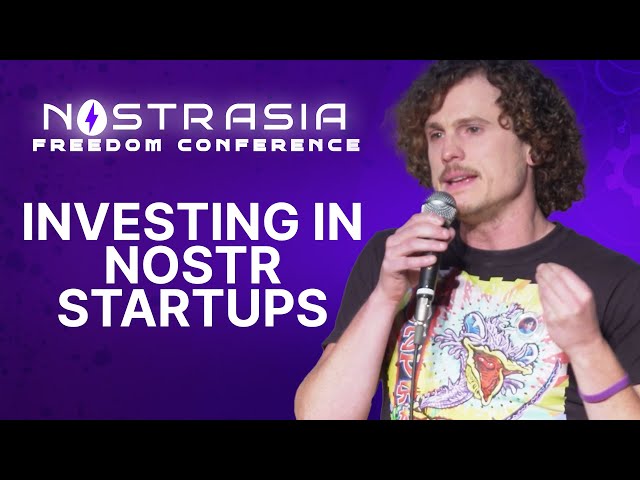
The YakiHonne community is excited about Nostrasia, and they have diligently transcribed Nostrasia's inspiring speeches. Additional speech transcripts will be made available over time. The Japanese and Spanish versions are initially translated and proofread by community members with the help of AI tools. All YakiHonne users are invited to join in the review process. Those who successfully complete the review will be granted a special reward of 3000 Sats. To get started, simply reach out to us (Comment here, DM, or TG) to sign up, and the first person to contact and submit their review will be the lucky recipient of the reward. And hey, if you're up for it, we'd love to have these speeches translated into even more languages. Join us!
🌟中文版: 投资 Nostr 初创项目 🌟日本語: Nostr Startupsへの投資 🌟Español: Invertir en empresas emergentes de Nostr
Okay, good morning, everyone. How are you guys feeling? All right, first of all, how badass is it that we're in Tokyo right now? Thank you guys so much. Yeah, thank you so much to the organizers. it's crazy that just seven months ago, we were all meeting up in Costa Rica, and now I think we're got to be in the coolest city on the planet. So this is really awesome. You guys pulled it off. I'm personally super excited to meet more Japanese users as well and learn more how the community here is using nostr. I think that's awesome. Also, I just want to say that the last presentation by Bob was mind-blowing. So round of applause for Bob. That was so cool. In fact, the presentation before it was also mind-blowing. Like so much cool stuff to talk about.
So I'm going to keep this talk pretty simple today. No slides, in fact, and my goal is to give you guys, perhaps a slightly different perspective on nostr and what I'm thinking about right, and so as an investor in this space, I'm extremely excited about what nostr means for freedom and for the world, but I also think we have the opportunity to build some of our generation's defining companies here, and I want to give a little bit of that perspective and then quickly, hopefully move into Q&A to answer whatever questions you guys have about, does it make sense for me to potentially build a startup on nostr.
So three things I want to touch on today. One, why am I excited about nostr personally and professionally? Number two, what does my model look like as a venture capitalist, and what am I looking for in founders, and then number three, what are some of the ideas that I would love to see explored and potentially built today. Sounds good? All right.
So first of all, why am I excited about nostr? In nostrica, about seven months ago, I talked a LNbit about this, so I want to give some of my updated thinking here today, which I think continues to evolve. First of all, I think humanity is at a turning point. I think everyone here agrees with that. I think that the technology of the day determines how humans organize, and so the state made a lot of sense when we needed information from the edges to be recentralized so decisions could be made and sent back out to the edges.
That made sense. Nothing bad with it. In fact, it was necessary, but the reality is, in today's world, when we have instant communication with information technology and now, as Bob just showed, instant value transfer as well. When you pair those things together, I think we have the opportunity to create what my fund is named after, which is a real-time coordinating hive mind. I think, in fact, the hive mind is inevitable. I think the technology of today necessitates that this hive mind is going to exist, a hive mind of eight billion humans and who knows how many trillions of machine intelligences. This is inevitable in the sort of Kevin Kelly sense of the word when he says that there are forces, sort of universal forces, that are forcing the structures of what technology and societal organization will happen, but I think there is a question, and that question is, will this hive mind be a decentralized hive mind where each neuron has autonomy or a centralized version? And I think that question remains to be answered.
So I think that our mission today, all of us here as builders, as investors, as promoters, as whatever, is obviously to make that latter vision the reality, the centralized or the decentralized version of this. So that's why I'm excited about nostr, just as an individual. I think together, as Bob just showed, when you have an entire stack of decentralized payments, decentralized money, and now decentralized communications and data, there's a tremendous amount of opportunity to build there as well, and this is what gets me excited as an investor, right? We're still at a very early stage in terms of even Bitcoin adoption. Maybe we have 200 million users, something like that. That's akin to 1997 levels for the internet from 97 to 2007 and a little bit later. That's when we saw some of the biggest companies of our generation ever built. The Googles, the Facebooks, the Twitters, all came about in that last wave. Now, whether or not we're ever going to see companies that big again, I think that remains to be seen. That's an open question.
It may or may not be a good thing for humanity, but I think that right now, as we go from 200 million users to two billion users in Bitcoin, things are going to happen over the next several years, and I think nostr is going to be, as we just saw with Bob, the messaging layer that pulls many of those applications into reality and so for me, when I look at this as an investor, I see the opportunity to rebuild the entire web that we have today as an open web on that open protocol stack and potentially build something many orders of magnitude bigger because once you include all the billions of people who are more or less cut off from markets today and all the trillions of artificial minds that are coming as well, I think no one has any idea of how big this is going to be. That sounds exciting to me. So that's why I'm excited personally. That's why I'm excited as an investor.
The second thing I want to talk about is what does that mean? So for you guys, I know the sort of world of investing in venture capital is kind of a little bit opaque. It's kind of weird. In fact, I was not an investor for most of my life before getting into investing just a few years ago. I was also a builder working on actually decentralized energy systems, solar in Mexico, and eventually came into the investing landscape, but I think it's important for you guys to understand how does an early stage investor think? What is it that I'm looking for and why? And every investor is going to be different. For me, to give you guys a sense, I think the true sort of best platonic ideal of venture capital is risk capital, right? I think a lot of what you think of as venture capital today has nothing to do with what I'm doing. It's become sort of late-stage private equity investing, which is looking for,what kind of boring enterprise, I don't think of that as real venture capital. What I'm interested in is can we try and build something radically new and still take risk, maybe even before anyone has traction in order to do that? That's why I have a very small fund. I've tried to keep my funds very small so that I can go in super early, write small checks, be that absolute first yes for an entrepreneur. If you have a really wild and ambitious idea.
Now, for me, the way my model works to keep this really simple is imagine if I have a $2 million fund that I'm investing. I write $100,000 checks. This is all just to make the math simple. Each of those checks that I'm writing in the back of my head is one question. If this thing gets really big, just imagine stuff goes right, really, really right, could I at least return the fund on that $100,000 investment? That means could my $100,000 check turn into $2 million with a 20x return? That's like the absolute minimum of what I'm looking for, and by the way, I think that there is a model where maybe smaller companies don't have to get to a Google or Twitter or Facebook size to make those kinds of returns. If you're a very lean and capital-efficient company and maybe you only raise once, maybe I'm the only check you ever take, which is great.
The other option, though, is that I'm thinking, well, what if this goes really, really, really right? Is there a chance that $100,000 check could thousand x and then, then all of a sudden you're talking about $20 million or more return to the fund. That's what I'm really interested in. So whenever you hear a venture capital say, maybe this idea isn't big enough, that's what they're thinking in the back of the head. That's what I'm thinking is if this goes right, what could this look like? And that's why I like betting on really wild ideas and founders that are exploring areas that could get really big.
So when I am looking and meeting with a founder, the three or four things that come to mind.
Number one: Could this market be big? Are they asking questions in a market where things go right? I could potentially thousand X on this.
Number two: Is this founder someone that has a unique insight about the world? I love listening to people that have discovered something new that lights me up, and almost every entrepreneur that I've had the fortune to work with has had some interesting insight about the world. In fact, I would say the insights that I just heard from Bob, that was certainly a big one for me, and then, from Stuart before that, he had a lot of incredible insights. I want to hear that you have something new, that perhaps I haven't thought of before, or if I have, it's a completely new sort of flavor.
The next thing I'm looking at is: Can you ship super fast? And the reason is, at the stage that I'm betting, I like to be the absolute first money in. I like to work with you at the very earliest stage, and so I'm thinking, is this person going to learn fast? Because no one knows what's going to work, right? Like, I love coming to conferences like this because people are experimenting with five, ten different things, and that's awesome because we don't know what's going to work and what's not. We need feedback from the market, but in order to get that feedback, we have to ship fast, we have to iterate.
And then the last thing I'm looking for is: Does someone have exceptional taste? At the end of the day, to build a truly great and lasting company, the only thing that really matters is taste, because as we see with open protocols, you can't just rest on your laurels with network effects anymore. That's not the case, and that's awesome. In order to build something that grows and becomes something valuable for society, you need to continue to keep iterating, continue to improve your user experience, to make something beautiful, right? And so to me, that's something that I'm always looking for. Is whatever you're shipping fast, does it have heart and soul, and is it beautiful? One example, a company I've been very fortunate to work with here is Stacker News. I think that Keon, first of all, he's a very lean machine. Most of what he was shipping was just one person. Now it's a very small team, but everything he ships, he ships fast, and it's always beautiful, and that's kind of the ideal of what I'm looking for in a founder. Someone that can iterate quickly and learn.
So I hope that's useful to give you guys some context on what a VC is thinking about investing at the early stages. Obviously, with a few caveats, this is only my model. Everyone has different models, but that's what I'm looking for, and I think a lot of people are probably in similar boats.
Number two, to be clear, venture capital is probably not the right instrument for most companies, and that's awesome. What I love about Nostr is that it enables the long tail. You know, growing up in the '90s, I just loved how weird the internet was. Being able to spend hours, looking for torrent, looking for all kinds of bizarre websites that frankly look pretty ugly but were cool because they were unique and personal, and what I'm excited about with Nostr is reiring the internet, and in doing that, I think and my hope is that, a lot of these businesses are going to be able to get profitable on their own. They don't need to raise venture, and that's awesome, but if you do want to work on something big that could get big, these are the kinds of things that I'm looking for.
Okay, so the final thing that I'll throw out there: What are some of the ideas that I'm excited to fund today? Some of these ideas that I'm really excited about are around, four different categories.
Number one: Completely net new apps that couldn't have existed before. Right? So in this sense, I'm thinking about open marketplaces where the order book is shared, and there's one shared liquid backend that's super interesting to me. I think this is obviously going to take place in many different places. I think digital goods first is super interesting. Things around oracles, the nostr asset protocol, I think local Bitcoins can make a lot of sense on here, and hopefully, things I haven't even thought of. That's one area that I'm super excited about.
The second area that I'm super excited about is completely open-sourcing and applying free markets to the AI stack. I think this can be absolutely huge. So my last investment that I made or that's announced is in a company called GPUtopia. This excites me tremendously, and, actually, I think just last week, they paid out their first bounty for Nostr integration. This is super exciting to me because with GPUtopia, anyone can plug in, a GPU, they get paid out sats. Okay, now all of a sudden, we have a marketplace, a free market for computation for GPUs, but that's just the start. I personally am excited to see what does the whole AI stack look like if we apply free markets to it? So that could be something like Hugging Face, where you upload a model and get paid. RHF, where you're providing feedback for these models and you get paid. I think there's so much work to be done here as the AI wave, which I believe is very real, continues to crest. For people to apply free and open markets, and I think Nostr and lightning payments are going to be a huge part of that.
The next thing I'm very interested in is, as a continuation of that, marketplaces for other physical goods that are consumed digitally, and so for me, this includes bandwidth, storage, and compute. We already talked about compute, right? , I actually, I made kind of a tongue-and-cheek comment a few months ago on Twitter and Nostr, where I was like, if you go to, like, any of the altcoin or the shitcoin, as it were, ecosystems and look for the good ideas, there are good ideas out there, and they're probably going to get just rebuilt with lightning and nostr, and so for me,I look at things like, Filecoin or Storage. Are we going to have open markets for storage? Absolutely, we are, and it's probably going to get built on top of nostr. I look at things like, obviously, we talked about Jensen and Gollum. We already have projects like GPiA on compute. What about bandwidth? Projects like Helium that were interesting on actually paying for Wi-Fi. In fact, I think I saw NVK had a very interesting, take on this yesterday as a first step, but I think all of those marketplaces for real-world, resources consumed digitally are going to be absolutely huge.
And the last thing that I'm really excited about is search and discovery. This is something that Stuart was talking LNbit about as well, but in an age when the amount of information on the Internet is about to go exponential, LLMs and generative models are about to create so much information. We're already swimming in information. It's going to get so much worse. We have to find some way to index and discover that information. I think this is probably the biggest opportunity, the thing that I'm most excited about. How can you use an open social graph and an open value graph to find that information? , I've been stoked to take a bunch of bets here, looking at this from different angles, but I think that, no one knows how this is going to work, so I want to take many, many, many more chances to work with entrepreneurs and solving this problem we have.
I know, Mr. Millian, in the audience who's doing some really interesting things on Primal. I know a lot of the other clients' projects like nostr, Band, and others that are exploring this stacker news to its own degree, but I think this is only the very beginning, and by the way, there're going to be subservices that come out of that. Things like reputation as a service. I was having a fascinating conversation with Oscar from Fountain yesterday, and he made the great point to me that so many more people would be prototyping on nostr and trying new things like Bob was talking about. Imagine pay 100 SATs or a thousand SATs if you sign up, but they need to know this person's on a bot, and one way to do that is to have nostr reputation, right? So I think whoever builds those services, you can offer that as an API, paid API. It's going to be very interesting, and that's an idea that I am right now looking to potentially support.
So I hope this guy, I hope this gives you guys a decent overview of how I'm thinking about building on nostr. To sum, I think we have a chance to completely rebuild an open web, potentially more significant in magnitude, with free markets all around it. I think nostr is emerging at just the right time. I think it's not coincidental. I think the fact that the amount of information in the world is going exponential with AI right now means that we need something to fight back, and I think an open social graph with value ranking is going to be a big part of that.
Number two, I hope you guys took away a little bit about how a VC thinks. I know this world is pretty opaque to those that are not in it. So I hope that's a helpful clarification, and again, for most people, VC is probably not the right model, but for some people that want to take really ambitious swings, I think it absolutely is, and finally,I have a couple of ideas that I'm excited about, but the thing that I love the most is if you an entrepreneur, entrepreneur out there, and you have a unique insight that I haven't thought of, I'm way more excited. So with that, I am going to go ahead and open this up to questions because I think frankly hearing from you guys on. What are you actually thinking about like when you're starting a company, what questions do you have? I think that's probably the most useful thing I can do. So with that, we'll go ahead and maybe, take whatever questions you guys have on your mind.
Hi. Thanks for your talk there. I'm just interested as an investor in this space. I mean, so many of the projects are open source, which is obviously a great thing for the community, but what is your ultimate plan for monetization when you're investing in an open-source project?
Ye. So the question is how do we monetize open-source projects? So first of all, this is the trillion-dollar question, and I don't presume to have the answer here. what I'm betting on in a very sort of general sense is if we can onboard 8 billion people and who knows how many machines, the markets are going to be so large that there will be opportunities to monetize. One way of thinking about this on the payment sort of system is, the margins that you're going to take are probably going to be much lower on things, but potentially on a much bigger pie. So today, let's say you're paying 2.9% to Visa or Mastercard. Maybe in the future, with Lightning, payment rails, that comes down to one 100th of the cost. However, if you're onboarding 8 billion people around the world, all kinds of artificial intelligences, maybe the size of the economic pie, total GDP, is actually a thousand times bigger than it is today.
I think that's one way of thinking about it, but there are like very clear models that I think we're going to try and probably will work for a while. One of those models is, looking at how open-source software companies have monetized today. One way is by hosting, right? You go out there, you produce the absolute best product, you get distribution. Distribution is what matters the most, and the way I think about it is if you're using software, everyone pays for it, but you pay for it in the currency that you have. So in the case of a corporation, they have a ton of money. So they would much rather pay someone to host it and potentially offer an SLA, some kind of service and support around that. If you're a hacker with the time and the skills, great. You should be able to use that for free, but you're paying for it with time. So you don't have the money, but you have the time, and I think that's always going to be the case.
If you're a business, you want to focus on what drives revenue for you, and if you can, outsource hosting and service, great. I think another thing that's going to be very interesting is, even though these marketplaces, as an example, are going to be decentralized, there still are going to be pretty sticky and important user interfaces for using the marketplaces. So as one example, how do you become, imagine an open market for everything? LNbits has their marketplace software. It's very interesting today. Anyone can run their own instance, but where are most people in the world going to go and look for that? Like, is there an opportunity to be, maybe it's not Amazon, but maybe it's the Amazon for digital goods where, you have whatever 30% of market share. Maybe it's not 80 or 90% like today, but because people trust you, it comes down to having the best user interface, the best brand, potentially the best guarantees and service around that. So short answer, TBD, long answer, a couple of things we can test.
Other questions for Max?
I remember this topic being discussed at nostr as well, but maybe have different perspectives now. How are we going to avoid centralization because of the VC funding in the space?
Ye. Well, the question is how are we going to avoid VC or centralization due to VC funding in the space? I think a couple of things. Number one, architecturally, what I love about nostr is, even if there is some amount of centralization that occurs, which there will be, at different points in time, we don't know how this is going to look out five, 10, 15 years. There might be different levels of centralization depending on when you're looking out, but you always have that right of exit, and you always have the ability to bring your social graph and go somewhere else. Now, I do think that there are some very critical challenges that need to be solved, for example, before we onboard the next 10 million users.
Some of the stuff that Pablo is working around with some of the gossip relay models and the ability to have potentially topic-related relays, I think that's pretty important, and it's important that stuff builds up before any individual clients or browsers or whatever get too big, but I think in the long run, I'm still not nearly as concerned about that problem. Like, to be clear, there will be big businesses and relatively centralized interfaces which surface, but unlike in today's world where if you're on Twitter, there or X, there's just no way out, you know In this world, as long as we always preserve the right to exit, I think that's the absolute most critical thing, but I do think it's important that we get some more diversity in relays before we get too big. That's one of the bigger threats, I would say.
I'm coming Rockstar on faster, faster.
Hey, Max. So I must say, like, I'm really impressed with you as an investor, and I'm curious, like, who are your in? Who are the investors you're impressed with so we can, like, orange and purple fill them, like, get them in nostr so that they support founders. Because I agree with what you said in the presentation. Like, a lot of investors nowadays, it's all about, oh, can I make 3x on this deal. There are not many VCs that are taking these big risks and betting on founders and helping them develop themselves to, like, hit that window of opportunity that's extremely important in startups. So who are the investors like you that we should, like, orange and purple fill.
First of all, thank you, Roxar. I appreciate it, it's interesting. My girlfriend just showed me this morning an excellent tweet. I actually don't know who it was, but I really resonated with it, where it's like it's kind of ridiculous that Venture Capital has become synonymous with a way to fund sort of SaaS businesses. The reality is for SaaS businesses and the to build an internet business, you can really do that pretty much anywhere today, and frankly, you probably don't need Venture Capital. It's probably not the best way to even be doing it. Like, what Venture Capital, like, at its Platonic ideal, what makes it so beautiful is when it's truly financing something with real risk. Now, for some people, that just means market risk, but I like even more technology risk. That's where venture capital is at its best. So I think, for things like biotech, for things like new forms of energy, I want to see a lot more investing in those types of fields. One day, and, one day when we all ride off into the sunset, everyone has their own INB and their own lightning wallet. That's the kind of stuff I'm excited to be investing in.
Quantum Computing and stuff like that, but in terms of, where we are today, we do still, I do still see a lot of risk in the nostr Community. Like personally, I have strong conviction here and a lot of it just comes down to my gut, but most investors are not going to be comfortable with a lot of these unsolved risks. Like things we were just talking about with relays and whatnot. So I think you have to look for people that really love, again, the Platonic ideal of going super early and also who are mission-aligned, right? I think that's one important thing Is, I am an investor, but I haven't really been an investor for most of my life and don't plan to do this forever, right? Like, I truly believe, I view myself as much as anyone as one of the movement, right? And so we do need more Mission-aligned capital for sure, but then I think we need people that, yeah, that are willing to take those big reps. So you asked me for specific investors. Who would I like to see orange-pilled? First of all, I mean, I have to say I love, for example, what Y Combinator has done over the years, EMB betting when it's just a technical founder or a hacker.
I think that's beautiful, and I think I would like to see a lot more of that. In my own little small way, that's kind of what I'm doing. I'm trying to bet on people when it's just a hacker, and I think that's amazing, in terms of, funds and firms, I will say this, like, there are a lot of funds and investors I used to really look up to and idealize, killed a lot of my heroes over the last four years, seeing people, get kind of, I don't know, taken away, even Sequoia here in FTX or whatever, like, you're kind of like, what's going on? and so it's given me a little bit more confidence of like, okay, maybe the last generation, maybe that's not who we're going to get. I hope we do eventually, but, I would personally love to see, just to give you a couple of specific names, and I am working on some of this. I think there's a lot we can do to build Bridges with Silicon Valley. They don't fully get it yet. They all kind of got swindled in crypto land, but there are smart people there, and I think they will come back, and there are people with good hearts and good consciences as well that want to see a decentralized world.
So to give you specific examples, I think Union Square Ventures, I basically cribbed a lot of their playbook from the early 2010s, and I'm just applying it to nostr and lightning. I would love to see them come out of Ethereum land and come back to nostr and lightning. That would be a really great one for me. Obviously, getting some of the big-name firms, Sequoia coming back in. I think that would do a lot to signal to everyone else that this is real. I think, I always, in certain ways, really appreciate guys like Bill Gurley and I think, someone like him maybe if he looked at this with fresh eyes would probably get excited about the upside and the opportunity, but I think, again, at the end of the day, hopefully it'll be new investors. I know there's other people out there besides me, but people that really, in their hearts, believe nostr and Bitcoin and lightning are what the world needs. so I wish I had a better answer for you.
Give it up for Max. Thank you. Thank you all very much. Appreciate It
About YakiHonne:
YakiHonne is a Nostr-based decentralized content media protocol, which supports free curation, creation, publishing, and reporting by various media. Try YakiHonne.com Now!
Follow us
- Telegram: http://t.me/YakiHonne_Daily_Featured
- Twitter: @YakiHonne
- Nostr pubkey: npub1yzvxlwp7wawed5vgefwfmugvumtp8c8t0etk3g8sky4n0ndvyxesnxrf8q
- Facebook Profile: https://www.facebook.com/profile.php?id=61551715056704
- Facebook Page: https://www.facebook.com/profile.php?id=61552076811240
- Facebook Group: https://www.facebook.com/groups/720824539860115
- Youtube: https://www.youtube.com/channel/UCyjDDtWFCntGvf4EyFJ7BlA
Help keep these ideas circulating
This is an independent project. If you'd like to help support it, you can make a contribution. But there's no obligation at all. Reading, sharing, and coming back is already a form of support.
Read also
1
## 📌 Table of Contents 1. [What Are Paid Notes?](#what-are-paid-notes) 2. [The Evolution: From Flash News to Paid …

2
In traditional social media, platforms monetize attention. On Nostr, value flows directly between people. This is the …

3
Share your thought on comparison of different social medias to win 190,000 SATs.
Want to publish here too? No sign-up, and the text stays yours. Learn how to start
Replies (0)
Loading…