Virtual Reality vs Augmented Reality: Game Changer or Gimmick
2vwH5c1C_MxSTc7qkA6pH

YakiHonne
YakiHonne is a Bitcoin-native, open-source social payment client on Nostr — sovereign content, Lightning payments, and programmable infrastructure for the open internet.
13 min read
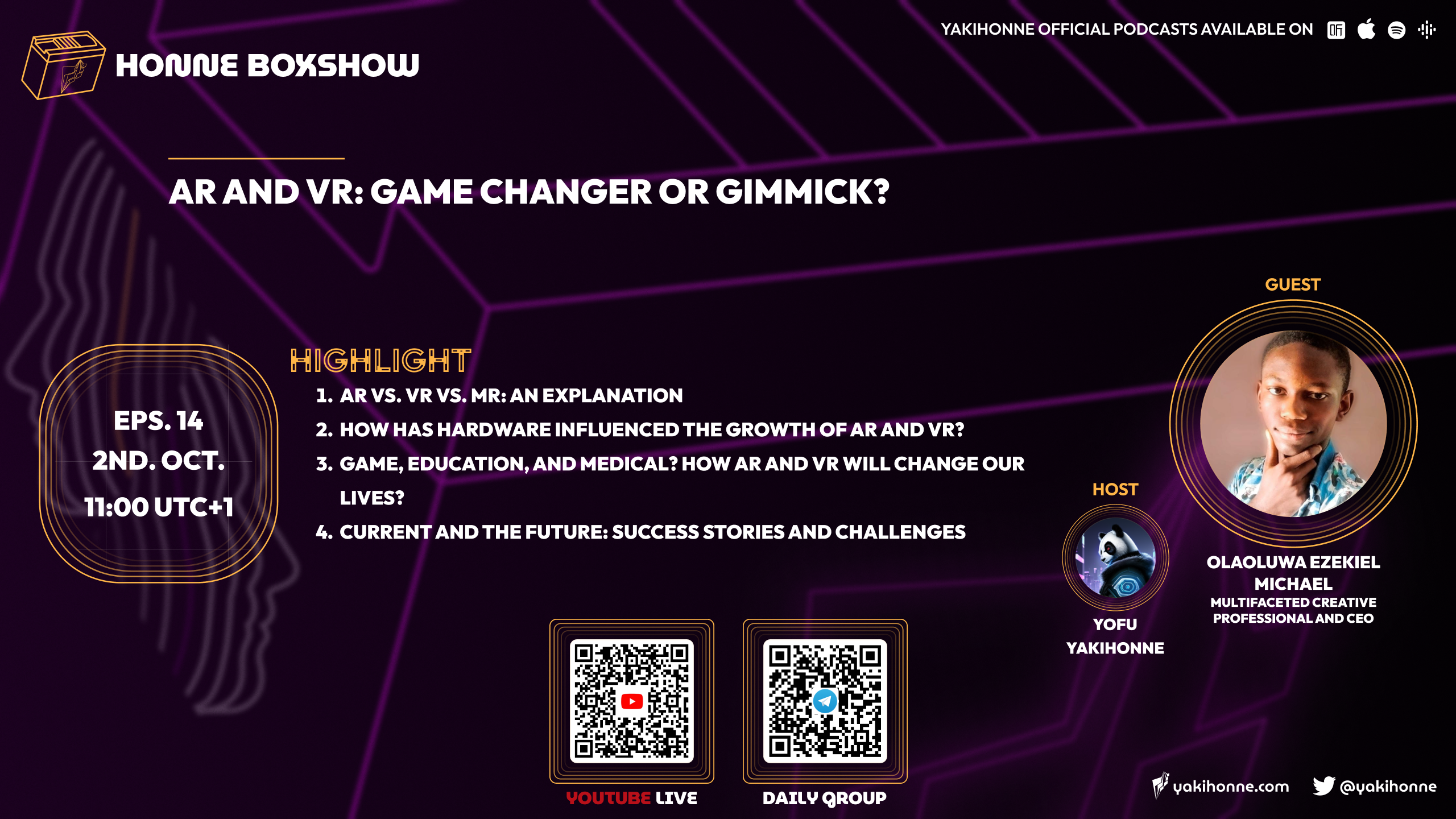
Honne Boxshow EP14 | AR and VR: Game Changer or Gimmick? (Feat.Ezekiel)
Hi there! Welcome to Yakihonne Honne Box show, this article gives the run through of the recent VR vs AR: Game Changer or Gimmick podcast Hosted by Yofu alongside Ezekiel as the guest speaker.
Tighten your seatbelt as we take a drive into the realms of VR and AR.
What Is Virtual Reality?
Virtual Reality is a 3D simulation that overlays the real world, once the user puts on the VR headset he is been placed in this new dimension power by a 360° visual coverage making the user lose all sense of the real world and is then fully immersed into this virtual space. Wearing the VR headset without it been turned on gives the user a sense of blindless as it fully covers the visuals of such person showing how completely covered the user will be, and when turned on all the user sees is this new dimension i.e the Virtual Reality.
What Is Augmented Reality?
Augmented Reality however gives visual displays overlaying our surroundings and points out details to items around us, if you've watched the movie "Avenger" you will see that Tony Stark (Iron Man) has this glasses that gives him information and so on. Just as that was shown in the movie Augmented Reality does just that.
In contrast to augmented reality, which enhances your eyesight, virtual reality replaces it. Many enterprise-level "smart glasses," including the Microsoft HoloLens, the original Google Glass, and others, are transparent augmented reality (AR) devices that enable you view everything in front of you as if you were wearing a pair of clear glasses.
While projecting graphics over anything you're looking at, the technology is made to allow for unrestricted movement. The idea also applies to smartphones with augmented reality (AR) applications and games, like Pokemon Go, which use the camera to follow your surroundings and put visual information on top of them.
AR screens can offer features as basic as a text overlay that displays the time to more complex ones like floating furniture holograms. A Pokemon from Pokemon Go is projected onto your screen and sits atop whatever the camera is focused on. Meanwhile, you can virtually place floating app windows and 3D decorations around you with the HoloLens and other smart glasses.
What Is the Fundamental Difference Between Augmented Reality (AR) And Virtual Reality (VR)?
The key Difference lays within there usage, as one take you to a different world the other give visual information over the real world, in simple terms; Augmented Reality (AR) overlays digital content onto the real world, while Virtual Reality (VR) immerses users in a completely digital environment.
How Do AR And VR Technologies Work, And What Are Their Primary Applications?
As mentioned earlier VR aims at giving the user a feel of reality even while in the virtual space thereby immersing such person completely into that realm, while AR does more be putting out visuals or digital info onto the real world. VR uses headset as the main hardware for running the tech gadget while AR makes use of glasses known as Hololens alongside mobile phones integrated with AR tech Which allows the phone using it's camera to also overlay digital info into it's space. Tech items like Google lens on various phones and PC's is already utilizing this tech.
The Virtual reality technology can be utilized in many ways starting from healthcare all to the military it's potentials are boundless. You can imagine where training doctors can freely learn and treat patients in the virtual World gaining the adequate experience the need to be full flegde doctors without the risk of loosing or harming a real life patient along the process.
Or even look to a situation where our military personnel can give tangible battle experience in the virtual space without ever stepping on a real battlefront. Indeed the applications are limitless.
In current days the gaming industry has been impacted greatly by VR tech and many die-hard and causal gamers are trooping into the virtual space. Though more implications of MR(mixed reality) are also widely used but that will be covered up ahead.
Even civil engineering firms and architects can utilize this tech as they can easily show clients live samples of how the project will turn out using the VR tech.
Also, many implications of AR are used in our day-to-day life like in cases of Google Lens in which you can just take a photo of an item and details about it will be brought up from across the web, or in the case of navigation and Autopilot vehicles.
The Concept Of "mixed reality" And How It Fits Into The AR vs. VR discussion? Initially, AR and VR were mutually separate concepts, but over time, they converged to form a new umbrella category of reality-altering technology called mixed reality. Mixed reality—also referred to as XR or MR—occurs when VR headsets, in particular, use AR components.
There are outward-facing cameras on every major VR headset now on the market that can scan your surroundings and show you what's around you. When those surroundings are taken into account when you're using the headset, virtual reality transforms into mixed reality. Setting boundaries around you to prevent tripping over stuff in the real world can be as easy as that, or it can be as difficult as taking precise dimensions of furniture and creating a virtual environment that accurately replicates those real-world items.
Although it's a broad phrase that, in the end, can refer to any area of the AR/VR spectrum, we are increasingly observing a stable middle ground between them. For instance, the Meta Quest Pro contains color cameras that offer a far crisper picture of your surroundings, project virtual screens on your desk, allowing you to work as though you had several monitors, and even use your actual keyboard and mouse in place of virtual replicas of them. These capabilities appear to be present in the new Apple Vision Pro, which will similarly project virtual things around your actual environment. Apple refers to its offering as a "Spatial Computer."
However, both of these experiences actually rely more on VR than AR. Any headset will still entirely decide what your eyes see, pixel by pixel, unless you're dealing with a transparent display that overlays information about an environment that you can look at directly. While wearing a VR headset, pass-through video gives you a taste of augmented reality.
Key Industries That Have Embraced AR, And How Has It Transformed Their Operations?
Industries like healthcare, automotive, and retail use AR to enhance training, visualization, and customer experiences.
Also stating practical companies like Pokemon go and IKEA which have implemented AR and VR tech has significantly boosted their company stats and stands among there fellows.
In What Ways Has VR Been Used For Immersive Gaming Experiences, And What Sets It Apart From Traditional Gaming?
VR offers immersive gaming by placing users inside a virtual world, providing a sense of presence not achievable in traditional gaming.
The fact that you don't control an avatar or persona to play VR games but rather you are the character itself enjoying is little feel of the game personally is quite thrilling and exciting and of course, will beat traditional gaming in that reference.
What are the current challenges and limitations in the development and adoption of AR and VR technologies?
As for the earlier versions of the VR headset which were release, it was common to trip or bump into something while using and so a large clear space was required to use it, though in a recent development the headsets come with external camera that helps scan the environment around you and ensures that you don't have unnecessary collisions.
Also the VR headsets specifically the advanced ones are not so affordable thereby reducing the populace who can purchase, though they're affordable ones Available but they do not exactly carry much punch as the advannced ones. Also high development costs, limited hardware capabilities, and concerns about privacy and safety are some other challenges faced by this industry. Just like the VR, AR are relative expensive, also adding up to the fact that the various Hololens and glasses made for it are quite large and are not so mobile in use. In addition to that, the hardware for both the VR and AR are quite pricey to come by thereby increasing their production cost.
How Do AR And VR Impact Education And Training, And What Potential Benefits Do They Offer In These Fields?
AR and VR are revolutionizing education with interactive learning experiences and realistic simulations for training purposes. You can imagine just waking up and attending a virtual class, you can just put on your VR headset and immediately be immersed into a digital classroom with other students and a teacher where you can fully interact as though you were actually in a live classroom, compare this to the traditional online classes we currently take and you will see that this is by far more captivating. This wouldn't just be conduesive but also a capturing way to get the students attention as many young lads are interested in new ways of learning using tech resources not to mention this is actually an exciting way to learn certainly it will capture a lot of young people attention and Interest.
What Role Does Hardware Play In The AR vs. VR Debate, And How Have Advancements In Hardware Influenced Their Growth?
Hardware advancements have led to more accessible and powerful AR and VR devices, making them more practical and affordable.
As I mentioned earlier the hardware used to produce this tech gadgets are quite pricey and so makes the cost of production high and on the long run makes the price of the VR and AR devices expensive.
In the coming years more affordable and easily accessible materials will be utilized to the production of AR and VR gadgets making it more affordable to the public. Saying as of now their price cost will make them only accessible to a few individuals and for this reason their current hardware will definitely be improved upon seeking better more affordable hardwares to implement in their production.
Having dealth with the hardware issues the VR and AR industries will definitely reach a wider audience making it more accessible and more demanded.
Ethical And Privacy Considerations Associated With AR And VR Technologies?
Ethical concerns include data privacy, potential addiction, and the impact on social interactions due to extended use.
In the AR and VR industry data privacy will be another issue to deal with as such data for research and improvement sake might be shared to a rather broad Community. Also the possibility of been addicted and losing touch to the real world also raises a critical concern for the AR and VR World, as such could affect social commutation and interactions.
How Are AR And VR Contributing To The Fields Of Healthcare And Medicine, And What Innovations Have Emerged In These Areas?
AR and VR are used in medical training, patient education, and telemedicine. Surgical procedures and diagnostic visualization benefit from these technologies.
This tech advancement is sure impacting greatly into the health sector, imagine where Doctors can train practically in the virtual space without risking any human life, not just that but also having a large flexibility to keep researching. This will by far increase the number of experienced Doctors drastically enabling many young doctors to have the hands on knowledge needed.
The AR can also greatly help in medical research reducing the burden and making information more accessible.
What Are Some Notable AR And VR Success Stories In The Business World, And What Lessons Can Be Learned From Them?
Businesses like IKEA and Pokemon Go have successfully implemented AR technology, showcasing its potential in marketing and customer engagement. These companies have greatly cub down it's labour force burden after this implementation, and not just that but also increasing it's efficiency and making there Services more thrilling just like In the case of Pokemon go.
Are There Any Emerging Trends Or Developments In AR And VR That Listeners Should Keep An Eye On?
Yes there are many upcoming implementation of VR and AR tech that you should watch out for such as: AR Aut
- omotive( Self driven vehicles)
- Architecture preview with VR (Show casing your blue print to your clients In the most realistic way possible)
- Medical training using VR
- Military training using VR
- A reshaped gaming industry
- And lots more, indeed the future is bright for VR and AR tech.
How Do Consumer Adoption Rates Compare Between AR And VR, And What Factors Contribute To These Differences?
Users so far seems to be adopting more to the VR space considering how exciting it is actually, though many devices are currently been incorporated with AR tech so users will definitely be seeing and using the AR tech also. If any of them should be more affordable than the other then we can be sure that it will be demanded more.
Also the MR gadgets seems to have quite a number of attention including mine. Gadgets such as the Apple visions pro is game changing as it offers both the AR and VR utilities, a device that can totally sync with your mobile or PC devices letting you access all your stuffs from it in the coolest way possible.
In Your Opinion, What Does The Future Hold For AR And VR, And How Might They Continue To Evolve And Intersect With One Another?
The future holds promise for AR and VR in various industries, including entertainment, healthcare, and remote collaboration. Convergence of these technologies may lead to more versatile mixed reality experiences.
Although the distinction between AR and VR won't disappear completely anytime soon, it will get blurrier in the near future as mixed reality becomes more prevalent in VR headsets.
We will be seeing lot's of this innovation taking center stage at the heart of many Industries.
Welcome to contact us if you want to talk on Honne Boxshow.
About YakiHonne:
YakiHonne is a Nostr-based decentralized content media protocol, which supports free curation, creation, publishing, and reporting by various media. Try YakiHonne.com Now!
Follow us
- Telegram: http://t.me/YakiHonne_Daily_Featured
- Twitter: @YakiHonne
- Nostr pubkey: npub1yzvxlwp7wawed5vgefwfmugvumtp8c8t0etk3g8sky4n0ndvyxesnxrf8q
- Facebook Profile: https://www.facebook.com/profile.php?id=61551715056704
- Facebook Page: https://www.facebook.com/profile.php?id=61552076811240
- Facebook Group: https://www.facebook.com/groups/720824539860115
- Youtube: https://www.youtube.com/channel/UCyjDDtWFCntGvf4EyFJ7BlA
Help keep these ideas circulating
This is an independent project. If you'd like to help support it, you can make a contribution. But there's no obligation at all. Reading, sharing, and coming back is already a form of support.
Read also
1
In decentralized social networks, your first interaction often defines your entire experience. On YakiHonne, that moment…

2
## The Turning Point of Social Media For years, social media has defined how people communicate, share ideas, and build…

3
## Algorithms vs Ownership Most people don’t realize that when they post on traditional social media platforms, they ar…

Want to publish here too? No sign-up, and the text stays yours. Learn how to start
Replies (0)
Loading…