Two Treatises of Government
library-two-treatises

Max
Praxeologist ~ Cryptoanarchist ~ Cypherpunk Message me on nostr:nprofile1qqs8t4ehcdrjgugzn3zgw6enp53gg2y2gfmekkg69m2d4gwxcpl04acpzamhxue69uhhyetvv9ujuurjd9kkzmpwdejhgtcppemhxue69uhkummn9ekx7mp0w3radp
4 min read
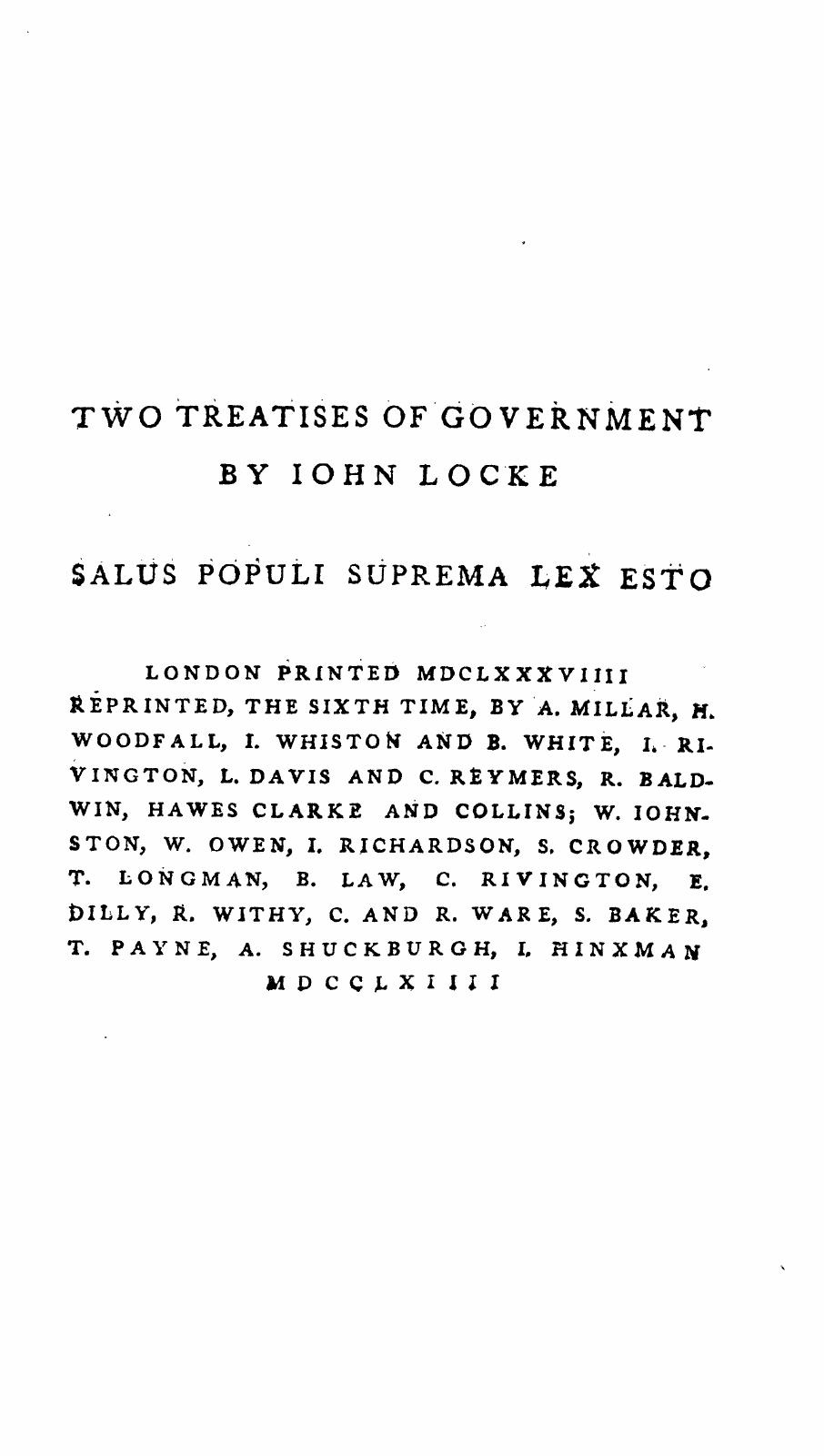
John Locke's Two Treatises of Government asks what gives one person a right to command another. The First Treatise examines Sir Robert Filmer's claim that kings rule absolutely as heirs of the dominion God gave Adam. The Second starts from people who already hold rights under natural law and explains why they form a government and when it loses its authority. Citations follow the Online Library of Liberty's September 2011 Portable Library version 6.0 transcription of the 1764 London edition edited by Thomas Hollis (edition page).
Filmer, as Locke quotes him, rests royal power on Adam's fatherhood and Adam's property in the world, titles that Locke says differ as a lord of a manor differs from a father of children. For argument's sake Locke grants both and follows how each descends. An estate can pass whole to one heir. Paternal power comes from begetting, and an eldest brother did not father his younger brothers, so each son who has children holds authority over them. Within a generation inheritance divides the two titles among different persons, breaking Filmer's single line of absolute kingship. Scripture gets the same scrutiny: a power over Eve drawn from Genesis would need some title other than begetting. Locke's preface defends King William's crown by the people's consent, so monarchy itself survives the argument.
In the Second Treatise people in the state of nature are free and equal because all are the workmanship of one maker and belong to him, and for the same reason each must preserve himself and may not destroy himself. The earth starts in common, and a man who gathers acorns makes them his by labor, since waiting for everyone's consent would starve him. He may take what he can use before it spoils, provided enough and as good remains for others, and enclosing land a parish holds in common by compact requires the consent of all fellow-commoners. Gold and silver, valued by tacit agreement, relax the spoilage limit and let people hold unequal amounts without waste. Each modern estate must meet these conditions to claim the argument's support. The weakest premise concerns America. Because Locke measures improvement by European tillage, he values what an Indian drew from an American acre at almost nothing and treats such land as waste, and his conclusions about who may occupy it rest on that contestable measure.
Government answers the defects of the state of nature, where each person judges his own case with partiality and enforces judgments as far as his strength allows, leaving lives, liberties and estates, which Locke calls property, insecure. Published standing laws and impartial judges supply the remedy. The legislative is supreme yet bounded by preservation, since an unchecked ruler judging his own cause would restore the original danger. Locke offers a standard for assessing governments, without claiming every state began in consent.
Each person joins a society by his own consent, and that act commits him to be governed afterward by its majority. Taxes require "the consent of the majority," given directly or through representatives, and no single taxpayer holds a veto. A landholder who consents tacitly owes obedience while he enjoys the land and may sell it and leave, whereas an express member stays a subject perpetually unless the government dissolves or a public act ends his membership. Locke extends tacit consent to a traveler on the highway. Once residence counts as consent, almost everyone governed has consented, and the voluntary starting point no longer separates a government people chose from one they happen to live under.
In the last chapter, legislators who replace law with arbitrary will betray the trust under which they hold power and forfeit it. Section 225 answers the fear of constant rebellion with a prediction: people bear great mistakes and wrong laws without revolt, and rouse themselves when a long train of abuses makes a design visible. Locke also leaves judgment with individuals. Where no earthly judge exists, every man decides whether another has put himself into a state of war with him and may appeal to heaven, as Jephthah did. Section 243 concerns political power, which stays with the community while the society lasts and reverts to it when an entrusted legislative forfeits its power, so the people may erect a new form or place the legislative in new hands.
The book suits readers who want Locke's reasoning about consent and limited power with its theology and colonial assumptions intact, though the First Treatise's scriptural disputes and the old spelling slow it. The Online Library of Liberty also holds a complete 429-page scan of the 1764 edition, a file separate from the transcription, and that printed text is in the public domain in the United States. Copies of that scan can be downloaded from the Towards Liberty relay, nostr.download and 24242.io.
Help keep these ideas circulating
This is an independent project. If you'd like to help support it, you can make a contribution. But there's no obligation at all. Reading, sharing, and coming back is already a form of support.
Read also
1
Riggenbach's 2009 map of American revisionist history links war, fiction, textbooks and politics, then supplies a fairne…
2
A hands on Python course that builds Bitcoin signatures scripts and transactions from arithmetic and shows what validati…
3
Patrick Newman traces how American interest groups sought government privileges from 1849 to 1929, and how later appoint…
Want to publish here too? No sign-up, and the text stays yours. Learn how to start
Replies (0)
Loading…