Security Engineering by Ross Anderson: Who Guards the System and Who Pays
library-security-engineering

Max
Praxeologist ~ Cryptoanarchist ~ Cypherpunk Message me on nostr:nprofile1qqs8t4ehcdrjgugzn3zgw6enp53gg2y2gfmekkg69m2d4gwxcpl04acpzamhxue69uhhyetvv9ujuurjd9kkzmpwdejhgtcppemhxue69uhkummn9ekx7mp0w3radp
4 min read
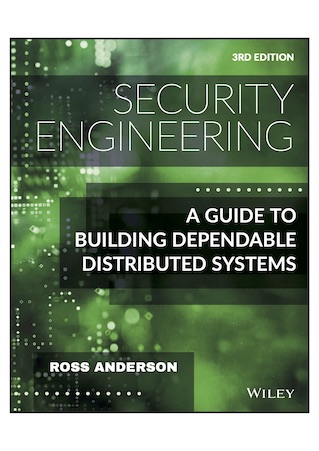
Ross Anderson's Security Engineering: A Guide to Building Dependable Distributed Systems, third edition (Wiley, 2020), treats security as the work of keeping systems dependable against malice, error and mischance. First published in 2001 and revised in 2008, the book argues that a strong mechanism proves little in isolation. A system holds up when four elements fit: a policy stating what must be protected, mechanisms implementing it, assurance about how far those mechanisms can be relied on, and incentives acting on defenders and attackers alike. The book's three parts cover core principles, case studies from banking to medical records, and development, management and assurance. Anderson's archived Cambridge page offers the chapters under an agreement with Wiley.
The framework separates failures that look alike. Anderson classifies the 9/11 hijackers' knives as a policy failure: screeners kept out the guns and explosives they were tasked to stop, while short blades were permitted. Incentives also pushed decision makers toward visible screening and away from cheaper, more effective measures such as reinforced cockpit doors.
The psychology chapter applies the same discipline to people. Anderson distinguishes slips of skill, mistakes from following the wrong rule, and misconceptions about how a system works. Post-completion error explains why more people leave cards at cash machines that dispense money before returning the card: once the goal is met, the tidy-up step gets lost, so the remedy lies in task sequence. Developers have misconceptions too. Beyond a study showing PGP too hard for most college students, Anderson notes that programmers misuse security APIs in code that still appears to work, then spread the errors by copying examples.
Protocols get the same scrutiny, as rules establishing trust between principals under threat assumptions. Early car remotes broadcast a fixed code that devices could record and replay. Manufacturers doubled the code from 16 to 32 bits and advertised billions of combinations. That slowed guessing but left replay intact, because each car still answered to one or two fixed codes. Defeating replay requires an authenticated exchange in which the receiver checks each message's freshness and rejects any it has already accepted, since a nonce protects nothing until the receiver verifies it. Formal proofs help only within limits: TLS was verified in 1998, and later bugs appeared in added features and implementations.
The economics chapter supplies the connecting argument. Security economics starts from an observation: failures persist when a system's guardians do not bear the cost of failure. In Anderson's reading, a vendor racing for dominance gains by shipping fast and courting application developers, then may add security shaped to lock customers in or to protect premium content. A payment provider that spots a new fraud pattern may then have to carry the loss, so it has reason to wait. Applying these historical interpretations to today's vendors needs current evidence. Each case turns on who chooses a control and who pays when it fails.
Privacy appears as a conflict of interests. Anderson separates a patient's privacy from hospital staff's duty of confidence, and shows how metadata, such as contact with a clinic, can reveal what encryption hides. His conclusion treats security as a relationship about how systems exercise power, asking whether social-network users get privacy or advertisers get access. The argument then becomes openly political. With large firms setting policy on speech, contact tracing and facial recognition, Anderson urges engineers to join democratic policy debate, and he welcomes a European sale-of-goods directive on software maintenance for goods with digital elements. In our reading, his cases document misaligned incentives without proving that legislation is the remedy.
The assurance and sustainability chapter extends the incentive problem across time. In 2020 phones got security patches for a few years while cars averaged about fifteen years before scrappage, and Anderson poses decades-long maintenance of software in durable goods as an open research challenge. In his account, assurance moves from certifying a static product toward monitoring and updating devices already in the field along with the online services and phone apps that support them. A connected device's security then depends on whoever ships its updates across the device's service life.
The specifics date from 2020, and the book covers each technology through road maps and reading lists, so current deployment guidance needs current sources. Start with chapters 1, 3, 4 and 8, then the case studies nearest your work, then chapters 28 and 29.
Help keep these ideas circulating
This is an independent project. If you'd like to help support it, you can make a contribution. But there's no obligation at all. Reading, sharing, and coming back is already a form of support.
Read also
1
Konkin's 1980 manifesto proposes counter-economic markets and insurer arbitration as the libertarian route to statelessn…
2
Hazlitt’s Economics in One Lesson guides beginners through prices, machinery, employment and saving, tracing economic co…
3
Walter Block's 1976 defense of reviled occupations, suited to readers testing moral disapproval, coercion, and economic …

Want to publish here too? No sign-up, and the text stays yours. Learn how to start
Replies (0)
Loading…