Man, Economy, and State
library-man-economy-and-state

Max
Praxeologist ~ Cryptoanarchist ~ Cypherpunk Message me on nostr:nprofile1qqs8t4ehcdrjgugzn3zgw6enp53gg2y2gfmekkg69m2d4gwxcpl04acpzamhxue69uhhyetvv9ujuurjd9kkzmpwdejhgtcppemhxue69uhkummn9ekx7mp0w3radp
4 min read
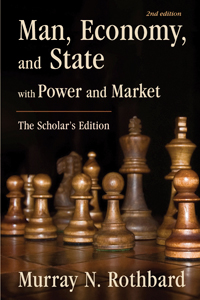
Murray Rothbard's Man, Economy, and State, first published in 1962, builds economics as one continuous verbal deduction. It starts from the fact that people use means to pursue ends. It then adds two subsidiary postulates, that human and natural resources vary and that leisure is a consumer good, and carries the argument from an isolated actor's choices through exchange and money, then production over time and the incomes it generates, to the consequences of coercive intervention.
Rothbard grounds diminishing marginal utility in the ranking of wants. The first unit of a supply serves the most urgent use and the second serves the next most urgent, without any appeal to satiation. He then answers an apparent counterexample. If a cake needs four eggs, the fourth egg seems to complete what three could not, so its marginal utility appears to rise. Rothbard rejects that inference. For him, a good is any supply whose units are equally serviceable, and because the fourth egg is not interchangeable with the first, the relevant unit becomes the set of four. This ties a good's definition to how an acting person can use it, and the later price theory keeps that definition.
Production takes time, and capitalists advance present purchasing power to factor owners before final products sell. Rothbard separates pure interest on that advance from the rents earned by factor services. The capitalized expected value of those rents prices whole factors, and he treats entrepreneurial profit or loss as a further category. To isolate them he uses an evenly rotating economy, which he treats as explicitly imaginary: with every future value known, profit and loss vanish and pure interest remains. Real conditions keep changing and bring uncertainty back, so the market tends toward that state without ever arriving.
His illustration assumes a going interest rate of 5 percent. Jones buys factors for 100 ounces and expects to sell the product after two years for 120. If he forecasts correctly, he earns 10 percent a year. The 5 percent above interest is profit, earned because the market had underpriced those factors relative to the product they would yield. The same accounting can turn a positive cash return into a loss. A line yielding 2 percent against the 5 percent benchmark suffers a pure loss of 3 percent, because in the illustration the going rate was available elsewhere.
The monopoly chapter draws one of the book's most disputed conclusions. On an unhampered market, Rothbard argues, no identifiable competitive price exists against which an observed price could be judged a monopoly price, and a seller who cuts output may be correcting earlier overproduction. The argument attacks the competitive benchmark on conceptual grounds.
The cycle theory puts the time structure to work. When time preferences fall, people save more, and the lower interest rate shifts resources toward longer processes whose output later raises real incomes. Rothbard contrasts this with bank credit expansion while preferences stay unchanged. In his example, two million new ounces are lent to businesses, which bid existing scarce resources into higher stages of production. The new money supplies no saved real resources, and factor owners, whose consumption choices have not changed, keep spending in the old proportions, which reveals the mismatch. A footnote sets the boundary: insofar as the new money is lent to consumers, these particular cycle effects do not occur.
The treatise ends by contrasting voluntary exchange, which benefits both parties and coordinates production, with coercion, which benefits some at others' expense and compounds its own disorder. Rothbard then has economics step aside and leaves the ethical and political choice to the citizen. The Mises Institute offers an official PDF of the 2009 second Scholar's Edition. That edition binds the treatise with Power and Market, a separate 1970 work, and adds an introduction by Joseph T. Salerno.
Help keep these ideas circulating
This is an independent project. If you'd like to help support it, you can make a contribution. But there's no obligation at all. Reading, sharing, and coming back is already a form of support.
Read also
1
Condy Raguet's banking treatise treats banknotes as debts payable in coin and asks which laws could make American banks …
2
Walter Block's 1976 defense of reviled occupations, suited to readers testing moral disapproval, coercion, and economic …

3
Knight's 1921 treatise shows how measurable risk becomes a pooled cost while uncertainty, borne through responsible judg…
Want to publish here too? No sign-up, and the text stays yours. Learn how to start
Replies (0)
Loading…