Lessons for the Young Economist
library-lessons-for-the-young-economist

Max
Praxeologist ~ Cryptoanarchist ~ Cypherpunk Message me on nostr:nprofile1qqs8t4ehcdrjgugzn3zgw6enp53gg2y2gfmekkg69m2d4gwxcpl04acpzamhxue69uhhyetvv9ujuurjd9kkzmpwdejhgtcppemhxue69uhkummn9ekx7mp0w3radp
4 min read
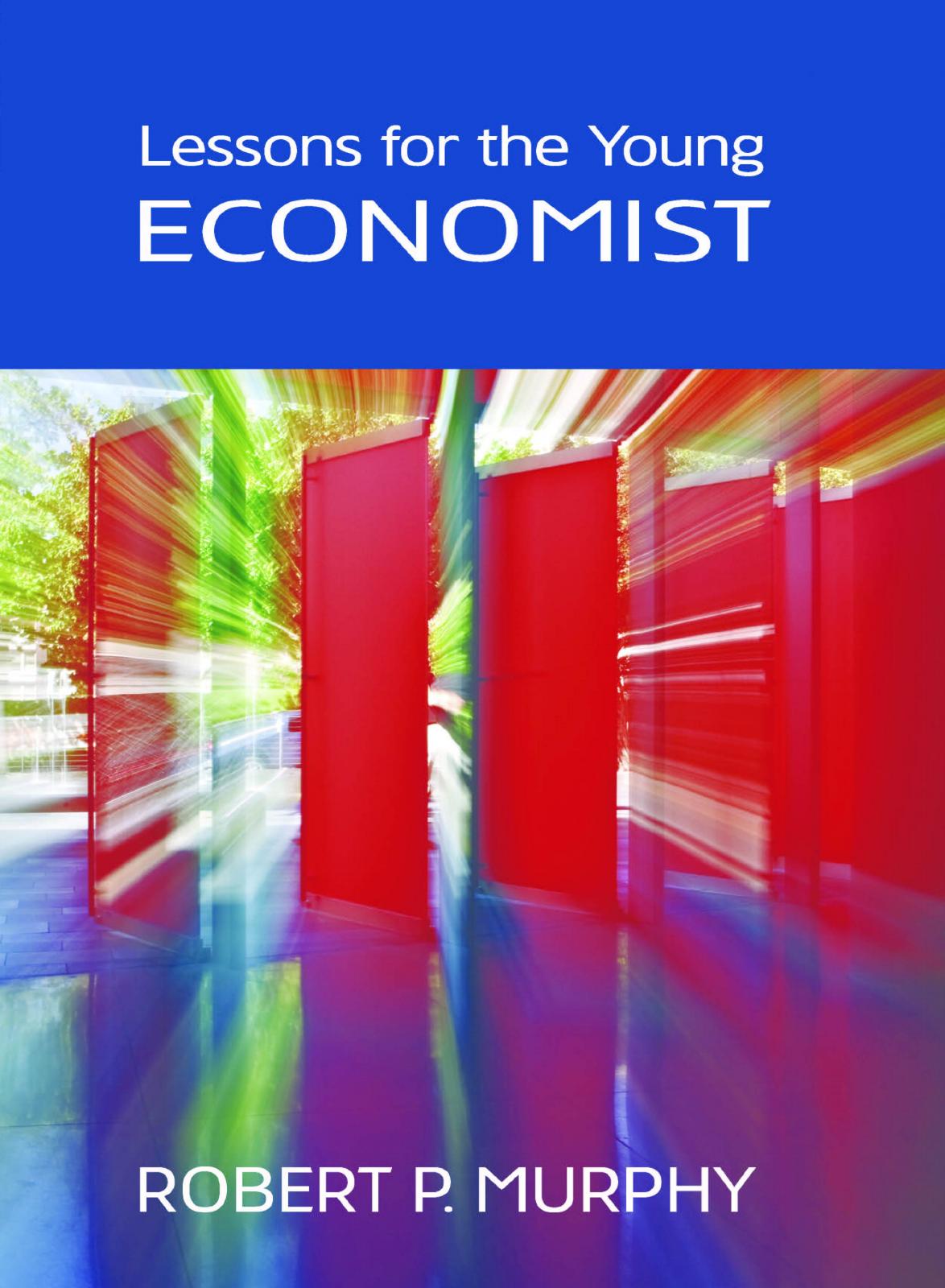
Robert P. Murphy's Lessons for the Young Economist is a 2010 Mises Institute textbook that builds Austrian economics from purposeful choice under scarcity, where every decision gives up some alternative. Its four parts and twenty-three lessons run from Crusoe's island through money and profit to socialism and intervention, closing with the business cycle before a glossary. Murphy treats this core theory as deduction from stated assumptions, closer to geometry proofs than to laboratory results. Method In his account economics leaves ultimate ends to the people acting, so an owner may put charity or family ahead of maximum income while accounting shows what that priority costs. The later policy chapters reuse cost comparisons built in early examples, so their conclusions arrive with the reasoning open to inspection. Lessons for the Young Economist
Comparative advantage puts that comparison to its first visible use. Marcia sells and tidies faster than John, who runs a mall cleaning service, yet in Murphy's numbers closing her store half an hour early to clean forfeits about forty dollars of sales earnings a day, while John will clean for fifteen. Any fee between those figures benefits both. Her superiority at both tasks leaves the hiring decision open until her forgone earnings are compared with his price. Lesson 8
Saving carries the comparison across time. Crusoe's coconut stockpile feeds him while he builds a pole meant to raise his later output, and because capital wears out, some output must keep replacing it before living standards can even hold steady. In a money economy Murphy separates consumption loans from financing for production, and his case for higher future output rests on resources shifting from present consumption into capital goods, a time-consuming shift that consumption loans leave undone. Lessons 4 and 10
Profit accounting turns opportunity cost into a business test. Murphy's investor pays $10,000 for land holding young Christmas trees and by December collects $10,300 from trees and land. If an equally safe bond paid five percent, her three percent return leaves her $200 poorer in economic terms even with her own money, a loss her accountant never records. Such comparisons let consumer spending and input prices steer resources among competing uses, and a profit reports what buyers paid against those costs, a different claim from moral approval. Profit and loss
The calculation lesson removes that feedback. Murphy assumes government ownership of all means of production, leaving inputs without market prices, and grants planners goodwill and engineering skill. Labor and materials still have competing uses, and without input prices the planners lack a way to compare what each project sacrifices. The argument covers that specified system. Calculation
Rent control shows what a legal ceiling does to those signals. In Murphy's apartment example, a ceiling below the market-clearing rent raises quantity demanded and lowers quantity supplied, so landlords ration by screening and other nonprice criteria, and sitting tenants can gain while excluded applicants lose. Murphy's model gives the direction of these effects whenever the ceiling binds. Lesson 17
Lesson 23 ties the saving and calculation arguments together in Murphy's 2010 Austrian account of the business cycle. Voluntary saving frees resources for longer projects and lowers interest rates. Central bank credit creation lowers rates without freeing resources, so entrepreneurs begin long projects that available savings cannot finish, and the economy can consume capital while ledgers show record profits, what Murphy calls "eating the seedcorn." The bust reprices those plans, and workers and resources must move to sustainable lines, a reallocation that takes time.
The chapter closes on unemployment insurance as a tradeoff: how long benefits should last is an economic question no engineering formula answers, and Murphy expects even zealous advocates to reject a hypothetical twenty years at ninety-five percent of salary. His answer favors voluntary saving, yet the analysis prices the tradeoff without proving which moral ends a society should pursue. For a newcomer, the fit lies in arithmetic small enough to check by hand, such as Marcia's forty dollars against John's fifteen or the investor's $200 shortfall, and in a lesson order that lets the business-cycle chapter build on the saving and calculation arguments before it.
Book download
PDF: our Blossom · PDF: mirror 1 · PDF: mirror 2
Robert P. Murphy, Lessons for the Young Economist (Ludwig von Mises Institute, 2010), CC BY 3.0. Unmodified copy; original notices retained.
Help keep these ideas circulating
This is an independent project. If you'd like to help support it, you can make a contribution. But there's no obligation at all. Reading, sharing, and coming back is already a form of support.
Read also
1
Mises explains how entrepreneurial profit and loss arise from judging future consumer prices against costs, and why abol…
2
Henry Hazlitt builds a secular ethics from economics and jurisprudence, judging general rules by their long-run effects …
3
Smith traces wealth to specialization, market reach, capital, institutions, and public finance, offering conditional pol…
Want to publish here too? No sign-up, and the text stays yours. Learn how to start
Replies (0)
Loading…