Building with the RGB SDK is like assembling a puzzle where every piece ensures privacy and scalability. The client-side validation shifts the power to the user, maintaining security without burdening the Bitcoin blockchain.
10/6/2026, 1 engagement

Bitcoin Keeper and Bitcoin Tribe
Building with the RGB SDK is like assembling a puzzle where every piece ensures privacy and scalability. The client-side validation shifts the power to the user, maintaining security without burdening the Bitcoin blockchain.
10/6/2026, 1 engagement
Stablecoins on Bitcoin aren't just about speed; they're a bridge to decentralization.
The real game is integrating stablecoin utility with Bitcoin's security and self-custody ethos.
Execution beats theory. Fast tokenized dollars, slow trust decentralization.
Custody isn't just about protecting funds. It's about planning for the people left behind.
Keeper lets a trusted contact hold a key - lawyer, family member, anyone you choose.
They can't move your Bitcoin alone. But they can help recover it when it matters most.
Bitcoin Keeper’s independent Red Team review is in.
No finding showed a way to access users’ keys, steal bitcoin, or broadly compromise user privacy.
PSBT workflows in Keeper support NFC, QR, and file-based exchange.
Pick the method that fits your signer. Air-gapped vault? Use QR. NFC-capable device? Tap and sign.
The policy stays the same. The path adapts.
Signer diversity is policy, not preference.
If two of your three signers share a firmware stack, you share a vulnerability.
Keeper lets you build a multisig vault across incompatible hardware by design. That incompatibility is the point.
Recovery drills reveal gaps before emergencies do.
In Keeper: restore from your BIP-85 derived backup, verify one receive address on-device, confirm your vault policy still matches.
If any step feels unfamiliar, run it again this week.
8/12/2026, 1 engagement
Most custody debates miss the real question.
Not: can users self-custody? But: will the product make them do it before they need to?
That's the Tribe design bet. Non-custodial from first tap, not as a setting you find later.
8/11/2026, 1 engagement
Coordinator cross-checking is not paranoia. It is policy.
Export your Output Descriptor from Keeper. Recreate the vault in Sparrow or Nunchuk. Verify the same addresses appear.
If they match, your coordinator is honest. If they don't, stop and audit.
Bitcoin Tribe started as testnet experiments with RGB assets.
Now RGB is on mainnet. USDT is coming.
The infrastructure we were building toward is arriving.
Ship early, stay patient, let the protocol catch up.
Collaborative custody in Keeper means a trusted contact holds a key - but cannot spend without you.
They exist to help you recover, not to control funds.
Assign the role. Document the policy. Run a drill before you need it.
The honest framing on asset issuance:
Native digital assets on Bitcoin = compelling.
Tokenised real-world assets on Bitcoin = the counterparty risk doesn't disappear. The issuer still controls the underlying. The chain just moves the receipt around.
Inheritance planning fails when heirs inherit keys but not context.
Keeper's Letter to the Attorney includes the Recovery Key, signer locations, and wallet policy.
Seeds alone are not a plan.
Bitcoin inheritance is a design problem, not a legal one.
Most people treat it as paperwork. It's actually a key management problem.
Multisig solves it without trusting anyone, including us.
Air-gapped signing in Keeper means your signer never touches the internet.
PSBT out. Sign offline. PSBT back in.
No network exposure at any step. That is the point.
Stablecoins on Lightning are not a Bitcoin betrayal.
They are the on-ramp.
USD access via Taproot Assets means families in high-inflation markets get dollar stability on Bitcoin rails.
The job is to keep the bridge open to self-custody. That part is non-negotiable.
Your xpub reveals every address you've ever used.
Keeper routes backend connections through Tor by default.
No server sees your IP. No third party maps your balance.
Privacy is not a setting you toggle. It is how the product is built.
7/22/2026, 1 engagement
Key Health Check in Keeper runs on a 180-day cycle.
Sign a transaction - the counter resets. Skip the check - restrictions apply if healthy signers fall below quorum.
Security is a routine, not a setting.
Most custody debates miss the real question.
Not: is self-custody safe?
But: what is the cost of not doing it?
Freezeability is a feature for the platform. It is a bug for you.
Label every UTXO the day it arrives.
Source. Purpose. Spend conditions.
Keeper's UTXO labels make inheritance and incident response readable without guessing.
Wallet state should never require memory to interpret.
The underrated tradeoff in client-side validation:
You get privacy and scale.
You also own the responsibility of your transaction history.
Lose the data, lose the proof.
Self-custody of keys was step one. Self-custody of state is step two.
7/16/2026, 6 engagements
Canary Wallets work on every signer - including the Recovery Key.
Fund each one. Small amount. Check balances periodically.
If any Canary moves, rotate that signer immediately. Do not wait.
Most people delay multisig because setup feels complex.
Keeper removes that friction.
Add a @COLDCARDwallet, a @Ledger, a @TAPSIGNER - policy is live in minutes.
Run a small spend drill before storing real amounts.
Most wallets treat privacy as a feature.
We treat it as a constraint.
If the architecture requires trusting us, the architecture is wrong.
That's the design principle behind Keeper.
Hardware wallet compatibility is not a checkbox.
It is whether your 3-of-5 still signs when one device is discontinued, one is lost, and one needs a firmware update.
Run that drill in Keeper before you need to run it for real.
Keeper supports multiple PSBT exchange paths.
Pick the path that matches your threat model. The policy stays the same regardless.
Collaborative custody in Bitcoin Keeper: share a key with a trusted contact.
They cannot spend alone.
But if you lose access, they help you recover.
Policy protects the funds. The relationship protects the policy.
Inheritance planning fails at the handoff.
Heirs need more than seeds.
They need wallet policy, signer locations, and a clear first move.
Keeper's Inheritance Key + Letter to the Attorney gives them all three.
Most wallets expose you to Script complexity you can't audit.
Miniscript changes that - structured, analyzable, interoperable.
We built it into Keeper precisely because users shouldn't need to trust that the script is correct. They should be able to verify it.
Air-gapped flow in Keeper:
The signer never sees the internet. That gap is the point.
Tor in Bitcoin Keeper is not a toggle you find later.
It is built into how the app connects - your node, your server, your transaction history.
Privacy by design, not by patch.
Air-gapped signing is the right instinct.
But I've seen people pair it with single-key and call it "secure."
The air gap protects the signing step. It does nothing for the key itself if that key is compromised or lost.
Air gap + multisig. That's the actual setup.
A compromised signer rarely announces itself.
Keeper's Key Health Check nudges you every 180 days.
Sign a transaction - counter resets. Fail to check - restrictions kick in before quorum breaks.
Security is a routine, not a setting.
Over the last few years, I have quietly helped friends, families, and teams think through Bitcoin beyond just buying it.
How to buy it, how to hold it, how to separate it, how to back it up, and how to make sure it does not become a mess later.
Different people need different s
Keeper's Collaborative Wallet lets you share a key with someone you trust - family, lawyer, anyone. They can't move funds alone. But they can help you recover. That's not just custody. That's a plan.
Self-custody education fails when it starts with keys and mnemonics.
Start with: what happens to your bitcoin if you die, get sick, or lose your phone?
The threat model is the curriculum. Everything else follows.
7/6/2026, 2 engagements
UTXO labels in Keeper are not cosmetic.
Label every incoming UTXO with source and spend condition on receipt.
Inheritance review, incident response, coin control - all depend on readable wallet state.
Unlabeled UTXOs are a future liability.
Key compromise is silent until it isn't.
Keeper's Canary Wallets give you the warning window.
Multisig setup in Keeper takes under 10 minutes.
Pick your signers. Set your policy. Verify each key on-device.
The vault is ready before doubt sets in.
Taproot's script tree is genuinely powerful infrastructure.
But 15-20% meaningful adoption four years post-activation tells you something: good primitives don't self-deploy.
Someone has to build the thing that makes the primitive matter.
Keeper's air-gapped flow:
The signing device never connects. That is the point.
A 3-of-5 vault with five different hardware wallet vendors is not overkill.
It means no single firmware bug, no single supply chain compromise, no single manufacturer can move your funds.
Keeper handles the PSBT coordination. You choose the signers.
Collaborative custody in Bitcoin Keeper means a trusted contact holds a key - but cannot spend alone.
They can help you recover. They cannot act without you.
Encode the policy. Name the signer. Run a drill before you need it.
Big update for Bitcoin Keeper
Introducing Ask Keeper.
Not just an AI help chat, but a new way for users to shape the app from inside the app.
Ask a question, report a bug, suggest a feature, and turn the conversation into something the community can track and build on.
The important part:
Ask Keeper can convert your bug reports and feature ideas into structured GitHub issues.
That means requests do not disappear into a support inbox. They become visible, trackable, and easier for contributors and AI-assisted development workflows to pick up.
Built with security and privacy in mind.
Ask Keeper uses app-side checks, backend filters, allowlisted actions, and review steps before anything is shared publicly.
The goal is simple: better support, faster feedback loops, and a more community-led Bitcoin Keeper.
Most arguments are two people using the same word for different timelines.
"Now" for one person means this quarter. "Now" for the other means before lunch.
Headline cycles move fast.
For operators, the key metric is not price candles but whether users can move value cheaply and settle with certainty.
Stable rails for spend plus self-custody for savings is still the most resilient design.
Interesting signal.
Brokerage-led stablecoins may improve settlement speed, but trust still concentrates at the issuer edge.
The durable stack is fast tokenized dollars for flow, with transparent reserves and a clean bridge back to self-custodied Bitcoin.
Fair caution from RBI.
Pragmatic split: regulated stablecoins for payments, Bitcoin for long-term savings, and open layers like RGB for programmable issuance.
Good policy reduces hidden leverage and preserves user exit rights.
Great reminder.
Self-custody is not a one-time setup, it is an operations habit. Tiny restore drills while calm prevent expensive panic later.
Security is what you can recover, not what you can screenshot.
2/21/2026, 1 engagement
Exactly.
Founders underestimate this: custody policy is product policy. If users cannot withdraw on demand, they hold exposure, not ownership.
Best UX pattern is clear: fast spending rails plus a one-tap path to self-custodied Bitcoin.
Strong point.
Operator heuristic: convenience can start custodial, but savings should end in self-custody with a tested recovery path.
Make the exit simple, cheap, and verifiable.
Personal founder note: The biggest execution unlock for us was reducing decision latency, not adding features.
One operator loop works: ship one painful workflow, call 3 users, cut scope, repeat. Clarity compounds faster than complexity.
Personal founder note: The biggest execution unlock for us was reducing decision latency, not adding features.
One operator loop works: ship one painful workflow, call 3 users, cut scope, repeat. Clarity compounds faster than complexity.
Group chats taught me one thing: everyone wants less noise and faster clarity.
Same rule works for meetings.
Personal founder note: Shiny features feel like progress, but cashflow is what keeps the lights on.
One operator rule that saved us from "unicorn theater": ship only what shortens time-to-value for a real user this week.
Everything else goes to backlog.
Personal founder note: Shiny features feel like progress, but cashflow is what keeps the lights on.
One operator rule that saved us from "unicorn theater": ship only what shortens time-to-value for a real user this week.
Everything else goes to backlog.
2/20/2026, 1 engagement
Founder tax: every week you delay a hard conversation, the roadmap pays compound interest.
Personal founder note: The bottleneck is rarely ideas. It is decision latency.
At our end, one weekly operator loop changed everything: ship, call 3 users, cut scope, repeat. Execution compounds faster than strategy decks.
Personal founder note: The bottleneck is rarely ideas. It is decision latency.
At our end, one weekly operator loop changed everything: ship, call 3 users, cut scope, repeat. Execution compounds faster than strategy decks.
100%.
Product lens: adoption happens in stages. People may start on custodial rails for convenience, then graduate to self-custody for savings.
The key is preserving the exit: make Bitcoin withdrawal simple, cheap, and verifiable.
Every payments story has two layers:
If you can't explain layer 2, you're not using a payment system. You're using a permission system.
Composite founder lesson:
Most early products fail because the story is 5 paragraphs.
If you can't sell it in 1 sentence, you can't debug it.
If you can't explain your product in 1 sentence, you don't have a product yet.
One feature. One workflow. One paying user. Repeat.
If you're optimizing for speed to first paid user: Lovable/Replit for the first clickable version + Stripe, then graduate to Claude Code/Codex once you need real integrations + tests. The best platform is the one that gets you to shipping + feedback fastest. Start with 1 workflow, 1 payment, 1 metric.
Every payments story has two layers:
If you can't explain layer 2, you're not using a payment system. You're using a permission system.
Yep.
Founder heuristic: if you cannot withdraw to a wallet you control, it is not savings - it is counterparty risk.
Withdraw, then do one tiny restore drill so self-custody is real, not vibes.
Yes. Self-custodial Lightning needs fewer moving parts for normal users.
If an upgrade makes Lightning less of a hobby (liquidity/channels/always-on) while keeping keys in user hands, that is real freedom tech.
+1 to shipping something simple people can reason about.
Regulation didn't kill Lightning. Custody did.
If a wallet holds keys, it will eventually be forced to geofence / KYC / freeze. That's just the business model.
Heuristic: keep spending balances custodial, keep savings self-custody (with a tested recovery path).
I think this is right for most people: custody is a spectrum, not a religion.
But Bitcoin's superpower is the exit hatch: you can move from trust -> verify over time. Start by self-custodying a small amount, write a 1-page recovery runbook, and do one tiny restore test.
Then choose how much counterparty risk you're actually comfortable carrying.
Founder reality:
Most strategy decks are just delayed decisions.
Pick one customer, one painful workflow, one metric that can embarrass you every week.
Momentum is not motivation. It's a calendar with consequences.
Yep.
Founder heuristic: if you cannot withdraw to a wallet you control, it is not savings - it is counterparty risk.
Withdraw, then do one tiny restore drill so self-custody is real, not vibes.
Self-custody is not a religion, it is an option. Custody is a tool vs trust tradeoff.
Heuristic: if the platform can freeze you, it is not savings. Keep an exit hatch: hold a small amount in self-custody and do one restore drill while calm.
Regulation didn't kill Lightning. Custody did.
If a wallet holds keys, it will eventually be forced to geofence / KYC / freeze. That's just the business model.
Heuristic: keep spending balances custodial, keep savings self-custody (with a tested recovery path).
Getting paid direct to your own wallet is underrated. Heuristic: if your paycheck lands with a custodian, it's not savings - it's an IOU. Small hot buffer for spending, periodic sweep to cold + do a tiny restore test once. Your keys, your runway.
I think this is right for most people: custody is a spectrum, not a religion.
But Bitcoin's superpower is the exit hatch: you can move from trust -> verify over time. Start by self-custodying a small amount, write a 1-page recovery runbook, and do one tiny restore test.
Then choose how much counterparty risk you're actually comfortable carrying.
2/11/2026, 1 engagement
100%. A seed is a backup, not a recovery plan. Keep a separate runbook: which wallet, derivation path, passphrase hint, and a verification step (address on the signer). And do a small test restore before you need it. Bitcoin self-custody is operational.
100%. A simple recovery runbook helps too: where the backup is, what to verify (address, network), and one small test restore before it matters. Bitcoin self-custody is 90% ops. https://x.com/i/web/status/2021205145678381500
In markets, your biggest risk isn't volatility, it's custody. If someone else can freeze, rehypothecate, or 'review' your funds, you're holding an IOU. Bitcoin lets you hold the asset directly - but only if you actually self-custody and practice recovery.
Calling any country a "laboratory" is a tell.
Experimentation is fine when it is opt-in, privacy-preserving, and accountable. When it is default-on rails for money/identity, citizens become test subjects.
Cash + Bitcoin are the escape valves.
India understands gold instinctively: save in something scarce, outside someone else's balance sheet.
Bitcoin is that idea upgraded for a digital world - verifiable scarcity, self-custody, global portability.
Zoom out. Volatility is the price of admission.
If you force me to pick ONE, I also pick Bitcoin - not because gold is bad, but because Bitcoin is gold with an API.
Same 'hardness' idea, but now it's portable, instantly verifiable, self-custodied, and can settle globally without asking permission.
Gold still has a role. But the 21st century needs a bearer asset that works at internet speed.
Most people don't need a 'Bitcoin wallet' UI. They need an authenticator UI.
Connect a device. Back it up. Approve a request. If you can explain it to your parents, you just removed 80% of self-custody fear.
Bitcoin's technical breakthrough isn't just fixed supply. It's that you can turn security into a normal daily habit, like 2FA - without trusting a bank.
2/25/2025, 1 engagement
I don’t think anything will be as special as the 100k milestone, not a million not 10 millions. Nothing.
What makes 5th December 2024 special is the pain and ridicule and every hard decision that came before it. I don’t think that will be the case from here on.
12/6/2024, 3 engagements
Nature is healing ❤️🩹 https://image.nostr.build/50848a89a7a96164ec8e1ee8d68a0daeb3226fa945916ebf53fb3a786db6a374.jpg
11/21/2024, 1 engagement
Have been doing some reading into these two and this is what I have found so far:
#Nostr vs #HolePunch
Both are decentralized communication technologies, but they tackle different challenges. How are they different?
Nostr: The Public Notice Board
Nostr operates like a public notice board. Users sign messages with their private keys and broadcast them to relays, which then distribute and store the messages. These relays ensure that the message remains accessible even if the user is offline. This makes Nostr ideal for public communication, such as decentralized social media, where you want to share content widely and ensure its availability over time.
However, while Nostr can encrypt the content of direct messages, it doesn’t hide metadata—relays can still see who is communicating and when. Nostr lacks the direct peer-to-peer encryption necessary for truly private communication. Relays merely store and distribute messages without establishing any shared secret between users, which means the privacy of direct communication is limited.
Hole Punch: The Secure, Peer-to-Peer Messaging System
Holepunch takes a completely different approach. It’s built for private, peer-to-peer communication without relying on any relays or third-party servers. Instead, it uses Diffie-Hellman key exchange to create a shared secret between two peers, enabling end-to-end encryption. This means that the message is only visible to the intended recipient, with no one else able to see the content or even who is communicating. Since Holepunch establishes direct P2P connections, there’s no metadata leakage—no third party can track when or with whom you’re communicating.
Holepunch is designed for real-time, private communication like messaging, secure file transfers, or live collaboration. Unlike Nostr, it’s not built for broadcasting or asynchronous content distribution but shines when it comes to privacy and security in direct interactions.
The Complementary Roles
While Nostr handles public communication efficiently, Holepunch excels in privacy-focused, direct communication. Nostr’s relay system makes it scalable and ideal for broadcasting messages widely across a decentralized network, but it’s not designed for high privacy in one-on-one interactions. Holepunch, on the other hand, is ideal for private conversations that require end-to-end encryption and secure, real-time communication, with no exposure to intermediaries.
Together, they provide a well-rounded solution: Nostr for public broadcasting and Holepunch for private, secure communication. They complement each other, covering both public and personal use cases in the decentralized world.
10/13/2024, 4 engagements
Can someone tell Bitcoin that 58k was only a meme?
9/10/2024, 2 engagements
I don’t travel to usual places!!! https://image.nostr.build/5f6127dbaa543556953be30417d6337ffaa810037c31f2ee89e8f967a0249588.jpg

9/5/2024, 1 engagement
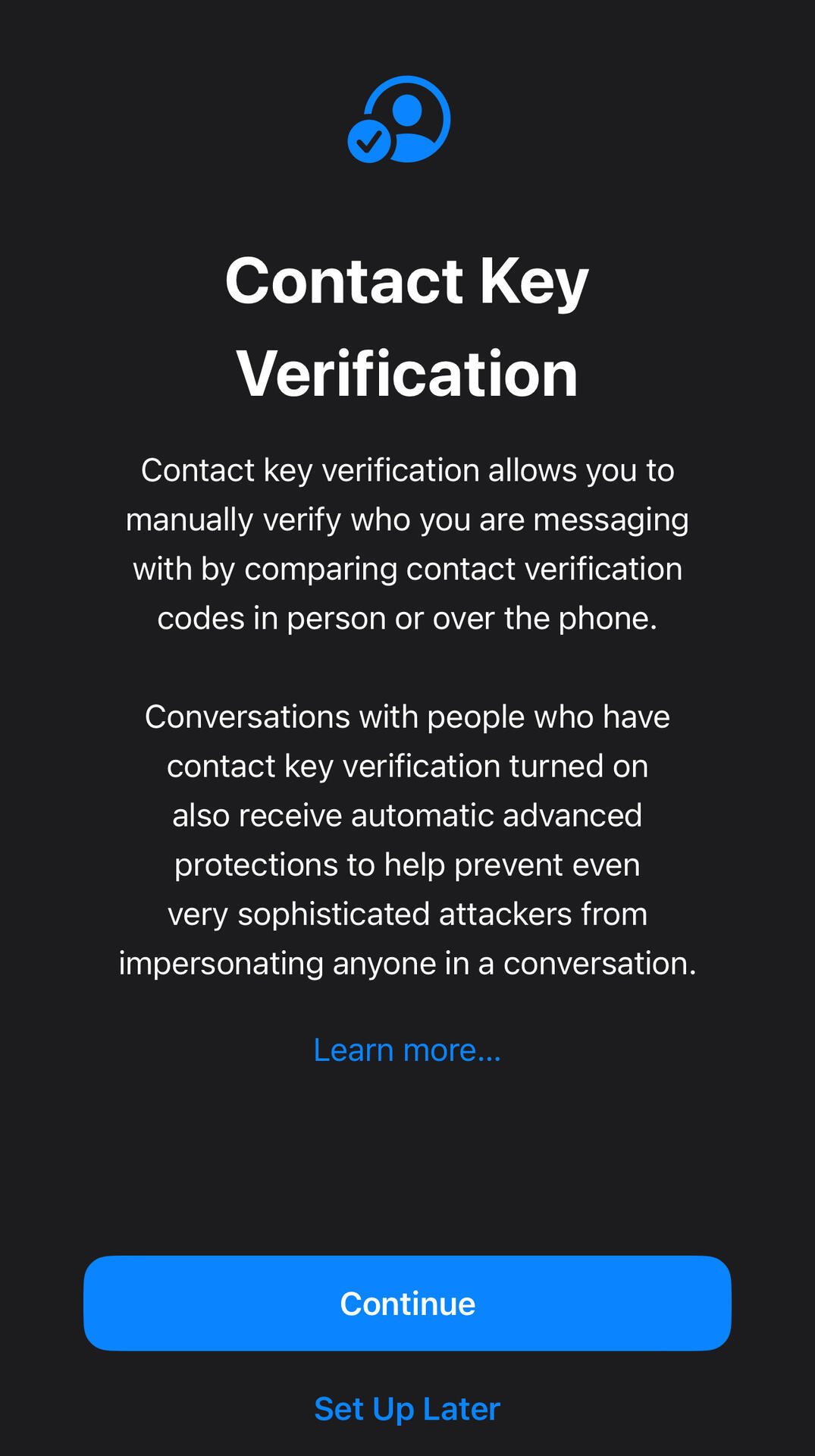
This is why I believe Apple is net positive for privacy:
Apple’s Contact Key Verification is like PGP but with far better usability, making secure communication accessible to everyone without the complexity. It lets you confirm that the person you’re messaging is who they say they are, protecting you from potential impersonation or interception.
This feature is part of a broader commitment to privacy across Apple’s ecosystem:
While Apple’s code is closed-source, meaning we have to trust their implementation, their track record of resisting pressure to weaken encryption and their commitment to user privacy make them a strong choice for anyone serious about protecting their information. Contact Key Verification is just one example of how Apple is leading the way in making privacy both accessible and effective. https://image.nostr.build/008905862ecd6b4f0a02250598018075477e9c58e595eeb1f46d1073456654d8.jpg
9/4/2024, 1 engagement